
Last week, we looked into Secretary of War Pete Hegseth’s “plan” to secure the United States’ military’s bases and infrastructure against a “siege” scenario, focusing on food security for the military.
This week: Fuel.
Every mechanized – or motorized – military force on earth shares one operational vulnerability, and it is not ammunition. Ammunition is heavy and finite, but it is also consumed unevenly — there are quiet days, and quiet days can both replenish the stockpile, or at least not drain it. Fuel is different. A diesel engine does not have quiet days. The M1 Abrams consumes roughly ten gallons of fuel per mile of road movement and approximately 300 gallons per hour under combat power, figures that have not changed because the physics of moving sixty-eight tons of steel have not changed. The vehicles that carry the ammunition, the food, the spare parts, and the water run on diesel too, as do the generators powering the communications systems and the field hospitals. A mechanized force that runs out of fuel is not a force in the field. It is a collection of expensive flower pots.
This is not a new observation. The German armored offensive in France in 1940 nearly stalled at the Meuse River because Guderian‘s panzers outran their fuel trains. The American logistics system in Europe in 1944 devoted more tonnage to fuel than to any other commodity combined, and the Red Ball Express existed specifically to solve the problem of an army moving faster than its supply chain could follow. What is new, in the contested environments of the 21st century, is the precision with which the supply chain can be targeted — and the ingenuity with which at least one irregular force has demonstrated that the supply chain problem has a low-technology answer.
The Problem
Drone reconnaissance and precision fires have transformed the logistics convoy from an irritant to a priority target. A fuel convoy moving by road in the modern Sahel environment — long unimproved tracks, minimal air cover, vast distances between population centers — presents as a predictable, high-value target that an armed drone can track, report, and engage with minimal risk to the attacking force. The AES states — Mali, Burkina Faso, and Niger — share a combined territory roughly the size of Western Europe and supply their military forces across road networks that cross some of the most ungoverned terrain on the continent.
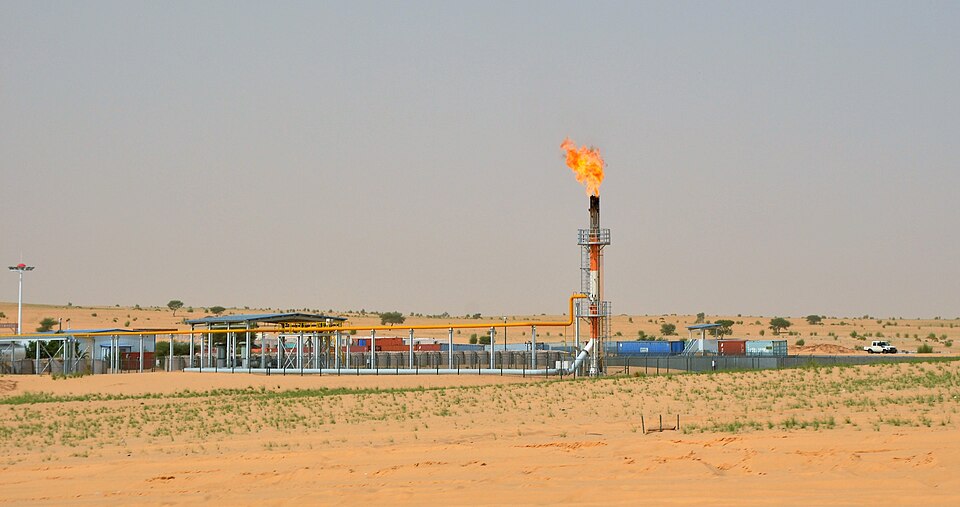
Niger’s domestic fuel supply chain illustrates the problem neatly. The country operates a single domestic refinery at Zinder, with a capacity of approximately 20,000 barrels per day, primarily supplying domestic civilian demand. The Chinese-built Agadem oil field — now producing at 110,000 barrels per day following a $4.6 billion investment by the Chinese firm CNPC — feeds a 1,950-kilometer pipeline to the Beninese port of Sèmè-Kpodji, the longest in Africa, intended to carry Nigerien crude to international markets. That pipeline was attacked by a rebel group opposing Niger’s military junta on June 16, 2024, after just one shipment had cleared. In early 2025, CNPC engineers on the pipeline route were evacuated under armed escort as jihadist violence spread into areas previously considered secure. JNIM, the al-Qaeda affiliate operating across the central Sahel, had already signaled its interest in Niger’s petroleum infrastructure by kidnapping three CNPC employees prospecting near the Burkina Faso border. Violence along the Niger-Benin-Nigeria border corridor rose eighty-six percent between 2024 and 2025.
A military force whose only source of refined fuel runs through a 1,950-kilometer pipeline crossing contested territory is a military force whose fuel supply chain is a vulnerability it cannot protect.
What ISIS Figured Out
The Islamic State ran the largest irregular oil operation in modern history between 2014 and 2017, controlling fields across Syria’s Deir ez-Zor province and Iraq’s northern basin, at peak producing an estimated 34,000 to 40,000 barrels per day and earning as much as $3 million daily in oil revenue. When the U.S.-led coalition began systematically targeting ISIS’s modular refinery infrastructure in September 2014, however, the group did not collapse into fuel poverty. It adapted.
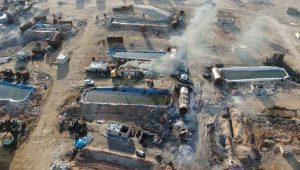
The adaptation was the ‘teapot’. In industrial refining, batch distillation is a mature technology: heat crude petroleum, collect the vapors that boil off at progressively higher temperatures, condense them into fractions — lighter products like gasoline and kerosene first, heavier diesel and residual fuel oil at higher temperatures. A commercial refinery does this continuously, at scale, under precise process control, with recovered fractions meeting tight specifications. What ISIS operators across Syria constructed was the same process running on improvised equipment: a pit or metal tank for the crude, a portable furnace or fire underneath it, a rudimentary condensation system, and containers to collect the output.
“It’s almost like distilling your alcohol at home,” according to analyst Shwan Zulal of Carduchi Consulting in London, who told reporters in 2016, “They get these big barrels and they just burn the petrol underneath it to get it distilled. You can make a new refinery in a week.” These micro-refineries — the Arabic term i “haraqat“, in English “teapot“, reflecting the same stubby, heated vessel — spread in the thousands across ISIS-controlled territory in Syria. Because they were small, dispersed, operated by civilians rather than by ISIS directly, and individually cheap to build and replace, the air campaign against them consumed strikes and intelligence resources without resolving the problem. Destroying a fixed modular refinery takes it off the production map for months.
Destroying a teapot takes it off the map for a week.
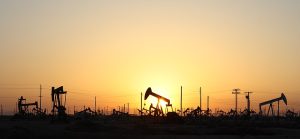
The output, however, is not “clean” fuel. The improvised distillation produced diesel and kerosene contaminated with sulfur compounds and uncracked heavy fractions — fuel that damages injection systems over time, produced thick black exhaust, and degrades engine performance. None of which mattered tactically, because the vehicles that needed to move could move. The generators that needed to run could run. The fuel that ISIS needed to sustain mobile military operations was available, locally sourced, and structurally resistant to air interdiction.
The Teapot Comes To The Sahel
The ISIS teapot model has two potential users in the Sahel, and they are not the same actor.
The first is the obvious one: jihadist groups already aligned with ISIS’s operational approach. The Islamic State Sahel Province (ISSP) and JNIM both operate in territory that borders or overlaps the Agadem basin. Niger holds an estimated one billion barrels of crude reserves. Those reserves are not exclusively accessible through the CNPC pipeline; field production and local distribution infrastructure exist at the point of extraction. A force that can seize or tax crude at the wellhead and operate even a rudimentary distillation unit can produce functional military fuel without needing a supply chain from Cotonou or anywhere else.

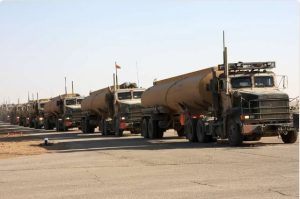
The second potential user is subtler, and more strategically significant: the AES national militaries themselves. The Alliance of Sahel States has progressively severed its logistics dependence on Western-aligned infrastructure — French bases withdrawn, ECOWAS sanctions absorbed until they stared them down, while their diplomatic framework reoriented toward Russia and China. But Russian supply chains are long, and Wagner / African Corps operational support does not solve the fundamental problem of a landlocked force operating across thousands of kilometers of contested road. A government military that can produce decentralized forward fuel from domestic crude reduces its convoy exposure and its dependence on a pipeline that jihadists have already demonstrated they can reach.
The technology barrier to a functional teapot operation is low. Batch distillation requires heat, containment, and basic plumbing — materials available in any provincial market town. The operational barrier is crude oil access, and the AES zone is not short of crude. What it has been short of is refining capacity disconnected from vulnerable fixed infrastructure. Niger’s Zinder refinery is a fixed target. Dispersed small-unit field distillation is not.
The Older Lesson
The teapot is not a new technology. Batch distillation of petroleum predates the commercial oil industry by centuries; the first industrial oil refineries in the 1860’s were essentially scaled-up versions of the same process outlined above. What ISIS demonstrated between 2014 and 2017 was not an innovation. It was the application of an old technology to a specific supply chain resilience problem: how do you sustain mobile operations when your fixed infrastructure is a targeting priority?
The Sahel is now the next place where that question is being asked, by actors on both sides of the front line. JNIM has already targeted the Niger-Benin pipeline — economic warfare against the junta’s revenue base, but also a proof that the fixed infrastructure model is highly vulnerable. The AES governments, as well as the non-state forces contesting their territory, will eventually arrive at the same answer ISIS did: the teapot is ugly, inefficient, and staggeringly toxic. It also works, and its infrastructure cannot be taken off the map with a single airstrike.
That may be the most important thing ISIS ever refined.
What This Means To FORTRESS America
How does the “terrorist teapot” match up with Hegseth’s “FORTRESS America”? Simply put, military bases need a backup fuel supply, to meet at least minimal needs for ground vehicles and field-deployable electric power generators, in the event of grid-power disruptions and/or a sudden cutoff of fuel supplies.
The problem? The howls of protest – from within the military sphere’s – over what this sort of low-grade fuel product will do to their engines, to say nothing of the hysteria from environmental groups over the horrible (to modern sensibilities) ecological disaster burning these fuels represents…but there are no real alternatives.
Except walking.