Let’s face it – tanks are sexy. So are “combat vehicles.” We’ve all seen them on television for years: big, brutalist vehicles, racing around a course, firing monstrous cannons, or grinding their way across the desert. Massive engines of war, practically defining the idea of the “warrior ethos.”
A Brigade of the U.S. 3rd Armored Division masses for the invasion of Iraq during the Gulf War, February 1991. US Army photo. Public Domain.
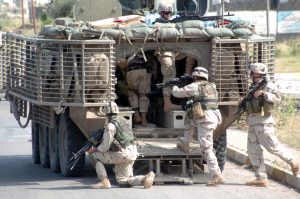
Or, perhaps, they are carrying infantry, dramatically exiting their vehicle, perhaps under fire. These kinds of vehicles fulfill another part of the “warrior ethos” equation, with warriors heading into violent, close-range, face-to-face battle with a dogged opponent. Very Audie Murphy.
US Army soldiers from 3rd Battalion, 21st Infantry Regiment, dismount from a Stryker APC, Mosul, Iraq, 2005. US Army Photo. Credit: SPC Jory C. Randall, US Army.
The idea of “sex” selling military equipment is alive and well, as can be seen by the marketing at any international arms show.
But this, of course, begs the question: Is this all there is? Of course, there are other aspects of “militarydom” that news media outlets and “infotainment” channels talk about relentlessly, as long as the public expresses interest in “things war-like.” These include paratroops, Rangers, or commandos, or special forces either stealthily creeping through enemy territory, or storming a “bad guy” hideout to neutralize said bad guys, or to rescue the hostages in dramatic fashion, especially if news cameras are present. Again – we’ve all seen these images and videos repeatedly, either on the news or in popular entertainment…and, for the most part, these all definitely deliver and validate that sort of drama, courage and honor.
This, of course, brings us once again to the question: it that it? In a word – no. Not by a long shot.
Combat troops require support. While combat troops are certainly capable of improvising, they are far better at executing their combat missions when the “non-combat” troops are relentlessly driving food, fuel, ammunition and spare parts forward, and doing the jobs that the combat units do not need to expend time and energy to learn: maintenance, medicine above the 1st Aid level, building (or destroying) structures – occasionally under fire – all of which are things that the combat forces need, but are too busy to spend time doing.
In “the biz,” this is expressed as the “tooth-to-tail ratio”, or, the proportion of combat to support troops. This is a very dense subject to get into, and there are a wide array of opinions on the subject, most of which disagree at one level or another with all of the other opinions. The point, however, is that any group with pretensions to military force is going to have more support troops who are unlikely to see actual fighting, than combat forces intended for straight up combat.
And those support forces need equipment – a LOT of equipment – and the unique supplies and spare parts to keep those running. And a main component of that equipment is armored support vehicles.
Lurking in the background, seldom photographed, and even less talked about or reported on, are the “combat support vehicles.”
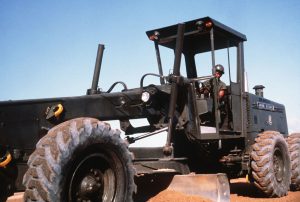
These vehicles are not cargo trucks, but the sort of vehicles you can see on your daily commute when passing a construction site – everything from road graders to backhoes, bulldozers. These vehicles frequently have a coat of “military green” paint slapped onto them; hopefully, they have slats of armor plate welded onto them to protect the operator. They are then sent out to build anything from roads, to towns and camps for refugees, to large airfields.
A United States Navy Seabee uses a grader to construct a parking lot during the combined US/Honduran training operation “AHUAS TAR” (BIG PINE), 1983. Photo Credit: TSGT Ken Hammond. US National Archives. Public Domain.
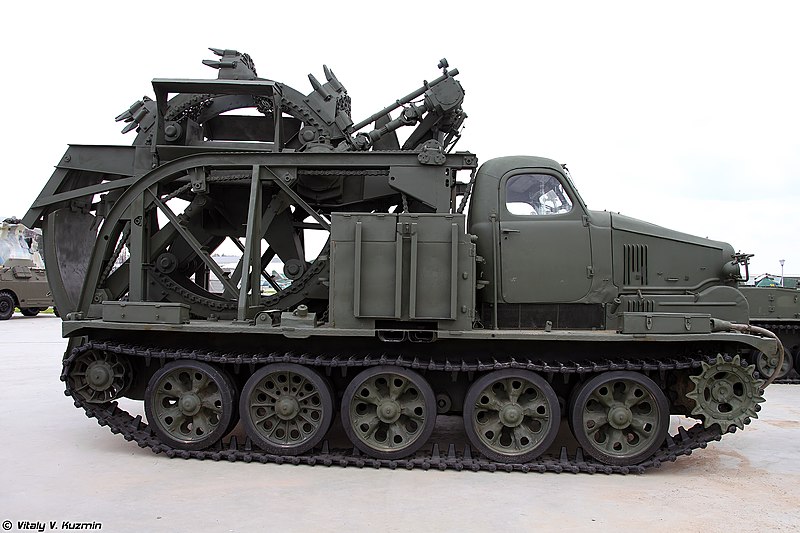
But these vehicles also include highly specialized vehicles, such as minefield breachers and high-speed trenching machines, like the Soviet BTM-3. The BTM, in particular, has made a resurgence in the Ukraine war (YouTube link), as both Russia and Ukraine quickly turned to trench warfare, as the war bogged down into a bloody stalemate. With trench systems resembling those of World War 1, the BTM and its later derivatives and cousins have worked frantically to construct vast trench systems far faster and more efficiently than individual soldiers can. After a trencher slices through the area, troops need to do no more than to expand the position, “filling in” the parts that the trencher vehicle cannot easily do.
Unfortunately, since these vehicles, as highly effective and vital as they are, are rarely given any kind of real consideration…because they are not “sexy.” And, disappointingly, the leaders of most countries have little interest in these vehicles (because they are not “sexy”), so the vehicles sit, rarely used or considered when discussions of “militarydom” occurs…until, of course, tensions suddenly escalate into actual war, and those vehicles – many times, barely running – become a decisive combat multiplier, usually outweighing actual “combat vehicles” in value.
And that’s before we talk about trucks.
If you’ve read this far, I will offer you the following advice: The next time your elected officials start talking about the “defense budget,” spend some time, and look into what they actually want to spend your money on. It’s your tax money, after all, that is spent to “defend” you.
You might want to look into how it is being spent.
The genesis of this article came from a completely different angle, namely, the deployment of laser weapons to the battlefield. However, as things frequently go, that initial idea led to something of much more immediate interest.
Previously, the Freedomist has covered some aspects of “improvised warfare” that some seem to take as James Bond-like fantasy. Yet, as we progress through the third decade of the 21st Century, remotely controlled drones – available in most countries through their local Amazon store – capable of both conducting tactical combat surveillance, as well as tactical air support by dropping small fragmentation grenades, are serious and maturing battlefield threats, threats that military and security forces are struggling to counter.
“Improvised warfare” has been around since the first caveman grabbed the jawbone of his last dinner to bash in the noggin of another caveman trying to muscle in on the first one’s turf. Throughout military history, outside of the heroically vast and sweeping battles of storied yore, there has always lurked the “PBI” – the “Poor, Bloody Infantry” – struggling to make do with usually-substandard weapons and equipment, improvising on the fly, on the idea that “if it looks stupid, but works – it isn’t stupid.”
This is also true in naval warfare. “Suicide boats,” in the form of “fire ships”, go back to at least the 3rd Century AD in China, and the 5th Century AD in the Mediterranean, and those dates are only the earliest we have on record. The use of fire ships in combat has always been problematic, as controlling the vessels after the skeleton crews abandoned them was impossible, and the abandoned vessels could easily come back on the attackers.
Chinese fire ships used by the navy as floating incendiaries, from the Wujing Zongyao military manuscript written in the year 1044 during the Song Dynasty. Public Domain.
As naval technology advanced however, fire ships, as such, disappeared, replaced by explosive-laden boats propelled by early steam engines. These boats had some advantages, not being as subject to winds as the old ships, and their explosive warheads were much more capable of inflicting serious, if not fatal, damage to large warships. Still, the inability to steer the boats remotely left their utility still strictly limited.
As with so many things in the military sphere, during World War 2, everything changed. The intersection of technologies with mass production and sincere desperation, allowed the first tactically useful guided weapons, not simply on land and in the air, but at sea, human control was still the primary aiming method until the last moment.
Post-WW2, the use of explosive motorboats continued, eventually evolving into actual “suicide boats”, where the crews rode the craft directly into their targets. While this was always a danger for the operators of these boats, very few navies outside of WW2 Japan set out with this as their operating profile. Beginning in the 1980’s, this began to change, first with the LTTE in Sri Lanka and with Iran in its “WW1, 2.0” war with Iraq. This is, in fact, what happened to the USS Cole (DDG 67) when it was attacked at anchor in October of 2000, as the suicide crew happily “saluted” the American crew before detonating their massive charge, nearly destroying the ship.
And then – another “sea change” (no pun intended) happened.
As the Soviet Union collapsed, and Communist China finally figured out how mix capitalism with a brutal, totalitarian governmental system, the West welcomed the Communist remnants into a burgeoning world trade system with open arms. As the global economy shifted and changed, the technology sector exploded in its own form of “business as war.” Technology once reserved only to the “Great Powers” became ‘democratized’, available at reasonable prices to the general public. While major nations certainly had far better and more capable – and much more expensive – systems, smaller states (and groups) suddenly had access to technology and manufacturing bases that significantly increased their capabilities versus local opponents (including their own citizens, but that’s another conversation, entirely).
Container port in operation. Credit: Piqsels.com. Public Domain.
All that was waiting was another spate of desperation to drive improvisation.
As the “Global War on Terror” (the “GWOT”) drove on in the aftermath of the 9/11 attacks, the many small, localized wars it spawned drove desperate innovation, once again. Various ethnic and religious factions around the world desperately sought some sort of advantage. This has led to everything from “homemade tanks”, to artillery, to ‘sci-fi’ weapons manufacture.
But now, desperation-induced technological innovation has caught up with the navies of the world.
On January 30, 2017, the Saudi Arabian frigate RSN Al Madinah (FG 702) was struck and seriously damaged by an explosive-laden speedboat. Initially, it was believed that the craft was a piloted suicide boat deployed by the Shi’a Islam Houthi rebels of Yemen, which country has been in its most recent civil war since 2014. Soon, though, it became apparent that the attack craft was actually a remotely- controlled craft.
Speculation immediately turned to Iran. Iran, in addition to being co-religionists to the Houthis, was already supplying the rebels with short-range ballistic missiles and combat drones. In this regard, Iran differs from Ukraine only in that they supply their craft externally.
Ukrainian naval drones, c.2022. Unknown author.
Given the rapid advances in remote-operations technology, it would be no great task to re-engineer common pleasure boats to function as drone attack craft; as well, the issue of a simplified, “standard issue” refit kit (similar in theory to an aircraft JDAM unit) is virtually guaranteed.
But ultimately – what does all this actually mean, in the grand scheme of things?
Simply, insurgents and guerrillas are now much more capable than they were in the past, as they are now capable to extend remote-controlled warfare into the nautical dimension. With the democratization of military training, this opens the ugly possibility of radical forces being capable of enforcing localized (if not regional) combined-arms dominance over all the most capable of national militaries.
The fact that this is an operational possibility worthy of consideration is not something that should alarm only strategic planners – it is something that average citizen needs to seriously consider.
Act accordingly.
The Freedomist — Keeping Watch, So You Don’t Have To
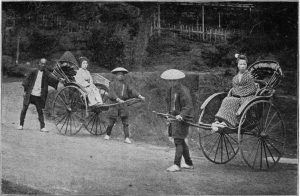
In the twenty-first century, few people in Western societies give much thought to bicycles. The machines are usually seen as something one gives to a child as a birthday present; or, something one buys to use for exercise in the sunshine. In some cities, and especially in Asia, bicycles are used as a primary mode of transportation, both in day to day living for activities like going to work and shopping, as well as in actual business, such as postal and product deliveries, but also as taxis for passengers, in those areas that still allow ‘rickshaw’ traffic.
Rickshaw in Japan, 1897. Credit: Rev. R. B. Peery, A.M., Ph.D. Public Domain
Very few people give any thought to the bicycle as a military tool, but it was – and remains – a vital component of many military operations.
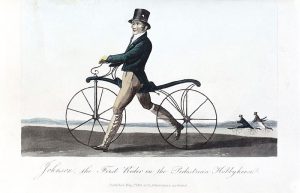
The modern bicycle dates from a design created by the German Baron Karl von Drais, who invented his “Laufmaschine” (German for “running machine“) in 1817 (patented in 1818), that was called “Draisine” (English) or “draisienne” (French) by the press; this term would evolve over time into “velocipede”. Von Drais’ design was the first commercially successful two-wheeled, steerable, human-propelled machine on record.
It should be noted that it also quickly earned the nickname of “bone-shaker”, for obvious reasons.
An early ‘velocipede’. Photo of a Lithograph from 1819. Public Domain.
But, the design fascinated people, and progress was made in developing it. Many of these designs, such as the ‘penny-farthing’ of Englishman James Starley and Frenchman Eugène Meyer, are outright silly and fanciful, more suited to the pages of a Jules Verne novel than to any kind of useable machine. All that began to change in 1885, and first line militaries around the world began to take notice.
An example of a ‘penny-farthing’. Skoda Museum, Czech Republic 2003. CCA/3.0
In 1885, John Kemp Starley, James Starley’s nephew, invented what became known as the “safety bicycle”. Departing from past designs by making both wheels identical in size, employing a high-necked caster to better anchor the handlebars for steering, and incorporating the first rear-wheel chain drive on a bicycle, all combined to vastly improve the ride, handling and speed of the bicycle.
The younger Starley’s design – which was widely copied, as he had failed to patent the design – was swiftly followed by the last two major developments that would draw serious military attention to the bicycle for military use.
The first innovation was the reinvention of the pneumatic tire by John Dunlop in 1888, greatly smoothing out the ride and simplifying the design, and the patenting of the folding bicycle by African-American inventor Isaac R. Johnson, approved on October 10, 1889. Johnson’s design is also the first recognizable appearance of the “diamond frame” design that is still common over a century later.
Racing bike, showing the diamond frame. Photo Credit: Julius Kusuma. CCA/3.0
These two developments created an explosion of interest in cycling throughout the United States and Western Europe in the early 1890’s, actually causing an economic bubble near the turn of the century. It is at this point that the ‘Turmoil of the Century’s Turning’ happened.
The decade from 1895 to 1905 saw multiple – and massive – wars break out all over the world, from the First Sino-Japanese War of 1894-1895, to the Second Boer War (1899-1902) in southern Africa, which saw Great Britain deploy nearly 300,000 Imperial troops by steamship – to the Russo-Japanese War of 1904-1905. In the midst of these massive conflicts – a sort of “dress rehearsal” for World War 1 – there was the Spanish-American War of 1898, and the “China Relief Expedition” of 1900, with saw an allied force of British, French, Japanese, Russian, German, Austrian, Italian, and American troops marching from the Chinese city of Tientsin to rescue the diplomatic staffs in Peking (now Beijing) at the height of China’s “Boxer Rebellion” (1898-1901).
“I’ll Try, Sir!” – American troops in the relief of Peking in China on 14 August 1900 during the Boxer Rebellion. H. Charles McBarron, Jr., for the US Army. Public Domain.
All of these major conflicts – as large and expansive as most of the wars of the twentieth and twenty first centuries – made the various militaries realize that they needed to continue to innovate and upgrade their forces, a process that had already been happening in earnest for over thirty years.
Infantry – the core of all military forces – moves at the speed of a walking soldier, unless there are tools such as railroads, motorized vehicles or airplanes to carry them…and even then, they will still be walking. As well, the infantry have been carrying much of their own equipment for most of that time, to the tune of some 120lbs (c.54kg) on their backs. Something needed to be done to improve their mobility.
Typical US infantry load. USMC photo. Public Domain.
Bicycles were obviously useful to horse-drawn armed forces as messengers, as the cyclists did not need to worry about sick or lame animals; bicyclers were relatively easy to fix if something broke down. Other functions were tried out, including using bicycles to lay communication wire, create local maps by fixing clinometers to the frame, and patrol rail lines; there were even experiments to use them as ambulances and to haul machine guns around the battlefield. While not usable in the cavalry role – which should be apparent from the nature of the machine – could the infantry use it?
Italian Bersaglieri infantry with folding bicycles, c.1917. Public Domain.
This led to the creation of “bicycle infantry”: infantry units began to test out bicycles during long-distance rides, more or less to see what happened. This is where James Moss enters out story.
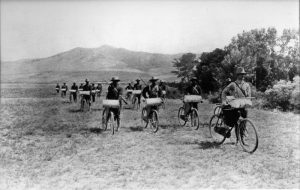
Then First Lieutenant James A. Moss, of the 25th United States Army Infantry Regiment (Colored), the storied “Buffalo Soldiers” (the United States military was still heavily segregated then) obtained permission in 1896 to take fifteen volunteers from the regiment on an experimental series of rides that culminated in a 1,900 mile ride from Missoula, Montana, to St. Louis, Missouri. Moss’ unit completed the trek – which avoided roads and paths where possible, sticking strictly to overland travel – made the trip in some 40 days, at an average of 6 miles per hour (pdf link). While the US Army was ultimately satisfied with conventional infantry units, armies outside the United States took notice of Moss’ experiments. (James Moss would go on to lead a bicycle-equipped unit in Cuba, and would later write a set of basic instruction manuals for troops and officer that form the basic framework of basic military instruction manuals today.)
25th US Infantry Bicycle Corps at Fort Missoula in 1897. Lt. James at right. Public Domain.
When World War One broke out, the bicycle served in all theaters. However, it was rarely deployed into direct combat, primarily due to the confines of trench warfare in Western Europe, and a simple lack of resources on the Eastern Front, in Russia. This unspectacular performance, overall, signaled the death knell of the military bicycle to the military pundits of the time.
However, other officers came out of World War One with a better understanding of bicycles and their military uses.
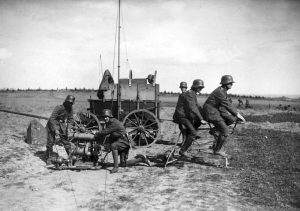
In the Second World War, bicycles were deployed extensively in Malaya, where Japanese intelligence officers, familiar with the Japanese Army’s use of c.50,000 bicycle infantry in the 1937 invasion of China, made sure in their pre-war scouting to note the presence of bicycle shops throughout the British-controlled colony. Likewise, Germany and Italy deployed units of bicycle infantry in rugged terrain, where horses would struggle. Many guerilla and partisan units – and the intelligence teams from the Allies who supported them – used bicycles for scouting, messages and to run electric generators to power radio systems that reported on Axis forces until the end of the war.
A German unit using a tandem bicycle power generator to power a radio station, September 1917. Public Domain.
Post-1946, the bicycle again faded into obscurity in most of the military world, although bicycle infantry units would continue to serve for decades in Swedish and Swiss military units. In one place, however, the military bicycle would reach its peak – in a place called Vietnam.
France, although it had been soundly beaten by Hitler’s Germany in 1940, was desperate to retain its colonial empire. When French forces returned to Indochina in September of 1945, the Vietnamese were less than impressed. Where French troops had capitulated to Japanese troops more or less without firing a shot, the resistance in Indochina had been led by native Vietnamese, and mostly by the Communist Party led by Ho Chi Minh and Vo Nguyen Giap (who were supported (pdf link) by the American Office of Strategic Services (OSS) during the war). After French forces seized control of Saigon (now Ho Chi Minh City) by force in September of 1945, the Communists retreated into the mountains and countryside, vowing to continue their war, now framed as a war of independence from France. This brought about the “cargo bike”.
The Communist forces, known as the ‘Viet Minh’, waged a brutal guerilla campaign in the rural areas of the country, causing steady and damaging casualties to French forces. However, the Viet Minh faced all the same challenges as a pre-WW2 non-motorized army, but with the added problem that suitable pack animals were few in number, and human porters could only carry a tiny amount of the supplies needed.
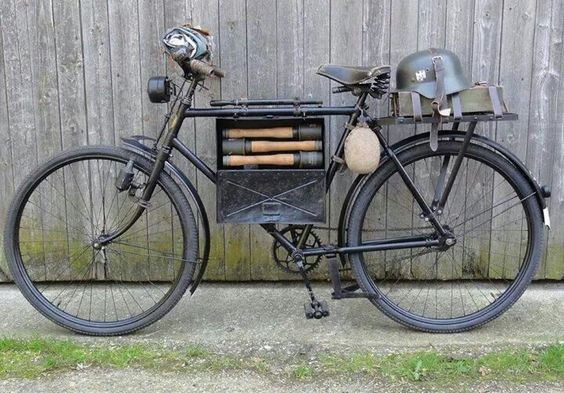
Viet Minh mechanics took the commonly-available bicycle, and began modifying it, resulting in a vehicle that could reliably carry up to 400lbs (c.181kg) at the pace of a walking adult human. While not the equal of a cargo truck or a boat, this was a far better solution. And it very shortly made its effects known.
Vietnamese army bike – Vietnam War Museum in Hanoi. Photo credit: Przemek P, 2010. CCA/3.0
In 1954, Viet Minh forces surrounded and destroyed the cream of the French Army in Indochina, at the Battle of Dien Bien Phu. France deployed its best units, numbering over 12,000 troops, in a badly thought out plan to bring the Viet Minh to battle in order to destroy them. At the extreme range of supply and support aircraft, the French troops found themselves over-extended and cut off, as French ground forces could not break through to reach them. The Viet Minh surrounded the town the French had fortified, and fought a nightmarish siege for nearly two months. Eventually, some 11,000 French troops would surrender; nearly 8,000 would die in a march to prison camps that rivaled the Bataan Death March in its brutality. The result was France agreeing to Vietnamese independence, surrendering their Indochina colonies in whole, which would lead to yet another war…but that is another story.
Viet Minh troops plant their flag over the captured French headquarters at Dien Bien Phu, May 7, 1954. Photo credit: Roman Karmen. Public Domain.
One of the primary reasons the Viet Minh were able to crush the French was their ability to move supplies, and the ‘cargo bicycle’ was at the heart of the Vietnamese logistical triumph. But again, the military use of the bicycle receded into seeming obscurity, despite its next successful showing against American forces in Vietnam…
…And yet – the bicycle remains in use as a military tool by guerilla and insurgent forces around the world. Why?
Within its obvious limits, the military facts of the bicycle of today remain unchanged from those same facts discovered by James Moss and his unit of Buffalo Soldiers in 1896: the bicycle requires no fuel, beyond the food required for its operator; it moves essentially silently, at a constant speed of up to twelve miles per hour; it raises no dust in its passing; it can operate in most weather and terrain conditions; and it can be used to power various systems, from air circulation fans to electric generators, and does so with no heat output, again, aside from the signature produced by the operator.
Three Swedish bicycle infanterists armed with m/45 SMGs and Bantam anti-tank missiles, Sweden, 1965. Public Domain
Given the ludicrous progress of the US Army’s new Infantry Squad Vehicle (ISV), it might be time for regular militaries to think about “going old school”.
The Freedomist — Keeping Watch, So You Don’t Have To
With the recent arrest of an Airman of the Massachusetts Air National Guard, the United States’ defence and intelligence establishments are once again under fire for apparently lax information security. In fact, this is the second time in less than a year that this has happened.
At first glance, this seems like a very bizarre thing…until you realize, sadly, that it is not.
Instead, incredibly – or, sadly, not so incredibly – the leaks were the result of rabid video game players trying to prove how cool and ‘edgy’ they were.
While some of the leakers may be older, this is the result of the programming of the so-called “Generation Z”. This is the first generation to grow up with social media as a main facet of their lives. When “social media” as we would now recognize it, first arose in 1997, no one had any real idea of what its impact would be. Whatever the imagined intent, what it has evolved into, is a sort of electronic version of an elementary school playground at recess, with no adults present to regulate it.
Where older generations who entered the various defense and intelligence services would never, in their wildest nightmares, have taken classified materials to their local watering hole and deliberately passed them around to score social points, this is becoming increasingly common for a deliberately infantalized generation of youth. While there certainly were, and are, spies and informants stealing and passing on information for money, ideology or “love”, those reasons were at least tangible and understandable. Scoring social media points is, to be blunt, pointless in the extreme.
Coupled to the insanity of the RESTRICT Act (deliberately misconstrued as the “TikTok Ban” bill), this works to sweep away all the foundations of legality of the Rule of Law, in the fleeting hope of gaining some sort of security.
And, like the hysterical attacks from the music industry against services such as Napster and Grokster, idiocies like the RESTRICT Act are guaranteed to have exactly the opposite effect, as outraged online activists will find ways to send out increasingly large amounts of classified material – not for the older reasons, nor even the newer reasons, but simply out of anger at such tight restrictions. The fact of facing heavy penalties for doing so, are irrelevant once the information is “out in the wild,” as the saying goes: the damage will have already been done.
But the above does not address the real question: Why are these kinds of leaks so dangerous?
For those not familiar with intelligence gathering, as a discipline, the short answer is that, in the “old days,” obtaining intelligence – meaningful intelligence – on a hostile target was hard…very hard. An intelligence agency – from East or West – had to insert “non-official” (or “illegal”) agents into the target country; those illegal agents would then have to either infiltrate a facility, or suborn an intelligence worker (assuming that they could identify them). Conversely, they could hang out in bars, nightclubs or restaurants (good for staging a honey trap) outside the gates of military facilities, or take menial jobs at establishments outside the gates such as working as a barber or as a waitress, in an attempt to glean nuggets of information from random conversations…Not very flashy, and not very James Bond, but such methods did work.
An example of a one-time pad. Credit: Mysid, 2007. Public Domain.
(My favorite intelligence warning in the mid-1980’s, was an order that came down, telling service personnel to stop…”liberating”…large bottles of Tabasco® sauce from restaurants outside base main gates in preparation for going to the field or “rapidly redeploy strategically”, to make the early Meals-Ready-to-Eat (MRE’s) at least somewhat palatable. The problem had gotten so bad, those base-local restaurants developed their own internal intelligence networks, and were suddenly “out of Tabasco” when they learned of a local unit deployment…thus giving hostile agents a dead giveaway that large unit movements were afoot.)
With the rise of online gaming and their associated forums and chat servers in the early 2000’s, however, intelligence agencies quickly grasped that their agents could sit behind Virtual Private Networks (VPNs), in the comfort and security of their home nations. They could then “lurk,” monitoring boards silently, while not communicating very often, waiting to pounce on discussions where people who should know better would often drop bits – or entire files – of classified data…and those agents wouldn’t even have to hound the leaker, because the rest of the forum or chat group would do that for them, unwittingly.
This kind of thing came naturally to intelligence agencies, as it was a form of OSINT [https://en.wikipedia.org/wiki/Open-source_intelligence]. OSINT, or “Open-Source Intelligence,” is a method, or discipline [https://en.wikipedia.org/wiki/List_of_intelligence_gathering_disciplines] of intelligence collection where a person meticulously (some might say, “obsessively”) scours every publicly available source of information on a subject they can find, and attempt to collate and boil-down the resulting information into a general picture.
OSINT differs from more expensive, technological or hazardous methods of information collection – like finding human sources of information, satellite reconnaissance, radio signal interception, etc. – in that it simply requires an illegal agent to buy multiple piles of newspapers and magazines, and inhabit libraries relentlessly. While also not very flashy, OSINT analysis often leads to very clear pictures of a nation’s defense strategies. As well, it lends itself very well to crowdsourcing [https://en.wikipedia.org/wiki/Crowdsourcing].
So…Where does this leave us, in mid-April of 2023?
Unfortunately, there are serious problems within the information security apparatus in the West, as a whole. With the need to bring in a new generation of intelligence workers, the West – as opposed to Russia and Communist China – is finding that the “Woke” agenda that has been allowed free rein over the last decade has badly polluted the potential recruiting pool, as people who have been raised in a culture where ephemeral “electronic cred” is as important, if not more important, than being a “quiet professional”.
And, as those who promoted that social context are discovering, there is no putting the toothpaste back in the tube.
The Freedomist — Keeping Watch, So You Don’t Have To
Last week, we discussed the Remington Rolling Block rifle, a weapon nearly forgotten outside of “gun-person” circles. To recap, the Rolling Block design equipped all or portions of the military forces of most of the nations on the planet, from the end of the American Civil War to World War One. Over a period of some fifty-odd years, the design had an impact out of all proportion to its simple design.
This week, we will look at the weapon that dethroned the Rolling Block – a weapon that is still being made, today. A rifle so iconic, it essentially stands as the image of “rifle” in the minds of most people.
A Mauser 1898, formerly of the Swedish Army. Photo: Swedish Army Museum. CCA/4.0
Imperial Germany had introduced the Gewehr 1888 to replace its Mauser Model 1871 (adopted as the Gewehr 71 or Infanterie-Gewehr 71, or “Infantry Rifle 71”) that had been designed by Mauser (originally Königlich Württembergische Gewehrfabrik (“Royal Württemberg Rifle Factory”)), of brothers Peter and Wilhelm.
Paul Mauser (1838-1914). Public Domain.
Unlike as has happened many times in military history, this rapid series of rifle adoptions was not a simple case of lining someone’s pockets. On the contrary, it was a vital necessity, as technology was swiftly changing, and the First German Empire had to maintain at least parity with its French neighbor. France had developed smokeless powder in 1884, and swiftly fielded the Lebel Rifle in 1886 to use the new and ‘game changing’ propellant. Mauser’s Gewehr 71 – while a fine weapon, overall – fired a huge (for rifles) 11mm bullet propelled by the now completely outdated ‘black powder’. The Gewehr 1888 (called the “Commission Rifle,” as it was designed by the German Rifle Commission (pdf link)); as a result, the Gewehr 88 was very much literally “designed by committee”, and Mauser, still tied into producing the 1871 model, did not take part in the development of the Gewehr 88. When it became painfully evident that the Gewehr 88 was not the right rifle for the job, the Kaiser’s government turned back to the Mauser family.
The Mauser brothers had acquired the Königlich Württembergische Gewehrfabrik arms factory from the government of Württemberg in 1874; after a series of mergers and divestments that swirled in the highly dynamic environment of late-19th Century Germany, Mauser A.G. would be formed in 1897, under the direction of Paul Mauser.
When the German government turned to Mauser to design a better rifle than the committee-birthed Gewehr 88, Mauser A.G. quickly responded. Mauser had been perfecting a smokeless powder rifle in the decade where other companies were producing the lackluster Gewehr 88. In that decade, Mauser rifles had become a world standard for hunting weapons, renowned for their inherent accuracy and durability.
Rifle line on the march, Dresden, 1914.
The Gewehr 98’s design works, because it is simple, solid and robust. There is very little to go wrong in a Gewehr 98; short of running over it with a tank, or loading it with overpowered cartridges, the rifle just keeps working. It is, very much, the penultimate example of “German over-engineering.” The one real fault in the design of the Gewehr 98 is the fact that its bolt – the heart of the system – did not lend itself very well to the mass production technologies of them time, making the weapon take measurably longer to produce than comparable weapons. Likewise, from a strictly military point of view, the ergonomics of its bolt layout do not lend itself to fast operation; the British SMLE Lee-Enfield and Pattern 1914 rifles remain much faster-operating actions. The “limitation” of the Gewehr 98’s five-round magazine is more an academic issue than a tactical one, especially as its main competitor until 1945, the Lee-Enfield designs – while having a ten-round magazine – also fed from five-round strip-clips, as the 98 does.
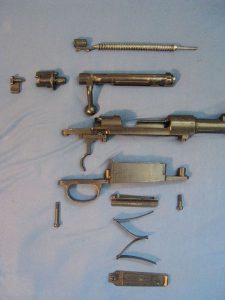
Partially disassembled Mauser Karbiner 98k action, with receiver in the middle, magazine well and magazine assembly below and disassembled bolt on top. Photo credit: wikimedia User “Mauseraction”, 2011. CCA/3.0.
The Gewehr 98 first saw action in 1898, in China, during the Boxer Rebellion, where it performed spectacularly well. By the outbreak of World War One in 1914, the German Army had well over 2 million of the rifles in their arsenals; by the end of the war, more than 7 million more would be produced.
After World War One ended, Germany took the lessons of that war, and produced a new version of the Gewehr 98 – the Karabiner 98k. Based on the same basic Gewehr 98 action, the 98k uses a much shorter barrel, a reduction in length that required the adoption of a new rifle cartridge to make the ballistics work without degrading the life of the barrels. The 98k, in a few models, were produced from 1935 to 1945; eventually producing over 14.6 million units…although records get spotty with many manufacturers towards the end of the war, meaning that the numbers are large – possibly significantly larger.
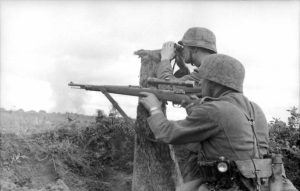
A German sniper armed with a Karabiner 98k with a Zeiss telescopic sight and spotter in position, observing at Voronezh, Soviet Unions, 1942. Photograph by Dieck. CCA/3.0/Germany.
After World War Two, the 98k would continue serving around the world. The Israeli “Haganah” begged, borrowed and stole as many 98k’s as they could lay hands on to arm the new Israeli Army; the Nationalist Chinese would produce their variant until 1949 – and those weapons remained in Chinese service. The 98k, among other “milsurp” bolt-action rifles like the Lee-Enfield and the Russian Mosin Nagant, remained in frontline combat service in many nations well into the 1970’s. Indeed, even today – in the 2020’s – a couple of hundred 98k’s would make for a respectable rebel army.
Graduation ceremony for artillery officers in the Israeli Army (IDF, Israel Defense Forces). The ceremony is taking place in the main basic training base, “Tsrifhim”. Public Domain.
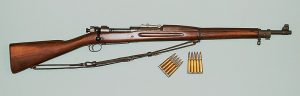
Of course, that is only up to 1945, and only covers weapons produced by Mauser and other German manufacturers. Mauser had let out licenses to many firms around the world to produce first the Gewehr 98, and then the 98k, manufacturers who happily produced millions more copies from China to South America. Indeed, the United States was so impressed by early versions of the 98 (the Mauser 1893) it encountered fighting Spanish troops in the Spanish-American War in 1898, it essentially copied the design outright, causing a lawsuit that resulted in the United States Government having to pay some $3,000,000 (over $45 million in 2023 money) to Mauser (the US Army Ordnance Corps has earned itself a very sketchy reputation over the decades).
Rock Island Arsenal U.S. Model 1903 Rifle, manufactured in 1906. CCA/3.0
The Mauser 98, in a variety of calibers, stock designs, and accessory packs, lives on, in the 21st Century, both as ceremonial rifles for formal military guards, military and police sniper weapons, as well as being the proverbial gold standard for hunting rifles – the Winchester Model 70, the “Rifleman’s Rifle,” is a Mauser 98 action – continues onwards, still being manufactured in many countries, by m several different manufacturers, and shows no signs of ending production anytime soon.
A pre-1964 Winchester Model 70 rifle. CCA/2.0
That’s pretty impressive, for a rifle designed before there was powered, heavier-than-air flight, and that has fought wars in three centuries.
Anyone with even a passing familiarity with modern firearms knows about the AK-47. In fact, we discussed it here, as part of another series. The AK-47 is so well known because it is so widespread, having been handed out at no- or low-cost to so many rifles, that they now appear on national flags and crests.
Flag of Mozambique, showing an AK-47 in the canton. Public Domain.
But the AK-47 was not the first weapon to have this kind of impact. This article is the first part of a two-part series on the rifles that had a similar impact to the AK-47. One of those is still all over the world. This one, however, is nowhere near as well known today.
Gevär m/1867, from the Armémuseum (The Swedish Army Museum) collection. CCA-4.0
As the American Civil War raged, weapons using metallic cartridges began to appear, both in the hands of civilians and on the battlefield. While flashy weapons like the Henry and its descendant from Winchester Repeating Arms are better known, those weapons’ use in the military sphere was very limited. Early cartridge revolvers because popular with cavalry, but the Winchester remained almost solely a civilian weapon.
Armies are conservative by nature. The reason for this is understandable, given the stakes – when a business gambles on new technology, and the new tech fails, that is a very inconvenient; it might even be sad, if it causes the company to fail and costs workers their jobs. In contrast, if an army gambles on new tech and it fails, the consequences can be catastrophic out of all proportion to the technology. Case in point, the mitrailleuse.
Muzzle view of a Mitrailleuse, Les Invalides, Paris. CCA/3.0
The mitrailleuse was supposed to be France’s ultimate war-winning weapons system, able to sweep the Republic’s enemies from the battlefield like wheat before the scythe…The problem? It was kept so secret, no one ever trained the French artillery to handle it, and thus no one ever realized what it really was: a simple volley gun that could be loaded moderately quickly, and didn’t have much better range than the regular French rifles.
When it came to rifles in the post-American Civil War era, militaries around the world weren’t stupid – they knew that breech loading, metal-case cartridge rifles were the wave of the future…but which one was the best to use? Many countries tried various designs from their arsenals. Many other nations, unable to afford the infrastructure to mass-produce their own internal design, did what states have always done:
They went shopping.
The Remington Company of Ilion, New York, had been making firearms and ammunition since 1816. While it was legendary for its staggering levels of management incompetence (it finally folded permanently in 2020, broken into several pieces), it managed to produce a long and majestic line of firearms. And its first real “smash hit” was the Rolling Block.
The single-shot Remington Rolling Block began in 1863 as a slightly different design. Modified to strengthen the breech mechanism, by 1867, the rifle had matured into a solid weapon. It was rugged, reliable, and – most importantly for armies – was the last word in “soldier-proof”: it literally cannot misfire during loading, and cannot fire unless the breech is fully closed. The action was so strong, it needed virtually no modification when smokeless powder was developed in 1884. The only real danger was the chance of a misfired cartridge “cooking off” while it was being removed from the breech.
Remington Rolling Block breech mechanism. CCA/3.0
Remington’s rifle was made in a vast array of calibers and chambering’s. Remington would happily cut barrels for any cartridge provided by the customer. Mechanically much more simple than some thing like a British Martini-Henry and vastly more reliable than the Prussian needle-fired Dreyse rifle, the Rolling Block quickly took the military world by storm.
Although the Rolling Block was never adopted in any great numbers by the United States (due to a very parsimonious Congress), it was adopted by at least forty-seven nations over its lifespan, a staggering achievement for a time (~1880) when there were only about fifty-five “nations” in the world recognized as such.
From the United Kingdoms of Sweden and Norway, to Peru, Qajar Persia and the Papal States (YouTube link), the Rolling Block fought wars, guarded walls and stood in parades for nearly fifty years. It was party to one of the oddities of the Spanish-American War (YouTube link), in 1898. Its last major war was actually World War One (YouTube link), where it served as a second-line rifle for rear area troops. It served countless hunters as far afield as Canada and the heart of Africa, and was “the other buffalo rifle,” next to the Sharps. The last version of the Rolling Block produced by Remington was the elegant “Number 7” target rifle (YouTube link), introduced in 1907.
But, as we will see next week, the Remington Rolling Block was buried in the public mind by a newly arrived competitor in the military rifle market, a rifle what would continue to serve for nearly a century in active military forces, a rifle so iconic, it will likely still be shooting when all the readers of this article will have passed beyond the Pale.
The Freedomist — Keeping Watch, So You Don’t Have To
However, there were other, smaller pneumatic artillery pieces used during the Spanish American War, primarily the 4-inch Sims-Dudley “Dynamite Gun”. The weapon received decidedly mixed reviews: while Frederick Funston, then an American officer advising Cuban guerillas, reported glowingly on it the weapon, Rough Rider commander Colonel (later US President) Theodore Roosevelt was decidedly not a fan.
Sims-Dudley 4 Inch Dynamite Gun on Field Mount, 1898. Public Domain.
But – these were not the first pneumatic weapons carried by US Forces.
Many Americans, confused by hysterical anti-gun propaganda, do not realize that the United States was on the cutting edge of military technology from its inception as an independent nation. From the first nation to issue breech loading, flintlock muskets (YouTube link) to flintlock machine guns (YouTube link), the United States armed forces rarely hesitated to embrace new technology, the American Civil War being the singular exception to the rule.
In 1803, French Consul (and soon-to-be Emperor) Napoleon Bonaparte sold the entirety of France’s “Louisiana” holding to the United States, a land deal that became known as the “Louisiana Purchase”, for $15 million (a paltry $337 million in today’s money), a price that amounted to about $0.03 per acre. Napoleon’s offer stunned the US diplomats sent to negotiate the deal, as they had expected to only buy the port and city of New Orleans. Napoleon offered the deal, as France’s hold over its North American territory was shaky, given that Napoleon was locked in an all-out war with great Britain, and trying to defend such a large territory, that France had never really capitalized on, was a headache he did not want.
It is important to understand the magnitude of this land deal: this massive purchase now comprises all or significant part of the states of Arkansas, Iowa, Missouri, Kansas, Oklahoma, Nebraska, Minnesota, Louisiana, New Mexico, Texas, North Dakota, South Dakota, Wyoming, Montana, Colorado, as well as parts of the Canadian provinces of Alberta and Saskatchewan. This is quite literally the central third of the “Lower 48” states.
A map of the acquired lands of the United States. US Government map. Public Domain.
The problem? No one in the United States really knew what was “out there”: there were only the scattered – and edited – reports of fur trappers and “Mountain Men”, most of whom had good reasons to “creatively edit” their reports. Thus, after the deal was done, President Thomas Jefferson ordered the commissioning of the “Corps of Discovery,” now better known as the “Lewis and Clark Expedition”. The “Corps of Discovery” set out in mid-1804, and returned a little over two years later, in 1806, returning with a wealth of detailed maps and information, that sparked the Western Expansion…
…But that was all in the future.
One of the items carried along with the Corps was a unique and little-known object: an Austrian-made Girandoni Air Rifle.
Various Austrian rifles; Girandoni Air Rifle at center. From the Heeresgeschichtliches Museum firearms collection, 2018. CCA/4.0.
The Girandoni (or “Girardoni,” in some spellings) Air Rifle took its name from its eponymous designer, on Bartolomeo Girardoni, who hailed from the Tyrol region. Very little is known for certain about Girandoni, nor about the development cycle for the rifle named for him; in fact, the date of the invention is not absolutely known, as it was apparently sometime in either 1779 or 1780.
Approximately 1,300 rifles are known to have been made, most of them used by the Austrian Empire. A small number, however, were sold commercially, which is apparently how the Lewis and Clark Expedition acquired their example.
The Girandoni, for the late-18th Century, is a stunningly impressive achievement in “firearms” design. It was a breech loading, lever-operated air gun, feeding from a twenty-round tubular magazine. While not silent, it was quieter than a musket, had no muzzle flash, and produced no smoke from firing, and all in a package that weighed in at just under ten pounds (4.5kg), and less than four feet long.
The air reservoirs were pressurized to between 750 and 1,000 psi (pounds per square inch), giving performances “downrange,” – out to ranges of c.100-125 yards – where the Girandoni’s projectiles would do about the same damage as a modern .38 Special cartridge, and possibly as much as a .45 ACP round, assuming that it was fired from a mostly-full air reservoir. The teardrop-shaped air bottle was screwed into place where the buttstock would normally be. As the rifle delivered almost no recoil to the shooter, the extra weight and mass of a normal stock was not necessary. The Girandoni’s rate of fire was around 20 to 30 shots per minute, depending on air pressure in the reservoir. The three air reservoirs provided with each rifle in Austrian service were refilled, initially, via a hand-pump, not unlike a modern bicycle pump; eventually, an automated pump was mounted in the bed of a small wagon, allowing air bottles to be refilled on the march.
Recreation of an Austrian Girandoni System Accouterments Bag, including spare air flasks, air pump, wrenches, bullet mold and ladle. Army Heritage Museum, U.S. Army. Public Domain.
The “firing mechanism” was almost the exact opposite of a conventional flintlock musket. After tipping the rifle up slightly (to drop a lead ball into position), the shooter would push a block protruding from the left side of the rifle to pull a ball from the tubular magazine into line with the bore. When the trigger was pulled, instead of the ‘cock’ (what we now call the ‘hammer’) falling and striking its flint against the frizzen (the latch over the powder pan) to strike a spark and ignite the powder charge, the Girandoni’s cock tripped an internal hammer that struck a pin; this pin pushed backwards, towards the shooter, and struck the head of a vale – not dissimilar to a trumpet valve – which depressed the valve just enough to release a blast of pressurized air. This burst of pressure struck the back of the ball in the chamber, and propelled it down the barrel. Because of the high pressure in the air bottle, the valve would snap shut almost instantly. The shooter would simply repeat the process, until either the ammunition tube was empty, or the air pressure in the reservoir had dropped too low to continue firing.
Needless to say, this seemed to be a definite revolution in military firearms. The Lewis & Clark Expedition made numerous comments in its reports about how impressed and intimidated the Native American tribes were when the Corps demonstrated the Girandoni to them.
The question, then, is: Why didn’t the Girandoni become the new dominant military rifle?
The Girandoni, for all its very impressive performance, was both an expensive and comparatively delicate weapon. Militaries of the time knew very well that when things “went sideways,” as they often do, troops needed a longarm that could withstand combat with bayonets, or be used as a very heavy club – actions that would shatter a Girandoni.
The Girandoni was very useful in the hands of well-trained, independent-minded skirmisher troops, but was not “soldier-proof” (to use the more polite modern phrase), and, even in the hands of well-trained troops, it did not provide enough of an advantage to justify its expense in even limited service.
As with many things, “newer” does not necessarily mean “better”. This is as true today, as it was c.120 years ago…
…Would that people in positions of responsibility would understand that idea more.
The Freedomist — Keeping Watch, So You Don’t Have To
Near the end of World War 2, the Soviet Union was searching for a new rifle. While the country was very happy with the venerable 7.62x54mmR (Rimmed)cartridge (dating from the 1880’s), its primary service rifle – the Mosin-Nagant – was long past its due date. The Mosin was, and is, a terrible rifle. Its one major positive, was that the Soviet state arms factories had been producing it for so long, they could (figuratively) make the rifles in their sleep. The 7.62x54R was, and remains, a fantastic cartridge for machineguns, as well as for sniper weapons, but as a general-issue cartridge for infantry weapons, there are serious issues that run against the cartridge, as the Soviets discovered to their regret.
SVT-40 Russian semi-automatic rifle (1940), without magazine. Caliber 7.62x54mmR. From the collections of Armémuseum (Swedish Army Museum), Stockholm, Sweden. CCA/4.0
The solution presented itself in the form of the M43 cartridge. The M43 – developed in 1943 – was formally adopted in 1945, for use in the SKS rifle. But the SKS, although a perfectly fine weapon, was on the tail end of technical developments, much like the Western FN-49 rifle. The Soviets had found that as war had changed, so too did tactics need to evolve as well. We touched on these tactical concerns recently, but a short review is warranted.
In their fight-back against Nazi Germany, the Soviets had learned that massed, fully automatic firepower from the infantry, assaulting alongside tanks, was one of the main keys to victory. This was especially true in assaulting into urban areas, where suppressive fire, delivered in close concert with the infantry, was vital to success. In these tight, fast-moving combat environments, long, cumbersome and slow-firing weapons like the Mosin (even in its shorter cavalry carbine version) were simply incapable of getting the tasks done.
The Soviet solution was deploying massive numbers (YouTube link) of submachine guns. This, however, was only a stopgap solution, as almost all SMG’s fire pistol caliber only. Even when using a longer barrel than a handgun, this significantly restricted the range of the weapons, forcing Soviet infantry to not fire until almost at point-blank range. And after that, if ranges suddenly opened back up, SMG-armed troops were immediately thrust back into a severe range disadvantage.
The solution to this problem was not a smaller weapon, but a carbine-class cartridge – and hence, the M43 was born. Fired from a 14- to 16-inch barrel, the M43 is accurate to 300-400 meters.
Home studio shot of the most common pistol and rifle cartridges. From left to right: 5.45×39mm, 5.56×45mm NATO, 7.62×39mm (the M43 cartridge), 7.62×51mm NATO and 7.62×54mmR. CC0/1.0
As noted above, although the SKS was – and is – an excellent carbine, it is severely limited by its fixed, 10-round magazine. A different weapon was required, a weapon that could feed its ammunition through a detachable magazine, similarly to an SMG, and with a similar ammunition capacity, of preferably in the range of thirty rounds. It needed to be selective-fire (capable of firing either single shots, for accurate fire, or emptying its contents in bursts, in the assault), and it needed to be compact, to fit in tight confines in vehicles, and when maneuvering through trenches and urban areas.
SKS Carabine, with charger strip of M43 ammunition inserted. CCA/4.0
The Soviets had faced the German StG-44 – the first true “assault rifle” – on the Eastern Front, and it fit the requirements for their new weapon. Although certain quarters still try to insist that what became the AK47 is a copy of the StG-44, nothing could be further from the truth. Aside from a superficial resemblance on the outside, the AK47 and the StG-44 are completely different weapons under the skin.
Although the story has almost certainly been embellished over the decades, Mikhail Timofeyevich Kalashnikov (1919-2013) had grown up tinkering, as so many inventors do, with anything mechanical. But his “grease monkey” side was balanced with his love of poetry; he would go on to publish six books of poems over the years. In 1938, Kalashnikov was conscripted into the Red Army, where his engineering skills had him first assigned as a tank mechanic, and then a tank commander. When Nazi Germany turned on Stalinist Russia, Kalashnikov commanded his T-34 tank in several battles, before being seriously wounded at the Battle of Bryansk in October of 1941.
While recuperating in the hospital, Kalashnikov began designing small arms in earnest. His design for a submachine gun was rejected in 1942, but was seen as good enough to warrant assigning him to the Central Scientific-developmental Firing Range for Rifle Firearms of the Chief Artillery Directorate of the Red Army.
The original prototype of the Kalashnikov rifle. CCA/2.0
Over time, his design would evolve, eventually being adopted as the AK-47 (Avtomat Kalashnikova, model 1947).
English: AK-47 copies confiscated from Somali pirates by Finnish minelayer Pohjanmaa, during Operation Atalanta, c.2012. Public Domain.
Comparatively light in weight and relatively cheap (especially after a stamping process was developed for the receivers), the AK47 was also more reliable than most of its Western competitors, and was a very easy weapon to learn. If the stock version of the AK47 has a major fault, it is the rifle’s “iron” (or, “manual”) sights, which – while usable – need real improvement. In this regard, however, it is no worse than most of the rifles and carbines that preceded it.
Once the design was perfected, the Soviet Union began producing them on a gargantuan scale. Factoring in licensing to non-Soviet manufacturers, a 2007 study (pdf link) estimated that, of the c.500million firearms in circulation in the world, approximately 100million are AK-variant weapons, with some ~75million being AK47’s.
AK47s are, quite literally, everywhere: in every conflict zone in the world – actual or potential – a person is guaranteed to run across an AK-variant rifle. The weapon is so ubiquitous, it is a central feature on national flags and emblems from Mozambique and Zimbabwe, to East Timor, in the Pacific Ocean.
The only significant version to see widespread service to date is the AK74. Entering service in 1974, the AK74 is chambered for the 5.45x39mm cartridge. This caliber was chosen as a result of studies of infantry combat during the Vietnam War (1946-1975), where the North Vietnamese Army and Viet Cong guerillas battled with French and US forces, the latter of whom deployed the M-16, in 5.56x54mm. While sharing the simplicity and reliability of its older sibling, the –74 is merely different – “good different,” to be sure, but only that. The later Kalashnikov variants have never surpassed the older rifle in popularity, reinforcing the rubric, “If it ain’t broke, don’t fix it!”
For good or for ill, Kalashnikov rifles have battled across the globe for over 75 years, and are not likely to disappear within the lifetimes of the readers of this article. Anyone who thinks that they may encounter a Kalashnikov model at some point, would do well to find a manual – if not an actual weapon – and learn how to employ it.
One never knows when that kind of information might come in handy.
AK47 Manual, 2009. USMC. Public Domain.
The Freedomist — Keeping Watch, So You Don’t Have To
As the Cold War wound down in the early 1990’s, militaries around the world were being forced to prematurely “beat plowshares into swords.” Part of the so-called “peace dividend” was interpreted to mean that military forces had to take on more “civic” missions, in order to remain relevant. As a part of that shift in focus, certain quarters thought that “reinventing the wheel” was a good idea. In that regard, one of their less-than-bright ideas was to reinvent the concept of the submachine gun (SMG)…and, since reactionary-anything is regarded negatively, they had to slap a new logo onto the idea.
The idea was for something better than a handgun, but something not as powerful as an “assault rifle”. Readers may recall a recent article wherein we discussed this very concept. Without going into exhaustive detail, the results were less than spectacular…not least, since the PDW – then known as the “machine pistol” – had already been done some ninety-five years before, and had been done much better than the modern PDW.
Heavy and somewhat ungainly, the C-96 was a semiautomatic, that fed its ammunition from a ten round strip-clip; later models would use 20- and 40-round detachable box magazines. In a time long before neurotic and incoherent restrictions on firearms, the pistol’s grip was cut to accept a shoulder stock, allowing the shooter much more control over the weapon and increasing its accuracy considerably. Due to its compact size, even with a stock affixed, the weapon was easily wielded in very tight confines, making it one of the main choices for trench warfare when World War 1 settled into its slugfest phase, a role it would later play in China’s war against Japan.
Chinese soldier aiming Shansi Type 17 while wearing a gas mask, c.1937-1945. Public Domain.
As well, the pistol’s original cartridge, the 7.63x25mm Mauser cartridge, was no slouch: when the Royal Italian Navy tested what would become their 1899 Contract model, it was reliably punching 25mm-deep holes into 60mm-thick fir boards at a range of 1,000 meters (YouTube link).
C-96 with ammunition. 2010. CCA/2.0
The pistol was reliable enough, if having a problematic concept of a “safety” mechanism. Despite its clumsiness, however, Mauser quickly found itself with a hit to compliment its Gewehr 98 rifle, albeit not enjoying nearly as wide an acceptance. However, the steady stream of international orders for militaries quickly made the pistol a solid win for Mauser.
As World War 1 grew, the nations led by Germany needed more and more handguns, and Mauser greatly increased its production of the C-96, even changing its caliber to the more common 9x19mm; those pistols had a large, red-painted, numeral “9” engraved into their hand grips, to differentiate them from the originals.
Mauser C96 M1916 “Red 9” with holster-stock fixed. CCA/4.0
Post-WW1, Mauser continued the development of the C-96 for its foreign markets, eventually producing the Schnellfeuer (rapid fire) selective-fire pistol with detachable magazines in 1932, after the Spanish gun-makers Beistegui Hermanos and Astra had started making variants in the late 1920’s.
Mauser C-96 machine pistol, model 712, with detachable magazine. Public Domain.
Over the decades, attempts were made to put machine pistols into service, but weapons like the Vz-61 Škorpion and the VP-70 never really caught on like the C-96 had.
While the C-96 is long gone, its legacy has never really been equaled. The SMG came and went, displaced by the assault rifle for most functions, and after the painful silliness of the various PDW projects, militaries settled on just using a simple handgun for their ‘back-up’ weapon to a long arm…which is unfortunate, since there was once a complete package of weapon that fit the needs of the PDW precisely.
Unless a person has paid essentially no attention to any news for the last twenty years, strident complaints and warnings about the abysmal state of basic infrastructure in the United States is nearly impossible to avoid.
Highways, local roads, bridges, railroads – the arteries that carry both commerce and the work force, both inter- and intrastate – are in terrible condition. The situation has become critical enough, that it has noticeably slowed the velocity of the supply chain, compounding the impacts of both the COVID-19 pandemic, as well as the grounding of the MV Ever Given container ship in 2021.
Critically, failures in the railroad network caused by favoring profiteering over operational efficiency – one of the few examples of actual failure in deregulation policies – are leading to staff cuts of up to twenty-nine percent, while the mileage of operating rail track has steadily decreased, even though per-mile profits rise.
An eastbound freight train at West Drive overpass in Brampton, Ontario. CCA/4.0
This is a toxic situation, as the imbalance between railroads and over-the-road (OTR) trucking continues to grow. Even given the inefficiencies inherent in OTR vs Rail (as freight trains commonly haul between 200 and 300 intermodal containers, or dedicated freight cars, allowing a crew of three or four to do the work of 200 or more people), slowdowns caused by poor infrastructure increasingly impact the economy…
All of this has been known for decades, although it is little remarked about in the mainstream press, unless there is some major newsworthy nugget to titillate the audience…That said – what does this have to do with a critical strategic threat to the United States? What does this have to do with security and defense, aside from the obvious logistics advantages?
A recent YouTube video by the channel “Real Life Lore” (YouTube link) pointed out that the Continental United States, i.e., the “Lower 48”, is uniquely blessed with a unique terrain that practically guarantees global economic dominance to anyone who can control this territory. This has, in fact, been the reason for the meteoric rise of the United States over the course of the last one hundred and thirty-odd years.
A map of the Mississippi River Basin, made using USGS data. CCA/4.0
The driving engine behind this geological and geographical system lays in the facts that, first, no major agricultural or manufacturing center in the Lower 48 is further than 150 miles (240km) from a navigable waterway. East of the Rocky Mountains, the majority of navigable waterways feed into the Mississippi River system (which is itself navigable all the way to Minneapolis-St. Paul, Minnesota), which then flows south, to the port of New Orleans.
From there, the Intracoastal Waterway chain of barrier islands provides a near contiguous navigable seaway, for almost the entire length of the US coast, from Brownsville, Texas, to Virginia, and from there, to the Hudson River, which connects to the Great Lakes, all with little exposure to open sea conditions. No other continent has this precise mix of features. And, as water transport is anywhere from ten to thirty times more efficient than any other type of transport, the titanic economic advantages are obvious.
However – there is a catch: Vidalia, Louisiana.
Most readers will have never heard of Vidalia. This is not surprising, as it is a tiny town of barely 4,300 people, even though it is the seat of Concordia Parish. Vidalia, however, is home to perhaps the single-most critical point of physical security in the world:
Completed by the US Army Corps of Engineers in 1963, the Old River Control Structure was built to prevent the Mississippi River from diverting its course into the Atchafalaya River. The Mississippi River’s tends to wander over time. For the entire existence of the United States as a nation, the Mississippi followed (more or less) its current course. As a result, the city of New Orleans – and its seaport – was built and expanded into the critical complex that it is today. Indeed, it was a pivotal point in the War of 1812, in a battle that launched the career of a future President, and later formed a cornerstone of Federal strategy in the Civil War.
The delta of the Atchafalaya River on the Gulf of Mexico. View is upriver to the northwest. 1999. U.S. Army Corps of Engineers.
In 1953, however, the Corps of Engineers concluded that the Mississippi was beginning to shift its course again, and that if left unchecked, it would divert into the Atchafalaya Basin by 1990. Thus, they launched the Old River Control Structure project at their predicted point of divergence at Vidalia, as the result of such a diversion would be catastrophic, as the Mississippi river would quickly and violently carve a new channel and river delta complex, emptying into the Gulf of Mexico some sixty miles to the west of New Orleans, an even that would leave both New Orleans and the Louisiana state capital of Baton Rouge not simply ‘high and dry’, but would leave both major cities without a source of fresh water.
Aside from the catastrophic environmental impact on the United States and major cities along the river’s route –as well as the significant impact on the strategic military system of the US in the Lower 48 – the impact on the economy of the United States would almost certainly lead to another “Great Depression”, virtually overnight, an economic contagion that would almost certainly crash the world’s economy, as the United States’ economic system is not designed to flow “upriver”.
The Corps of Engineers did a fantastic job on the control project; the only significant natural threat to the structure was the Mississippi flood of 1973, with damaged the structure to a degree.
Mississippi River inundating Morgan City, Louisiana, May, 1973. Environmental Protection Agency. Public Domain.
But now, we live in the world of the early 21st Century, and “lateral thinking” about security has to be taken into account…Specifically, the “Poor Man’s Nuclear Weapon”.
On April 16, 1947, an explosion in the port of Texas City, Texas mostly vaporized the SS Grandcamp, formerly, the SS Benjamin R. Curtis, a Liberty Ship built during World War 2 and later gifted to France to help rebuild that country’s merchant marine. The ship had been loaded with approximately 2,300 tons of ammonium nitrate – used in fertilizer or explosives – as well as small mounts of other cargo. The explosion leveled nearly 1,000 buildings within 2,000 feet of the explosion, killing at least 560 people (including all but one of the town’s 28-man volunteer fire department) and injuring more than 5,000 people, almost 1,800 of whom were admitted to area hospitals. Some 63 people were unidentifiable, and were buried in a memorial cemetery; an additional 113 people were declared “missing”, because no identifiable parts could be found. The Grandcamp’s 2-ton anchor was hurled over 1.5 miles, digging itself into a 10-ft deep crater, while one of her propellers was thrown 2 miles inland. More than 1,100 vehicles, 360 rail freight cars and 500 homes were damaged; 10 miles away, in the city of Galveston, half the windows in town were shattered. All told, damages totaled between $1,000,000,000 and $4,500,000,000, in 2019 dollars.
Texas City disaster. Parking lot 1/4 of a mile away from the explosion, 1947. University of Houston Digital Library.
Then, on August 4, 2020, an estimated 2,750 tons of ammonium nitrate fertilizer – confiscated from an impounded ship nearly a decade before – detonated in a gargantuan explosion. The blast – estimated as equal to 1.1 kilotons of TNT – killed at least 218 people, injured over 7,000, and left nearly 300,000 people homeless.
Port of Beirut, Lebanon. Before (Left, 7/30/2020) and after (R) comparison showing blast damage from the August 4,2020 explosion (circled area). Google Earth Pro and Maxar Technologies.
Such a blast would critically damage the Old River Control Structure; two or three, should they happen simultaneously, would certainly destroy it outright. Neither ships, nor ammonium nitrate, are hard to come by. And they are not, comparatively, all that expensive. Both are within easy reach of many “extra-national hostile groups”. And the MV Rhosus, the ship at the center of the Beirut blast story, would have been capable of transiting for most of the Mississippi’s length…
…And yet, there are no real security measures in Vidalia that would prevent an American version of the St. Nazaire Raid.
Someone should really look into this.
Really.
The Freedomist — Keeping Watch, So You Don’t Have To
Back FREEDOM for only $4.95/month and help the Freedomist to fight the ongoing war on liberty and defeat the establishment's SHILL press!!
Are you enjoying our content? Help support our mission to reach every American with a message of freedom through virtue, liberty, and independence! Support our team of dedicated freedom builders for as little as $4.95/month! Back the Freedomist now! Click here