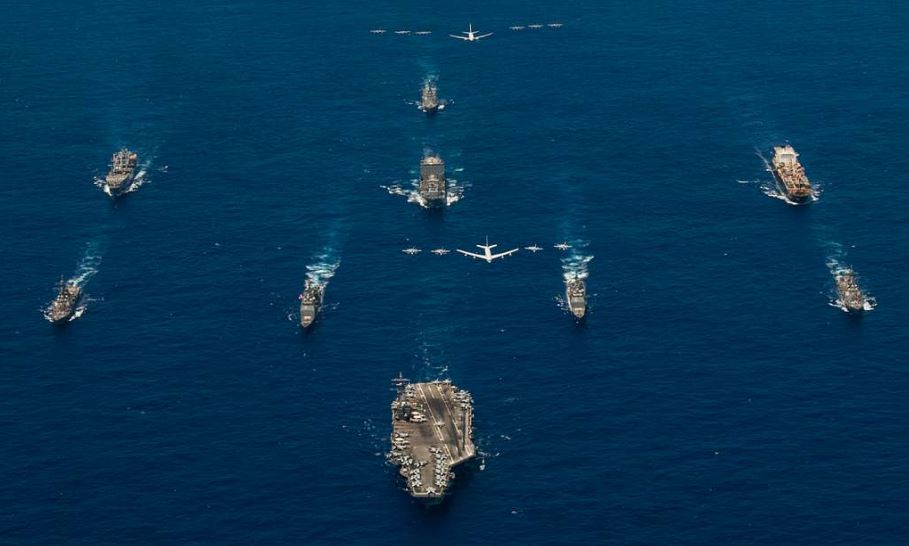
From the days of the very first aircraft carriers, like the USS Langely (CV-1), until the 2009 retirement of the USS Kitty Hawk (CV-63), virtually all of the aircraft carriers in the United States Navy ran on some flavor of marine diesel fuel. Beginning in 1961, however, with the advent of the USS Enterprise (CVN-65), the Navy began transitioning all of its new aircraft carriers to nuclear power. The benefits appeared to be clear, as the nuclear powered aircraft carrier could cruise without refueling its nuclear power plant for up to 25 years.
But, just how clear was that advantage, over the conventionally engined carriers of the past? And – much more important – what were the downsides of completely shifting to nuclear power? These question came into needle-sharp focus on January 1st, 2026.
The United States Navy began 2026 with a problem that should alarm anyone paying attention to the global security of the United States: of the current fleet of eleven aircraft carriers, exactly two were deployable – the USS Gerald Ford (CVN-78), which was the center-point of the operation against Venzuelan dictator Nicolas Maduro, and the USS Abraham Lincoln (CVN-72), which was patrolling the South China Sea.
By early February, facing simultaneous crises from the sudden Iranian revolution, to the increasing instability in Communist China, the Navy emergency-scrambled two more carriers (the USS Theodore Roosevelt (CVN-71) and the USS George H. W. Bush (CVN-77)) to operational status — completing their Composite Training Unit Exercises COMPTUEX while already underway to their deployment zones.
Of the remaining carriers, only the USS Eisenhower (CVN-69) is undergoing “workups”, beginning the three or four month process to return to deployment. Every other nuclear carrier is either undergoing decommissioning (USS Nimitz (CVN-68)), or undergoing repair/overhaul/refueling. It is unclear exactly when a carrier other than the Eisenhower will be available for operations.
This isn’t a sign of extraordinary capability – it’s a symptom of a fleet in crisis.
The ten nuclear-powered Nimitz-class and the one Ford-class carriers represent remarkable engineering achievements. They can steam virtually forever without refueling. The USS Stennis, however, has been undergoing its mid-life nuclear refueling and overhaul since 2021 — a process now entering its fifth year. The USS Truman remains sidelined following collision damage, unable to deploy before its own – now-delayed, because there is only one refueling dock for nuclear carriers – refueling cycle. When you need carriers now, theoretical capabilities matter less than actual availability.
This brings up the uncomfortable question: what are we actually buying with nuclear propulsion for aircraft carriers?
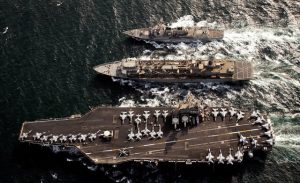
The standard answer is “unlimited range” — carriers that never need to refuel their main engines. But carrier strike groups don’t operate in isolation. Their aircraft require JP-5 jet fuel continuously. Their escorts need bunker fuel. Even the carriers run backup diesel generators and require regular underway replenishment for aviation ordnance, food, and supplies. The nuclear reactor means the ship’s hull doesn’t need to refuel, but the mission absolutely does. The need for UNREP operations remain constant regardless of propulsion type.
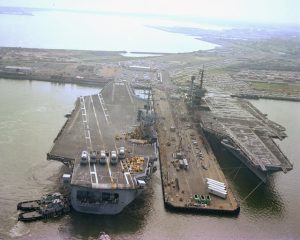
What nuclear propulsion does require is specialized infrastructure. Refueling and Complex Overhaul (RCOH) cycles take two to three years, normally, and demand nuclear-qualified facilities and workforce. The Navy has only one, single facility that can refuel nuclear aircraft carriers – which is why the USS Truman is currently riding at anchor, waiting for the Stennis to clear the dock, as the carrier fleet cannot use the same refueling docks as nuclear-powered submarines, due to size and configuration.
Budget cuts have also compounded the maintenance delays — the Obama administration’s sequestration-era budget reductions followed by COVID-related disruptions have created a cascading refueling backlog across the fleet. When institutional maintenance capacity is disrupted, nuclear carriers don’t degrade gracefully; they become tied to pier-side for years.
Diesel-powered carriers offered a different trade-off. Yes, they need refueling — something which is already done constantly for the rest of the carrier’s accompanying strike group. But they also eliminate multi-year RCOH cycles. Conventional powerplants can be serviced at standard shipyards around the world without nuclear certification requirements. Battle damage to diesel systems can be more easily repaired or replaced; damage to nuclear propulsion systems requires specialized facilities and extended timelines, if they are actually repairable at all – unlike World War Two, where rapid repair of severe combat damage was routinely accomplished in a few months, at most…But, as no nuclear powered carrier had yet to be seriously damaged in combat, we really have no idea if repair of a combat-damaged nuclear carrier is even possible. Construction timelines also shrink dramatically when you remove the nuclear certification requirements from the process.
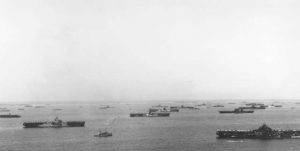
The question isn’t whether nuclear carriers are impressive pieces of engineering. They are. The question is whether that impressive engineering serves strategic needs. Consider the Essex-class carriers of World War II and beyond — diesel-powered, mass-produced, and maintained in sufficient numbers to ensure availability. Twenty-four hulls provided persistent presence through Korea and Vietnam. Our current eleven-carrier nuclear fleet just demonstrated it can field four during a global crisis.
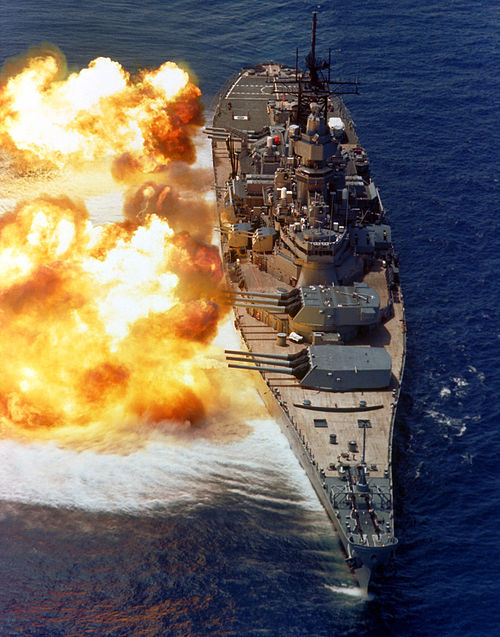
The Reagan administration’s 600-ship Navy called for fifteen carrier battle groups — emphasizing numerical presence across global theaters. President Trump has recently advocated for returning battleships to service, arguing their firepower and durability offer capabilities modern vessels lack.
Both proposals address real problems but miss the core issue: availability. Fifteen carrier groups – or eleven – mean nothing if chronic maintenance backlogs sideline half the fleet simultaneously. The proposed battleships — essentially huge missile platforms with armor — require crews of 1,500+ versus modern a destroyer’s c.300, while offering marginal advantages over “distributed lethality” concepts using existing hulls.
The actual requirement isn’t more carriers or bigger guns — it’s operational carriers and maintainable systems. Fifteen diesel-powered carriers with conventional maintenance cycles would provide far more deployable presence than fifteen nuclear carriers cycling through extended overhauls. Similarly, additional Arleigh Burke-class destroyers deliver sustained missile capacity without the proposed battleships’ manpower and maintenance burdens.
Strategic presence requires operational availability — not just impressive-looking platforms.
Form should follow function. If the function is “project American power globally during crisis,” then presence matters more than theoretical endurance. A diesel carrier that’s actually there outweighs a nuclear carrier in year five of refueling. This isn’t about going backward technologically — it’s about being operational strategically.
The Navy faces a choice: continue investing in exquisite platforms that spend years unavailable for specialized maintenance, or diversify toward simpler systems that prioritize fleet availability. The Iranian crisis and Western Pacific tensions aren’t waiting for the Stennis to complete its overhaul. Neither will the next emergency. We need carriers that can steam now, not carriers that can theoretically steam forever.
Strategic availability isn’t a compromise…And in February 2026, it’s the actual requirement.

























.jpg)