American companies lost 32,000 net jobs in the month of September according to ADP research. In addition to losing jobs in September, the August report, which had shown a gain of 54,000 was revised down to a loss of 3,000 jobs. The constant dramatic disparities in initially reported numbers and revised numbers leaves some to doubt the efficacy of our current job measuring techniques.
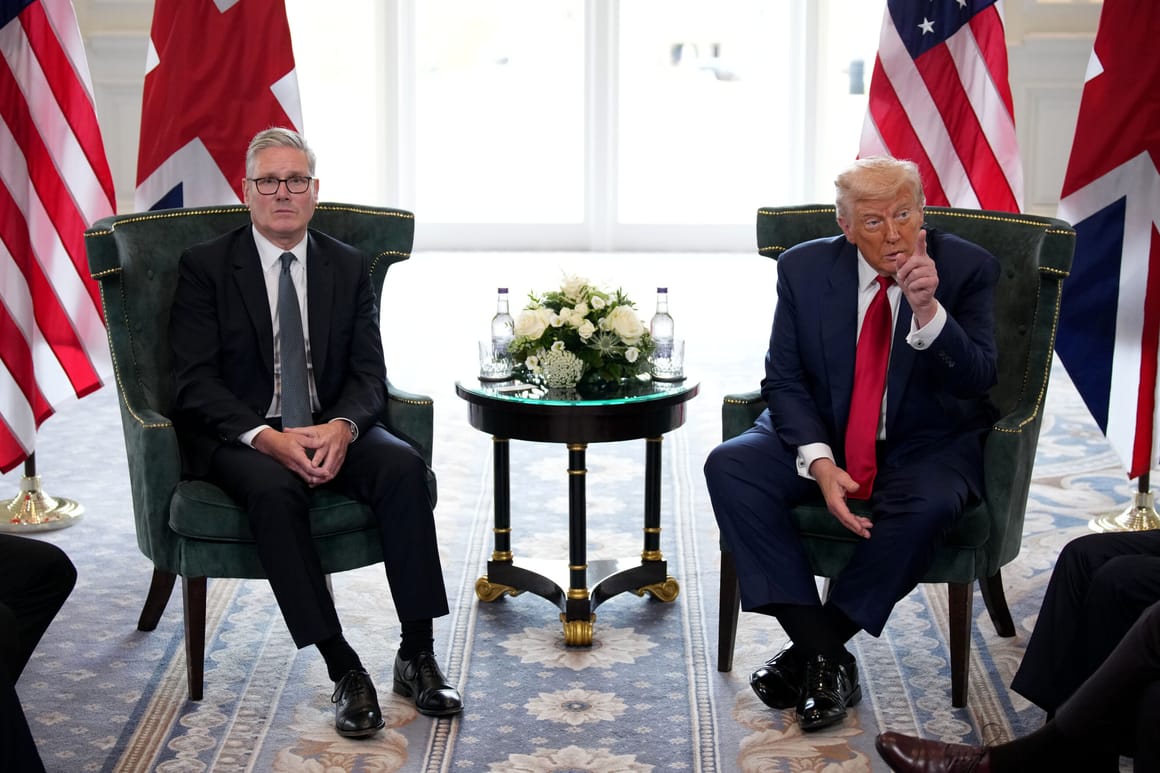
In the midst of pomp and circumstance, President Trump and the UK’s Prime Minister Kier Starmer announced a major tech trade deal intended to reinforce the two countries’ “unbreakable bond.” Trump charactered the deal as being “very big,” adding “it’s an unbreakable bond we have regardless of what we’re doing today.”
Trump, Starmer sign tech deal to seal ‘unbreakable bond’– www.channelnewsasia.com Source Link Excerpt:
… Britain’s work in wooing the unpredictable Trump on his second state visit seemed to have paid off as he and Starmer signed the partnership boosting ties in artificial intelligence, quantum computing and nuclear energy.
At the signing ceremony attended by a host of US tech CEOs, Labour leader Starmer said he and Republican Trump were “leaders who genuinely like each other.”
“It is the biggest investment package of its kind in British history by a country mile,” he added.
Trump said the deal was “very big”, and added of US relations with key NATO ally Britain that “it’s an unbreakable bond we have regardless of what we’re doing today”.
Old things rarely go away forever. In military terms, many things are frequently relegated to museums. But sometimes – things lay dormant, “sleeping” if you like, waiting for someone to need them again.
Like, for example, old air bases.
Eighty years after B-29 Superfortresses thundered down its runways carrying atomic bombs toward Japan, the airfield complex at Tinian, in the Northern Marianas Islands, is awakening from its jungle slumber. What was once the world’s busiest airport in 1945 — with 40,000 personnel and four 8,500-foot runways — has become ground zero for America’s most ambitious Pacific military infrastructure project since World War II.
The U.S. Air Force has committed nearly half a billion dollars to restore this historic airfield in the Northern Marianas, with satellite imagery showing dramatic progress as over 20 million square feet of degraded pavement emerges from decades of tropical overgrowth. Fluor Corporation received a $409 million contract in April 2024 to complete the restoration within five years, transforming what Pacific Air Forces commander General Kenneth Wilsbach called an “extensive facility” back into operational readiness.
But this isn’t nostalgia driving American bulldozers through Tinian’s jungle. This is strategic necessity in an era of renewed great power competition. The reclamation project is part of the U.S. military’s Agile Combat Employment (ACE) strategy, which shifts operations from centralized physical infrastructures to a network of smaller, dispersed locations that can complicate adversary planning. Translation: China’s expanding missile arsenal can now reach America’s major Pacific bases like Andersen Air Force Base on Guam and Kadena in Okinawa, making distributed basing a survival imperative rather than strategic preference.
The timing is no coincidence, either. The Pacific Deterrence Initiative, established in fiscal year 2021 and modeled after the European Deterrence Initiative created following Russia’s 2014 Crimea invasion, represents the largest regional deterrence investment since the Cold War, with congressional authorizations totaling over $40 billion from fiscal years 2021-2024. Tinian sits at the heart of this investment, positioned strategically in what military planners call the “Second Island Chain” — a defensive arc spanning from Japan through the Marianas to Australia designed to project American power deep into the Western Pacific.
The Pacific Ocean is massive. Most people don’t think of this on a daily basis, as if it comes up at all, it is in the form of air travel, measured in hours. A modern United States Navy supply ship, moving at 20 knots (about 23 mph) will require a minimum of 13 days to move from San Francisco, California to Manila in the Philippines. For modern armed conflict, this is a crushingly long distance. As a result, maintaining bases across the wide expanse of the Pacific is not an optional decision. It is for this reason, that the Second and Third Island Chains have been defined, and why real money is being spent to fortify both strategic lines.
Pacific Island Chains Map, 2024. US Navy. Public Domain.
Recent analysis by the Hudson Institute suggests just 10 missiles with cluster munitions could neutralize all exposed aircraft and fuel facilities at major U.S. airbases, underscoring why dispersion has become doctrine. Tinian’s restoration provides what one Pentagon official described as critical “divert capability” if primary bases become “unusable” — a euphemism for what happens when Chinese missiles start flying with any accuracy.
The island’s compact 39 square miles and sparse population of 3,000 residents belie its outsize strategic importance. Located less than 1,500 miles from both Tokyo and Beijing, Tinian still offers the same geographic advantages that made it invaluable in 1945. The difference now, is that instead of targeting Imperial Japan, American planners are positioning combat power to deter — or if necessary, directly combat — Chinese aggression across multiple potential flash points from the Philippines to the South China Sea.
Work that began in January 2024 has already achieved significant milestones, with a groundbreaking ceremony in August marking “one of the most extensive rehabilitation projects in Air Force history”. RED HORSE engineering squadrons — specialists in rapid runway construction — have been clearing jungle and restoring infrastructure that lay dormant since 1946, when the last American units departed what was then the world’s most formidable air base.
The symbolism is inescapable: where atomic weapons once departed to end one world war, conventional deterrence now prepares to prevent the next one. History may not repeat on Tinian, but it certainly echoes in the roar of returning American aircraft engines.
Tinian Island, 1982, Northern Mariana Islands (MNP). USAF Photo. Public Domain
But…why? Why are both the United States and Communist China struggling so hard over the regions off the Asian eastern coast? In a word – money. Ocean commerce currently accounts for between $2.5 and 3 trillion of revenue, yearly, providing around 150 million full time jobs. Look around your house – chances are nearly certain that at least one expensive item within your sight came from overseas, unless you are living in a wooden hut – and even then, at least one of the tools used to build that hut probably came to you via ship, whether you realize it or not.
The world is getting progressively more dangerous as 2025 winds onwards. It is neither hyperbole nor paranoia to chant “Si Vis Pacem, Para Bellum” when one goes to bed at night, because things have a tendency to creep up on you in the dark. It is for this reason that smart military’s only throw things that work away very slowly.
Including real estate…something that the BRAC should have paid more attention to.
The Freedomist — Keeping Watch, So You Don’t Have To
At one point, it looked as if Google would be busted up by the Federal government for having a monopoly on search engines. Now, that possibility is gone after U.S. District Court Judge Amit P. Mehta ruled Google will not be busted up. The reason for the change comes from the rise of generative AI and the need for companies the size of Google to develop them.
While Google was spared the Ma Bell axe, they won’t avoid some penalties, such as proscriptions against “maintaining exclusive deals that tie the distribution of Search, Chrome, Google Assistant, or Gemini.”
Google avoids breakup as court ruling fuels AI Mode expansion – Digital Watch Observatory Source Link Excerpt:
A US district judge has declined to order a breakup of Google, softening the blow of a 2024 ruling that found the company had illegally monopolised online search.
The decision means Google can press ahead with its shift from a search engine into an answer engine, powered by generative AI.
Google’s AI Mode replaces traditional blue links with direct responses to queries, echoing the style of ChatGPT. While the feature is optional for now, it could become the default.
That alarms publishers, who depend on search traffic for advertising revenue. Studies suggest chatbots reduce referral clicks by more than 90 percent, leaving many sites at risk of collapse.
Google is also experimenting with inserting ads into AI Mode, though it remains unclear how much revenue will flow to content creators. Websites can block their data from being scraped, but doing so would also remove them from Google search entirely.
Despite these concerns, Google argues that competition from ChatGPT, Perplexity, and other AI tools shows that new rivals are reshaping the search landscape.
The judge even cited the emergence of generative AI as a factor that altered the case against Google, underlining how the rise of AI has become central to the future of the internet.
On Monday, January 27, the city of Goma, in the Democratic Republic of the Congo (the former Zaire), fell to an assault by the Rwanda-backed M23 rebel group, Causing a sudden escalation in the fighting of one of the worlds least-known conflicts, a conflict that has run, in various phases, since the 1960’s. This does not mark an end to the fighting, by any means, but it does hint at a new phase, a phase which – coupled to the Trump administration’s upset to the region by its 90-day suspension of foreign aid across the board – could prove to be a disaster for high tech manufacturing industries around the world.
At the center of the fighting, are the vast mineral deposits of “rare earth elements” in the region, on both sides of Lake Kivu, in the DRC and in Rwanda, which is also home to its own vast mineral deposits. These rare earth elements are fundamental to the workings of everything from nuclear power plants to the computer device you are reading this on.
Lake Kivu, Africa, as seen from space, 2003. NASA Image. Public Domain.
So – if there is plenty of mineral wealth to go around, what’s the problem?
There are two factors at work, here. First, is the long history of mostly-European (and a few American) mining conglomerates, seeking to maximize profits by operating largely with what amounts to slave labor. This has been going on since at least the 1880’s, but today, disgruntled rebel groups have access to the same weapons as the governments and corporations that oppose them, as was predicted in 1940.
Second, is the phoenix-like rebirth of the DRC’s neighbor, Rwanda.
When most people in the west hear the word “Rwanda”, their first thought is likely a dim memory of the horrors of the Rwandan Genocide of 1994, and the abject failure of the “world community” to intervene to stop the genocide.
But, out of that fire, Rwanda emerged with a new face.
Rwanda’s transformation since 2000 represents one of Africa’s most remarkable recovery stories. Following the devastating genocide of 1994, which claimed an estimated 800,000 lives and shattered the country’s social fabric, Rwanda embarked on an ambitious development strategy under President Paul Kagame’s leadership.
The country adopted “Vision 2020“, a comprehensive development program focusing on transforming Rwanda from an agricultural subsistence economy into a knowledge-based, middle-income nation. This strategy prioritized several key areas: good governance, human resource development, private sector development, infrastructure, and regional economic integration.
Rwanda’s economic approach emphasized technology and business-friendly reforms. The government invested heavily in digital infrastructure, establishing widespread internet connectivity and promoting tech education. This earned Rwanda the nickname “Africa’s Singapore,” reflecting its ambition to become a regional hub for technology and services. The country consistently ranked among Africa’s easiest places to do business, attracting significant foreign investment.
In education, Rwanda made dramatic progress, achieving near-universal primary school enrollment and significantly increasing secondary school attendance. The country also emphasized women’s empowerment, achieving one of the world’s highest rates of female parliamentary representation.
Parallel to its domestic development, Rwanda emerged as a significant contributor to international peacekeeping operations. This involvement served multiple purposes: demonstrating Rwanda’s recovery, providing professional development for its military, and generating revenue through UN peacekeeping reimbursements.
The Rwandan military, rebuilt after the genocide, has become one of Africa’s most professional forces. By the early 2020’s, Rwanda ranked among the top contributors to UN peacekeeping missions globally. Rwandan troops earned particular praise for their effectiveness in challenging environments like South Sudan and the Central African Republic.
This peacekeeping role reflected Rwanda’s broader regional ambitions. The country positioned itself as a stabilizing force in central Africa, though this role sometimes generated controversy, particularly regarding its involvement in neighboring Democratic Republic of Congo.
Rwanda’s development model, while successful in many metrics, has faced criticism regarding political freedoms and regional relations. Nevertheless, its economic achievements are substantial: sustained GDP growth, reduced poverty rates, improved healthcare access, and increased life expectancy. The country’s per capita income more than tripled between 2000 and 2020.
The country’s approach to reconciliation and justice through the Gacaca courts system, while controversial, has been studied as a unique model for post-conflict societies. Rwanda balanced the need for justice with practical considerations of processing hundreds of thousands of cases, while simultaneously working to rebuild national unity.
This combination of domestic development and international engagement has transformed Rwanda from a symbol of tragedy to a notable example of post-conflict recovery and development. Its experience offers important lessons about the relationship between security, governance, and economic development in post-conflict situations.
The March 23 Movement (M23), formed in 2012, emerged from earlier rebel groups in eastern DRC, drawing its name from a March 23, 2009, peace agreement between the DRC government and the CNDP rebel group. The organization primarily consists of ethnic Tutsis from North Kivu province, sharing ethnic ties with Rwanda’s ruling elite.
Rwanda’s relationship with M23 has been consistently controversial. While Rwanda officially denies supporting the group, multiple UN reports and international investigations have documented evidence of Rwandan military support, including weapons transfers, tactical guidance, and direct military assistance. This support appears motivated by several factors: security concerns about anti-Tutsi forces in eastern DRC, economic interests in the mineral-rich region, and strategic ambitions for regional influence.
The first M23 rebellion (2012-2013) captured international attention when the group briefly occupied Goma. UN investigations during this period found substantial evidence of Rwandan support, including direct military intervention. This led to international pressure and aid suspension from several Western donors, eventually contributing to M23’s defeat and exile of its leaders to Uganda and Rwanda.
The M23 resurfaced in late 2021, launching new offensives in North Kivu. Fresh evidence emerged of Rwandan support, including allegations of direct military involvement. Rwanda has consistently argued that its actions are defensive, citing the presence of FDLR (Democratic Forces for the Liberation of Rwanda) – a group partly composed of perpetrators of the 1994 genocide – in eastern DRC.
The conflict reflects deeper regional tensions. Rwanda’s involvement with M23 has strained relations with neighboring countries and complicated its carefully cultivated international image as a model of post-conflict development. The DRC government has repeatedly accused Rwanda of using M23 as a proxy force to maintain influence over eastern DRC’s resource-rich territories.
The international response to Rwanda’s alleged support for M23 has been complex, partly due to Rwanda’s important role in regional stability (especially in Mozambique, to battle that country’s islamist insurgency) and its significant contributions to UN peacekeeping missions elsewhere in Africa. This has created a paradoxical situation where Rwanda is simultaneously a major contributor to African peacekeeping while being accused of destabilizing a neighboring state.
The situation highlights the complex interplay between regional security, ethnic politics, and economic interests in the Great Lakes region. Rwanda’s support for M23, while officially denied, appears to follow a pattern of intervention in eastern DRC that dates back to the aftermath of the 1994 genocide.
The implications of M23’s capture of Goma are severe, if Rwanda is actually deploying its own forces to back the rebels, given M23 stating their intent to march on the DRC capitol of Kinshasa to overthrow the government there.
While it may seem cold, given the scale of human suffering, the economic impact on the readers of this article and their neighbors could potentially be immense. The Trump administration’s 90-day suspension of foreign aid creates additional complications in an already volatile situation. Rwanda, which receives significant US assistance for both development and military programs, might find its peacekeeping capabilities affected just as regional tensions escalate. Similarly, the DRC’s government, already struggling to maintain control in its eastern regions, could see its military effectiveness further diminished by this temporary funding gap. This aid suspension, while brief, comes at a critical moment when both nations are positioning themselves for potential broader conflict, potentially accelerating the region’s descent into deeper instability.
Given the professional nature of Rwandan troops in general, there is a very real chance that this training may have been transferred to the M23 rebels after their unsuccessful rebellion a decade ago. The best example of this is the treatment of some 280 captured Romanian mercenaries, a profession with a long history in the region, which is jnot known to be very lenient in its treatment of non-African ‘operators’ when captured – the Romanians are in the process of being repatriated as this article goes to press, happy that they are not meeting a far worse fate than an unexpected plane flight home.
There is a solid chance that there may be serious disruptions to rare earth mineral extraction in the offing, disruptions that could potentially impact US and Western tech industries in a very short span of time. Events in Africa may not impact you, immediately or directly, but they will do so, eventually.
Forewarned is forearmed.
The Freedomist — Keeping Watch, So You Don’t Have To
In the shadowy world of conflict financing, a new player has emerged: cryptocurrency. As digital currencies like Bitcoin – once derided by many as useless money pits – increasingly gain mainstream acceptance, they are also becoming a tool for those operating outside the law, including insurgent groups, terrorist organizations, and sanctioned states. This technological shift is reshaping the economics of modern warfare and challenging traditional methods of tracking and interdicting illicit funds. Money makes serious violent conflicts and wars possible, and cryptocurrencies are increasingly the preferred go-to for all non-state actors in conflicts…and major nations are not far behind.
The Rise of Crypto in Conflict Zones
Cryptocurrency’s key features – decentralization, anonymity, and borderless transactions – make it an attractive option for groups operating in conflict zones. Unlike traditional banking systems, which can be easily monitored and controlled by governments, cryptocurrencies offer a degree of financial autonomy that’s unprecedented in the digital age. It also holds the potential to radically expand the democratization of warfare, a subject we touched on last week.
In recent years, there have been several high-profile cases of cryptocurrency being used in conflict zones. In 2019, Hamas – the militant group controlling Gaza, responsible for the October 7, 2023 assault into Israel – turned to Bitcoin to solicit donations, bypassing international restrictions on its financing. Similarly, in the ongoing conflict in Ukraine, both sides have leveraged cryptocurrencies: volunteers supporting Ukrainian forces have raised over $200 million in crypto donations, while some Russian-backed separatist groups have also turned to digital currencies to evade sanctions.
Terrorism Financing Goes Digital
The shift from traditional financing methods to cryptocurrency is particularly evident in terrorism financing. Al-Qaeda, ISIS, and other terrorist groups have increasingly turned to Bitcoin and other cryptocurrencies to fund their operations. These groups often use social media platforms to solicit donations, providing Bitcoin addresses where supporters can send funds anonymously.
The ease of creating online fundraising campaigns with cryptocurrency has led to a new phenomenon: the crowdfunding of terror. In 2019, a website linked to Al-Qaeda-affiliated groups in Syria raised Bitcoin donations for weapons and training. The campaign, which ran on the dark web, promised donors anonymity and the ability to support jihad from anywhere in the world.
This has extended into Asia, as well, as extensive NFT networks have been employed to both raise and transfer cryptocurrencies into fungible cash. Part of this fallout comes in the form of Afghanistan coming to the fore as a clearinghouse for crypto transfers to terror groups, as the lax controls of the ruling Taliban – who returned to power after the bungled and disastrous withdrawal of United States forces from the country in 2021 by the Biden-Harris administration – effectively closing off surveillance and enforcement efforts within the pariah state.
Challenges for Law Enforcement
This new landscape of crypto-enabled conflict financing poses significant challenges for law enforcement and intelligence agencies. Tracking and intercepting cryptocurrency transactions is a complex task, requiring specialized skills and technologies that many agencies are still developing. A major part of this is the reality of the “dark web“, and its associated “darknet markets“. Outside of cryptocurrency transfers, these markets allow all manner of criminal activity, including human trafficking and child pornography, as well as illicit drug trades, all of which terror groups have no issue leveraging such tools.
The catch for law enforcement and intelligence agencies in tracking terrorists and other criminals through the “dark web” lays in the fact that although the core operating principle of the ‘dark web’ – so-called “onion routing” – was developed and patented by the US Navy in 1998, the very nature of the system developed to secure US military and government communications networks means that forcing access remotely is virtually impossible. In fact, the arrest by the FBI of the founder and main operator of the notorious “Silk Road” darknet market in 2013 (which led to his life sentence in 2015) did not involve traditional methods of hacking, but involved an agent infiltrating the “Silk Road” site as an administrator, and using “social engineering” techniques to narrow down Ulbricht’s location, and using his personal security mistakes to finally locate him…”Hacking” really had nothing to do with the takedown of the “Silk Road“, because it cannot be taken down by conventional methods of “hack-attack“.
The pseudonymous nature of most blockchain transactions using the “non-fungible token” protocol that makes cryptocurrencies viable, provides a veneer of anonymity, though it’s not impenetrable. Agencies like the FBI have had some success in tracing Bitcoin transactions related to ransomware attacks and other cybercrimes. However, newer “privacy coins” like Monero offer even greater anonymity, making them increasingly popular among those seeking to avoid detection.
Legal and jurisdictional issues further complicate matters. As cryptocurrency transactions usually cross international borders, questions are raised concerning which agencies have authority to investigate and prosecute any “criminal activity” based on a computer physically located in their countries, not least because a specific instance of criminal activity in one country is not necessarily such in another country, as was demonstrated in 2012, when Hungarian scam artists attempted to run an insurance fraud scheme in the wake of the Costa Concordia disaster. The lack of consistent regulations across countries creates loopholes that bad actors can exploit.
The Humanitarian Dilemma
Interestingly, the same features that make cryptocurrencies attractive for illicit financing also make them valuable for delivering humanitarian aid to conflict zones. In areas where traditional banking systems have broken down, or where governments restrict the flow of funds, cryptocurrencies can provide a lifeline for aid organizations.
For example, during Venezuela’s economic crisis, some aid groups turned to cryptocurrency to deliver assistance, bypassing the country’s dysfunctional financial system and strict currency controls. Similarly, in Afghanistan, some NGOs have explored using cryptocurrencies to continue operations after the Taliban takeover restricted traditional financial channels.
However, this humanitarian use of cryptocurrencies presents its own risks. The same channels used to deliver aid could potentially be exploited by militant groups to divert funds. This creates a complex balancing act for aid organizations and regulators alike, not least as crypto-financing is increasingly being seen as a negative, since it is a “hidden” method of finance.
Looking to the Future
As cryptocurrencies continue to evolve, so too will their impact on conflict financing. The development of central bank digital currencies (CBDCs) and the increasing sophistication of decentralized finance (DeFi) platforms will likely create new opportunities and challenges in this space.
Regulators and international bodies are scrambling to keep up. The Financial Action Task Force (FATF), a global money laundering and terrorist financing watchdog, has issued guidelines for regulating virtual assets. However, the effectiveness of these measures remains to be seen, especially given the rapid pace of technological change in the crypto world.
The impact of cryptocurrencies on global power dynamics is also worth considering. As digital currencies potentially weaken the effectiveness of economic sanctions, traditional forms of financial warfare may become less potent. This could lead to a shift in how nations project power and influence on the global stage.
Conclusion
The rise of cryptocurrency in conflict financing represents a significant shift in the landscape of modern warfare. While it offers new opportunities for bad actors to fund their activities, it also presents potential benefits in terms of delivering aid and fostering financial inclusion in unstable regions.
As we move forward, the challenge will be to develop adaptive policies and technologies that can mitigate the risks of crypto-enabled conflict financing while preserving the innovative potential of blockchain technology. This will require unprecedented cooperation between governments, financial institutions, and the tech sector.
The genie of cryptocurrency is out of the bottle, and its impact on conflict financing is here to stay. The responses to this challenge will shape the future of global security in the digital age.
The Freedomist — Keeping Watch, So You Don’t Have To
A new report shows that global container shipping rates have jumped some 29%, as of the end of April, 2024. While the Pentagon is confident that military actions against the Iran-back Houthi terrorists in Yemen are succeeding in tamping down attacks on shipping, the mess of port congestion around the world is also seriously impacting the shipping world, which will inevitably cause significant price increases on all imported goods.
President Joe Biden has announced plans to once again raid America’s strategic oil reserves with a hope of lowering gas prices to protect his election chances. The Energy Department justified putting America at a critical risk with the claim that this move will help “lower costs for American families and consumers,″
Energy Secretary Jennifer Granholm justified the act of treason, stating “The Biden-Harris administration is laser-focused on lowering prices at the pump for American families, especially as drivers hit the road for summer driving season. By strategically releasing this reserve in between Memorial Day and July 4th, we are ensuring sufficient supply flows to the tri-state and Northeast at a time hardworking Americans need it the most.”
On Tuesday, the Biden Administration announced that it will be releasing another 1 million barrels of oil from a reserve in the Northeast, in yet another effort to lower gas prices ahead of the November election.
ABC News reports that the reserve in question, located in New Jersey and Maine, was established in the aftermath of Hurricane Sandy in 2013. The sale by the Biden Administration will take place in increments of 100,000 barrels, with the hope that there will be a competitive bidding process that will guarantee the flow of gasoline to local retailers throughout the summer.
The Energy Department said that the move aims to help “lower costs for American families and consumers,″ after a congressional mandate called for the executive branch to sell off the nearly 11-year-old Northeast reserve before its closure. This mandate was part of the spending deal that was passed in March to avoid a government shutdown.
The sale of 1 million barrels – which amounts to about 42 million gallons – comes as the average price of gas nationwide currently sits at about $3.60, according to data from AAA. This is not the first time that the Biden Administration has resorted to tapping into emergency reserves just to lower gasoline prices for political expediency, as he previously did so ahead of the 2022 midterm elections; this move was credited as one of several reasons why the Democratic Party did not face landslide losses as most polls projected.
It turns out all the claims that American needs immigrants because there are more jobs than people might not be as true as many have been claiming for the past decade. The Center for Immigration Studies (CIS) released a report that of the immigrants who have arrived in the U.S. after 2022, only 46 percent are gainfully employed.
Steven Camarota and Karen Zeigler, authors of the report, wrote, “Immigration clearly adds workers to the country, but it just as clearly adds non-workers who need to be supported by the labor of others. This was the case in the past, it is true today, and it will surely be the case for immigrants who arrive in the future. Those who simply see immigration as a source of labor need to understand it is also a source of school children, retirees, and many other non-workers.”
More than half of the foreign-born immigrant population in the United States under President Joe Biden’s administration is unemployed, according to a recent report.
The Center for Immigration Studies (CIS) released a report on Monday that showed that just 46 percent of migrants who had arrived in the U.S. “in 2022 or later” were employed as of the beginning of 2024.
“Immigration clearly adds workers to the country, but it just as clearly adds non-workers who need to be supported by the labor of others,” Steven Camarota and Karen Zeigler, researchers with the CIS, wrote.
This was the case in the past, it is true today, and it will surely be the case for immigrants who arrive in the future. Those who simply see immigration as a source of labor need to understand it is also a source of school children, retirees, and many other non-workers.
The data from the CIS report undermines arguments that supporters of illegal immigration have used to try to point out that migrant workers help the economy by working hard.
NEW: The foreign-born population has hit RECORD highs in March 2024 of 51.6m and 15.6% of the total U.S. population. pic.twitter.com/8sfD15kgqx
— Center for Immigration Studies (@CIS_org) May 13, 2024
Since the dawn of warfare, the most prized battlefield trophy that soldiers present to their commander is the enemy’s battle flag.
In the early Sixties, the objective of the Vietnam conflict, as established by Eisenhower and Kennedy, was to contain China’s Communist expansion in South East Asia. At the outset, our American leaders assessed the campaign with auspicious optimism. The Americans had the North Vietnamese out-gunned, and we enjoyed unassailed air superiority. How could we lose?
Indeed, up until 1975, when the South Vietnamese government lost in the Fall of Saigon, the American forces had decisively won every major kinetic battle in the war. Those victories would eventually grow hollow. Ho Chi Minh plotted to drag the American Forces into an endless hornets nest of guerrilla warfare.
A journalist once asked General Vo Nguyen Giap, Commander of the North Vietnamese Army, how long he would have continued to fight against the American forces had they not withdrawn in 1975. “Twenty years,” he replied. “One hundred years. Even more, if necessary. We would have fought indefinitely until we prevailed.”
In the Spring of 1968 the North Vietnamese Army suffered a bitter loss in their attempt to seize the Marine airfield at Khe Sanh. With B-52 bombers and F-4 fighter-bombers, the Americans dropped more bombs on the North Vietnamese defending that siege than all the bombs the US forces dropped in World War II. American commanders estimated that the NVA suffered as many as 15,000 KIAs at Khe Sanh.
Despite the horrific losses heaped on Giap’s army, Khe Sanh became a turning in the Vietnam War. The nightly news bombarded the American people with horrific images of the Tet Offensive and the siege of Khe Sanh. After the siege, Walter Cronkite broke his career-long tradition never to divulge his personal viewpoints on a news story. Cronkite declared on his nightly broadcast that the Vietnam War was a lost cause. President Johnson’s favorability rating plummeted so low that he closed his reelection campaign. Fed up, the American people were ready to bring the troops home.
And from the ashes of Khe Sanh, the North Vietnamese had discovered a surprising windfall – a political victory won on the American home front.
Finally, on April 30, 1975, at the Fall of Saigon, the North Vietnamese handed the mighty United States a humiliating defeat on the world stage.
Today Vietnam enjoys a thriving economy and a growing middle class. They have western shopping malls that sell the bourgeois brand names of Gucci, Louis Vuitton, Lacoste, and Rolex. As of this writing, each year the country hosts 12 – 15 million tourists adding $27 billion to their annual GDP. Their thriving aviation industry has a superb safety record. Vietnam is on pace to be the world’s 10th largest economy by 2050.
Their economy can be labeled as anything but “Communist.” A more accurate description would be “Free Market Authoritarianism.” But wasn’t the defeat of Communism America’s prime war objective in 1965? Of course. And so in 1986, the Vietnamese politburo passed economic reforms that have led to the prosperity they enjoy today.
To this end, the United States actually won the Vietnam War against the Communists.
We should never have fired a single bullet. The 57,939 service members need not have given their lives. Nor did the countless service members need to have sacrificed the healthy bodies of their youth, nor the soundness of their souls. The cauldron of death we waged upon our own boys and against the Vietnamese people lay in abject waste.
Without firing a shot, we ultimately defeated the Vietnamese Communists. And we did so by General Giap’s own measure: not over a matter of years, but over the course of decades; over generations.
And who were the grand prizewinners of the war? The Vietnamese people. The war reunited the North and South Vietnamese people under a unified flag, and they now enjoy a cornucopia of wealth bestowed by the Free Market.
Today Vietnam is Communist in name only. The Vietnamese people offer the party only a grudging appearance of respect, hollow of any sense of personal loyalty or pride. They regarded me as a fool when I purchased these flags. “Party members are the only ones who buy those flags,” they snickered.
In the same way the North Vietnamese failed to recognize their political power on the American home front, so too did the American leaders, at the dawn of the Vietnam conflict, fail to recognize the might of the Free Market.
The last shot of the Vietnam War was fired on December 18, 1986, when the Vietnamese Communist Politburo surrendered to the Free Market.
This hammer and sickle flag is their tattered, defeated battle flag; our prized trophy of their surrender.
Back FREEDOM for only $4.95/month and help the Freedomist to fight the ongoing war on liberty and defeat the establishment's SHILL press!!
Are you enjoying our content? Help support our mission to reach every American with a message of freedom through virtue, liberty, and independence! Support our team of dedicated freedom builders for as little as $4.95/month! Back the Freedomist now! Click here