As the hours wore on, more reports came in: Wagner troops captured the city of Rostov-On-Don, Russia’s primary regional headquarters tactically controlling the ongoing battles in the breakaway Ukrainian regions of Luhansk and Donbas; there were reports of army commanders “defecting” to Wagner; there were reports of scattered attacks by the Russian Air Force on columns of Wagner troops advancing north along the M4 highway, eventually reaching the critical junction of the city of Voronezh, in an apparent bid to storm the Russian capital city of Moscow, with attendant reports of loyalist forces frantically fortifying sections of the city, as well as mutinies at some military bases around the capital. Russian leader Vladimir Putin was reported to have fled the capital as did, apparently, many of the business “oligarchs” who control the Russian economy, leading to many Western governments and sophomoric, desperate-for-news pundits to chortle at Putin’s seeming demise…
…And then – it was over.
Late on June 24, the story suddenly flipped: Alexander Lukashenko, long-time dictator of the nation of Belarus and a staunch Putin ally, apparently negotiated an agreement between Putin and Prigozhin that saw the mercenary leader “exiled” to Belarus, in trade for ordering his prison-mercs to reverse course, and return to their original cantonments on the front lines of Southern Ukraine.
The world – and especially Western intelligence services – were dumbfounded…ourselves, included.
After careful analysis, the staff at FreedomistMIA has reached a general conclusion as to what we think has happened.
As we remarked in our article from June 23, our second point of analysis was the possibility that Prigozhin had actually launched his “putsch” at the direct order of Putin, in a bid to strengthen Putin’s position inside Russia. While we considered this to be unlikely at that time, that is what now seems to be the case.
At issue, firstly, was Prigozhin’s demonstrated fanatical loyalty to Putin (who had made Prigozhin his personal chef at one point, and then made him the head of the already-established Wagner PMC). Second, were Prigozhin’s, frankly bizarre and inconsistent (bordering on the incoherent) statements on various social media platforms, ranting (not too strong of a term) about the Russian Ministry of Defence not simply hamstringing his forces by deliberately denying them supplies and other critical combat support, but of actively bombarding them, in their forward bases, killing large numbers of the mercenaries…none of which made any sense, at all.
In response, Putin addressed the Russian nation and the world early on the 24th (US time), calling Prigozhin and any Wagner troops supporting him rebels and traitors, and calling on the Wagner mercenaries to detain Prigozhin and/or return to the Ukrainian front. Shortly after that address, Lukashenko “brokered” an end to the “fighting”.
So…where does this leave us, as of the afternoon (US time) on June 26?
The putsch is over. Wagner forces are returning to southern Ukraine. Prigozhin’s whereabouts are unclear. What has the result been, overall?
First, Putin’s hold on power – despite the desperate ravings of certain sections of the popular media – has been greatly strengthened: the abortive putsch saw many anti-Putin oligarchs and lower-level military commanders and officials either ‘sit pat’, or actively try to ingratiate themselves to Prigozhin. Where their loyalties to the Putin regime may have been questionable before the putsch, their stances are now out in the open, for all to see.
Second, there has apparently been no significant disruption in the logistical throughput passing through Rostov-On-Don, meaning that the Russian and mercenary forces on that front have suffered no real interruption to the flow of personnel, supplies, or equipment. Likewise, tactically speaking, there has been no opportunity for Ukraine to exploit “disruptions” in Russian ranks.
Third, is the interplay between Russia, Belarus and Wagner. With Prigozhin “exiled” to Belarus – to date, a ‘silent partner’ to Russia, allowing significant Russian forces to be based in their country – there is the significant possibility that Progozhin will take many of his Wagner troops with him (the idea of Russia allowing all Wagner troops to go to Belarus is a non-starter, as the mercenaries are too vital as shock troops). Those troops, likely under a different corporate name, would both strengthen the Russian units now in Belarus, while also providing vital training services for Belarusian forces, who have no combat experience to speak of. This could be enhanced, due to reports during the “not-a-putsch”, of Wagner units opening prisons, arming the freed inmates and adding them to their forces, something Wagner has done in the past, with official sanction. Where Wagner was suspected to have fielded approximately 50,000 troops worldwide, with some 25,000 fighting in Ukraine, that figure may have been significantly increased.
Overall, it would appear that Putin has staged a solid deception operation that has measurably strengthened his power base, added forces to his army prosecuting his war in Ukraine, and greatly shored up a close ally, an ally which may well need a “loyal” force of battle-hardened mercenaries to secure his regime, as Lukashenko is reportedly in ill health.
As a result, the world collectively has a lot of egg on its face, to Putin’s benefit.
And that, as it lowers the Western public’s opinions of their governments and news media in general, bodes ill.
The Freedomist — Keeping Watch, So You Don’t Have To
SUMMARY – On June 23, Yevgeny Prigozhin, a petty criminal-turned-hot dog vendor-turned-restaurateur-turned mercenary warlord led his mercenary army, the infamous “Wagner Group”, in what he describes as a “March of Justice” against the Russian Defense Ministry, accusing that governmental body of launching deliberate attacks on his troops in order to destroy his army. As of the dawn of June 24, Prigozhin’s forces have captured the major city and vital command and logistics hub of Rostov-On-Don, securing the city center, as well as the main regional military headquarters. Russian leader Vladimir Putin has vowed to crush the Wagner mutiny in a public address on the morning of June 24. These actions have dire implications for the world. This is a developing situation.
The Current Situation – The Wagner PMC has been the core of Russia’s recent battles in Ukraine, acting as elite shock troops in brutal battles throughout the region, particularly in Bakhmut, at the end of May. The mercenary army has been in action around the world, primarily in Africa (in Chad, Libya and Sudan) and the Middle East, earning a reputation for combat effectiveness, corruption and brutality.
Over the last few months, however, the 62-year old Prigozhin has been increasingly seen as unstable, making increasingly angry and bizarre claims that the Russian Ministry of Defence has been deliberately attacking his forces, claims that the Ministry has vehemently denied. It is these attacks that appear to be the linchpin behind the crisis.
The “Long March” Begins – On June 23rd, Wagner troops variously either left their positions to follow Prigozhin in his march to Rostov-On-Don, or turned and fired on regular Russian Army troops. This has completely disrupted Russian operations in Ukraine. Additionally, Western intelligence services have been caught flat-footed, not remotely suspecting Prigozhin’s actions, indicating that Prigozhin may not have been suborned.
As of the morning of June 24th, Wagner forces have been reported in the city of Voronezh, an approximate 6-hour drive from Moscow. In Moscow itself, loyalist troops and armored vehicles have been deployed into the city itself to protect the Kremlin and various areas where the oligarchs supporting the Putin regime live. There are also reports of scattered fighting and other potential mutinies at various bases around Moscow.
The danger, and the reason this action by Prigozhin is so dangerous, is that the vast bulk of Russia’s regular army is physically inside Ukraine at this time, meaning that there are very few forces between Prigozhin and Moscow who are either willing or capable of standing up to Wagner’s battle-hardened troops in any kind of fight.
Predictive Analysis
The Bad…Good and Ugly Being Irrelevant – Information on the situation remains highly fluid and uncertain, but some analysis is possible.
To begin, Prigozhin’s actions are frankly bizarre. “Friendly Fire” incidents happen in war, often frequently. Even in extreme cases, these kinds of incidents are no reason for a mutiny that can only be seen as not simply irrelevant, but highly damaging to an active war effort.
What is currently unknown – and is a decisive factor – is whether or not the flow of supplies through Rostov-On-Don has been disrupted or not.
This leads to three possibilities, none of them good:
Prigozhin may have been “turned”, or “suborned”, by a foreign intelligence agency to strike out against Putin’s government. It is hard to understand why Prigozhin would agree to do such a thing, as he owes everything good that has happened in his life in the last thirty-odd years to Vladimir Putin, personally. And, while not having any real, professional military training, Prigozhin must certainly understand the impact his actions will have on the Russian war effort against Ukraine. The fact that Ukraine itself does not seem to be taking advantage of this disruption immediately, would tend to indicate that they had no knowledge of Prigozhin’s actions beforehand. This is backed up by anonymous sources within the Western intelligence communities, who have confirmed that no one knew or suspected the mercenary chief’s actions until he struck out on his suicide charge.
Conversely, swinging into pure speculation-mode, Prigozhin may be tilting at this particular windmill at the direct order of Putin, himself, in an old-school-Hollywood bit of skullduggery, taking a radical action that would allow Putin to declare martial law, and make a clean sweep of the Russian oligarchs (most of whom, like Putin, are former KGB officers) standing in his way from a return to Stalinist-style policies of control, effectively creating a kind of “Soviet Union, 2.0”, with Putin as absolute and unchallenged ruler. In this scenario, Prigozhin could be “tried for treason” and “sentenced to prison”, and then retired to a nice country home in Siberia, far away from cameras and reporters. While certainly requiring some extensive mental gymnastics, this is not outside the realm of possibility.
Lastly, there is the most frightening possibility: That Prigozhin has actually become unhinged, and truly believes that his actions of the last forty-eight hours are perfectly justified. If this is the case, all bets are off, because Putin has been facing a quietly increasing rise of resistance from the oligarchs he relies on to retain power. This could lead to an all-out Civil War in Russia, a nuclear-armed superpower with a nuclear arsenal comparable to that of the United States, with the potential for unauthorized uses of nuclear weapons. Peripheral to this, is the possibility that, should Ukraine “steal a march” on Russia, and make a sudden spate of critical gains, the Russian military command could panic, and use tactical nuclear weapons to attack Ukraine’s Main Supply Routes (MSR’s) to hold their advance amid the confusion. Such an action would cause a panic in both the European Union and in NATO…and no one knows what will happen after that.
Conclusion – Yevgeny Prigozhin’s actions are unprecedented in the modern day. Nothing like this has been seen on so critical a geopolitical scale since the Russian Revolution of 1917. While pithy remarks about Machiavelli being right on mercenaries might be true, they are also largely irrelevant to the current situation.
By his actions, whatever their rationale might be, Yevgeny Prigozhin and his mercenary army have placed the world in significant danger of all-out war, on a scale never before seen.
The FreedomistMIA is keeping a close watch on this situation at press time, and will update this story for our readers as the situation develops.
The Freedomist — Keeping Watch, So You Don’t Have To
The hand grenade has been employed in warfare, in one form or another, for over 3,500 years. Very early on after gunpowder was perfected, well before the first real “firearms”, there were hand grenades. The first gunpowder grenades were small, fired-clay pots that were filled with gunpowder, small stones and scrap metal, had a simple fuse stuck into them and were hurled at an enemy. This was an easy development, because other such pots had been filled with thickened, flammable oil, and thrown at an enemy to cause burns, ignite flammable structures, and sow confusion and fear – essentially, what we would now call “Molotov Cocktails” – as well as various type of smoke making and stink bomb-type noxious mixtures.
The main problems with these early types of grenades were many. Their fuses were highly unreliable, for starters; this made them extremely dangerous to use, as they could easily explode early…assuming that the fuse didn’t sputter out, turning the grenade into a dud. Also, the early grenades suffered from the same issues of modern grenades, as there was a long development arc to learn how to balance the weight of the grenade canister, to the weight of the gunpowder charge, to the outer case’s design, to how to store and carry the devices. And, through trial and error, it was soon found that hand grenades are very non-discriminatory – if the thrower is too close when the grenade explodes, its fragments will hit the thrower as well.
An illustration of a fragmentation bomb from the 14th Century Ming Dynasty book “Huolongjing“. Public Domain.
It is that last part is what kept the grenade from truly widespread use: safety issues aside, the range of hand grenades is limited by the strength of the thrower. And, given the unreliability of fuses, getting close enough to physically hurl a grenade at an enemy was “problematic” at best; cannons were simply better. Although solutions were tested in the 17th and 18th Centuries, such as the creation of “grenadier” units – men chosen for their physical size and strength, seen as being better at throwing objects long distances – were tried, both the technology and the battle tactics of the era eventually made the throwing of hand grenades a largely pointless exercise; grenadiers eventually stopped carrying hand grenades entirely, instead refocusing their size and strength into acting as elite shock troops, used to storm enemy formations and entrenchments…most people tried to not think about the casualty rates.
By the end of the 19th Century, however, technology had advanced to the point where hand grenades could be equipped with reliable fuse mechanisms, while advances in metals and explosives could make hand grenades vastly more effective.
Hand grenades (as opposed to “rifle grenades”, which will be a subject for another article) are today one of the most widespread non-firearm “force multipliers” in use throughout the world. There are numerous misconceptions about hand grenades and their uses, largely engendered by Hollywood (the “pulling the pin with your teeth” being among the most egregious) that we will strive to correct here.
When World War 1 arrived, the war soon bogged down into the stalemate of trench warfare, it was soon realized that the infantry needed an edge when assaulting a trench. In both the Allied and Triple Alliance camps, some people remembered the grenade, and set to work. The results were very different – the German “Stielhandgranate” (known as the “potato masher,” from its distinctive shape) and the British “Mill’s Bomb” became the default standards.
Mills bombs. From left to right: N°5, N°23, N°36. Photo Credit: J-L Dubois, 2007. CCA/3.0
As the world passed through the inter-war years, then through WW2 and Korea, more types of grenades came into use, as the utility of the devices as married to advancing technology became evident. Today, grenades are everywhere, in a multiplicity of types.
Hand Grenade Types
There are several types of grenades in use, today. All of the types have very different characteristics, and thus should be used only in the right situation. Hand grenades can only be thrown about 30 meters/yards, and typically weigh between 0.75 and 1.25 lbs. Offensive and Pyrotechnic grenades are often rigged with tripwires as booby traps, although any type of hand grenade can be technically used as an IED.
There are five general types of hand grenades in current use:
Defensive
Offensive
Pyrotechnic
Gas
Special Purpose Munitions
Defensive Grenades
The Defensive Grenade (the “Mill’s Bomb”, referenced above) is what most people are probably thinking of when they hear the word “grenade”. This class of grenade is a high explosive, ‘fragmentation’ grenade, like a WW2 “Pineapple” grenade. These are termed “Defensive” because such grenades are designed to be used from behind “cover” (YouTube link).
A World War II re-enactor equipped with a replica Colt M1911 pistol, a pair of Mk 2 “pineapple” grenades (L) and a smoke grenade (R) on his uniform. U.S. Air Force photo by Staff Sgt. Nathanael Callon. Bastogne, Belgium, 2012. Public Domain.
These grenades explode violently, sending out a shower of fragments in all directions. In general, if you are within about 7 meters/yards of a Defensive grenade explosion, you have a better than 90% chance of becoming either a very serious casualty…or becoming very dead. If you are within 15 meters, chances are good that you will be wounded in some manner.
Russian combat F1 defensive fragmentation hand grenade. Photo Credit: Samo8383. CCA/4.0
In general, grenades technically have a 5 second fuse; one should expect a 3 second fuse, at best. Note, however, that when dealing with captured supplies, that anything recovered (or “dropped accidentally”) from a lone supply truck should be treated as suspect material.
Offensive Grenades
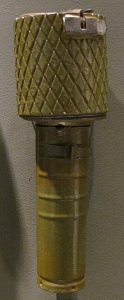
Offensive grenades – sometimes called “blast” or “concussion grenades” – are designed to kill/wound/stun through “blast effect” (the physical force of the blast) rather than through fragments. See the “Stielhandgranate” reference, above. The casings on these grenades are essentially vaporized by the blast (often, the casings are waterproof paper).
German soldier in Russia, about to throw a Stielhandgranate, c.1941. Author unknown. Public Domain.
For some reason, the Germans attached a handle to this grenade, which increased its throw-range (because the handle acts as a lever) by about 30% over the more “baseball”-like shapes, such as the Mill’s Bomb. It should be noted that WW2 Soviet RGD-33 stick grenade reversed this trend.
Soviet RGD-33 stick hand grenade. Photo Credit: MKFI, 2010. Public Domain.
The lethal radius of an Offensive grenade is about 3 – 4 meters, with a casualty radius of about 6 – 10 meters. Offensive and Defensive grenades are usually about the size and shape of a baseball.
Pyrotechnic Grenades
“Pyrotechnic” is a classification for grenades that do not cause casualties through their mechanism, but that do different things to support combat operations. In general, this means generating either smoke or illumination.
Smoke grenades produce smoke, usually in a variety of colors, the most popular being red, blue, green, yellow and white. These are useful for concealing movement, as well as signaling.
In contrast, illumination grenades use some kind of very bright-burning material, often magnesium, to light up dark places, usually well in excess of 200,000 candlepower.
Pyrotechnic grenades of all types are usually about the size and shape of a 12oz. soda can.
U.S. Air Force Tech. Sgt. Israel Garza explains tactical concealment using M18 smoke grenades to Forces Armèes Nigeriennes partners at Nigerien Air Base 201, Niger, Dec. 15, 2018. U.S. Air Force Photo by Staff Sgt. Daniel Asselta. Public Domain.
Gas Grenades
Almost universally, “gas grenades” employ CS gas (2-chlorobenzalmalononitrile) as their “tear gas” agent. For those reading this who may have previously served in the armed forces and have gone through the “gas chamber”, but have never had a full-strength riot grenade used on them, the real, “tactical”, grenade is far worse.
American-made tear gas grenade utilizing CS gas, used by Egyptian riot police. Photo Credit: Sherif9282, 2011. CCA/3.0
Tactically, CS grenades make fantastic contact-breakers for an outnumbered patrol that may be surprised, and has to withdraw quickly. This is because gas training is almost never taken seriously by most militaries…which is why it is vital for every unit to maintain gas masks, and train regularly to “don and clear” as rapidly as possible…However, it should be noted that gas grenades are technically classified as a “chemical weapon” in some quarters, which is why
Gas grenades are generally about the size and shape of a “regulation” softball. They do not generally break into more than 8 or 9 fragments, and have only a very tiny explosive charge in the fuse, just enough to break open the grenade body and disperse the agent within.
Special Purpose Munitions
“Special Purpose Munitions” is a catchall term for “everything else”. This includes both “stun (or ‘flash bang’) grenades” (lots of loud noise and bright flash, but no fragmentation and little real blast effect…unless you’re hold it when it goes off), low-powered “sting-ball” grenades (low explosive charge – or even compressed gas – and the “fragments” are low-velocity rubber balls), and “demolition charges” such as Thermite (which burns hot enough to melt through most types of steel) or White Phosphorous (“WP”, also known colloquially as “Willie Pete”), which disperses particles of phosphorus over a wide area.
A Flash-Bang Explodes In The Air. Photo Credit: Hongao Xu, 2020. CCA/2.0
The phosphorus tends to ignite flammable objects, and inflicts severe burns on human beings, and cannot be extinguished by water, because it carries its own oxidizing compound. The only thing that can be done to remove the WP matter is to submerge the patient in water, and remove the glowing “coals” from their body with forceps or tweezers.
Fortunately – or unfortunately, depending on your personal viewpoint – the hand grenade of today is the infantryman’s personal artillery: used intelligently, the hand grenade can get at enemies hiding around corners, hidden in rooms in a building, in folds in the terrain, or behind cover – all places rifles and pistols cannot reach.
While the technology behind the hand grenade is certainly lethal, and may be upsetting to contemplate for some, it will do to remember the words of the Chinese general Sun Tzu, writing c.500BC:
“There is no instance of a nation benefiting from prolonged warfare.”
The Freedomist — Keeping Watch, So You Don’t Have To
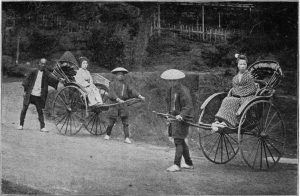
In the twenty-first century, few people in Western societies give much thought to bicycles. The machines are usually seen as something one gives to a child as a birthday present; or, something one buys to use for exercise in the sunshine. In some cities, and especially in Asia, bicycles are used as a primary mode of transportation, both in day to day living for activities like going to work and shopping, as well as in actual business, such as postal and product deliveries, but also as taxis for passengers, in those areas that still allow ‘rickshaw’ traffic.
Rickshaw in Japan, 1897. Credit: Rev. R. B. Peery, A.M., Ph.D. Public Domain
Very few people give any thought to the bicycle as a military tool, but it was – and remains – a vital component of many military operations.
The modern bicycle dates from a design created by the German Baron Karl von Drais, who invented his “Laufmaschine” (German for “running machine“) in 1817 (patented in 1818), that was called “Draisine” (English) or “draisienne” (French) by the press; this term would evolve over time into “velocipede”. Von Drais’ design was the first commercially successful two-wheeled, steerable, human-propelled machine on record.
It should be noted that it also quickly earned the nickname of “bone-shaker”, for obvious reasons.
An early ‘velocipede’. Photo of a Lithograph from 1819. Public Domain.
But, the design fascinated people, and progress was made in developing it. Many of these designs, such as the ‘penny-farthing’ of Englishman James Starley and Frenchman Eugène Meyer, are outright silly and fanciful, more suited to the pages of a Jules Verne novel than to any kind of useable machine. All that began to change in 1885, and first line militaries around the world began to take notice.
An example of a ‘penny-farthing’. Skoda Museum, Czech Republic 2003. CCA/3.0
In 1885, John Kemp Starley, James Starley’s nephew, invented what became known as the “safety bicycle”. Departing from past designs by making both wheels identical in size, employing a high-necked caster to better anchor the handlebars for steering, and incorporating the first rear-wheel chain drive on a bicycle, all combined to vastly improve the ride, handling and speed of the bicycle.
The younger Starley’s design – which was widely copied, as he had failed to patent the design – was swiftly followed by the last two major developments that would draw serious military attention to the bicycle for military use.
The first innovation was the reinvention of the pneumatic tire by John Dunlop in 1888, greatly smoothing out the ride and simplifying the design, and the patenting of the folding bicycle by African-American inventor Isaac R. Johnson, approved on October 10, 1889. Johnson’s design is also the first recognizable appearance of the “diamond frame” design that is still common over a century later.
Racing bike, showing the diamond frame. Photo Credit: Julius Kusuma. CCA/3.0
These two developments created an explosion of interest in cycling throughout the United States and Western Europe in the early 1890’s, actually causing an economic bubble near the turn of the century. It is at this point that the ‘Turmoil of the Century’s Turning’ happened.
The decade from 1895 to 1905 saw multiple – and massive – wars break out all over the world, from the First Sino-Japanese War of 1894-1895, to the Second Boer War (1899-1902) in southern Africa, which saw Great Britain deploy nearly 300,000 Imperial troops by steamship – to the Russo-Japanese War of 1904-1905. In the midst of these massive conflicts – a sort of “dress rehearsal” for World War 1 – there was the Spanish-American War of 1898, and the “China Relief Expedition” of 1900, with saw an allied force of British, French, Japanese, Russian, German, Austrian, Italian, and American troops marching from the Chinese city of Tientsin to rescue the diplomatic staffs in Peking (now Beijing) at the height of China’s “Boxer Rebellion” (1898-1901).
“I’ll Try, Sir!” – American troops in the relief of Peking in China on 14 August 1900 during the Boxer Rebellion. H. Charles McBarron, Jr., for the US Army. Public Domain.
All of these major conflicts – as large and expansive as most of the wars of the twentieth and twenty first centuries – made the various militaries realize that they needed to continue to innovate and upgrade their forces, a process that had already been happening in earnest for over thirty years.
Infantry – the core of all military forces – moves at the speed of a walking soldier, unless there are tools such as railroads, motorized vehicles or airplanes to carry them…and even then, they will still be walking. As well, the infantry have been carrying much of their own equipment for most of that time, to the tune of some 120lbs (c.54kg) on their backs. Something needed to be done to improve their mobility.
Typical US infantry load. USMC photo. Public Domain.
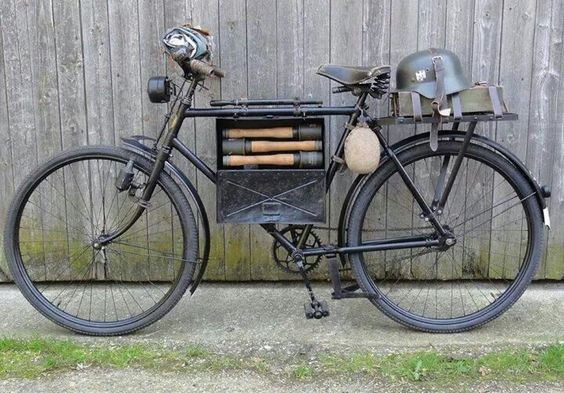
Bicycles were obviously useful to horse-drawn armed forces as messengers, as the cyclists did not need to worry about sick or lame animals; bicyclers were relatively easy to fix if something broke down. Other functions were tried out, including using bicycles to lay communication wire, create local maps by fixing clinometers to the frame, and patrol rail lines; there were even experiments to use them as ambulances and to haul machine guns around the battlefield. While not usable in the cavalry role – which should be apparent from the nature of the machine – could the infantry use it?
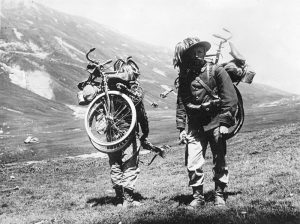
Italian Bersaglieri infantry with folding bicycles, c.1917. Public Domain.
This led to the creation of “bicycle infantry”: infantry units began to test out bicycles during long-distance rides, more or less to see what happened. This is where James Moss enters out story.
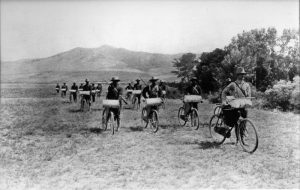
Then First Lieutenant James A. Moss, of the 25th United States Army Infantry Regiment (Colored), the storied “Buffalo Soldiers” (the United States military was still heavily segregated then) obtained permission in 1896 to take fifteen volunteers from the regiment on an experimental series of rides that culminated in a 1,900 mile ride from Missoula, Montana, to St. Louis, Missouri. Moss’ unit completed the trek – which avoided roads and paths where possible, sticking strictly to overland travel – made the trip in some 40 days, at an average of 6 miles per hour (pdf link). While the US Army was ultimately satisfied with conventional infantry units, armies outside the United States took notice of Moss’ experiments. (James Moss would go on to lead a bicycle-equipped unit in Cuba, and would later write a set of basic instruction manuals for troops and officer that form the basic framework of basic military instruction manuals today.)
25th US Infantry Bicycle Corps at Fort Missoula in 1897. Lt. James at right. Public Domain.
When World War One broke out, the bicycle served in all theaters. However, it was rarely deployed into direct combat, primarily due to the confines of trench warfare in Western Europe, and a simple lack of resources on the Eastern Front, in Russia. This unspectacular performance, overall, signaled the death knell of the military bicycle to the military pundits of the time.
However, other officers came out of World War One with a better understanding of bicycles and their military uses.
In the Second World War, bicycles were deployed extensively in Malaya, where Japanese intelligence officers, familiar with the Japanese Army’s use of c.50,000 bicycle infantry in the 1937 invasion of China, made sure in their pre-war scouting to note the presence of bicycle shops throughout the British-controlled colony. Likewise, Germany and Italy deployed units of bicycle infantry in rugged terrain, where horses would struggle. Many guerilla and partisan units – and the intelligence teams from the Allies who supported them – used bicycles for scouting, messages and to run electric generators to power radio systems that reported on Axis forces until the end of the war.
A German unit using a tandem bicycle power generator to power a radio station, September 1917. Public Domain.
Post-1946, the bicycle again faded into obscurity in most of the military world, although bicycle infantry units would continue to serve for decades in Swedish and Swiss military units. In one place, however, the military bicycle would reach its peak – in a place called Vietnam.
France, although it had been soundly beaten by Hitler’s Germany in 1940, was desperate to retain its colonial empire. When French forces returned to Indochina in September of 1945, the Vietnamese were less than impressed. Where French troops had capitulated to Japanese troops more or less without firing a shot, the resistance in Indochina had been led by native Vietnamese, and mostly by the Communist Party led by Ho Chi Minh and Vo Nguyen Giap (who were supported (pdf link) by the American Office of Strategic Services (OSS) during the war). After French forces seized control of Saigon (now Ho Chi Minh City) by force in September of 1945, the Communists retreated into the mountains and countryside, vowing to continue their war, now framed as a war of independence from France. This brought about the “cargo bike”.
The Communist forces, known as the ‘Viet Minh’, waged a brutal guerilla campaign in the rural areas of the country, causing steady and damaging casualties to French forces. However, the Viet Minh faced all the same challenges as a pre-WW2 non-motorized army, but with the added problem that suitable pack animals were few in number, and human porters could only carry a tiny amount of the supplies needed.
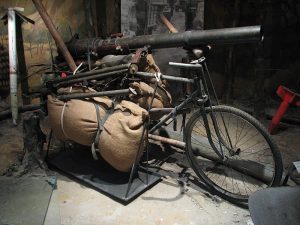
Viet Minh mechanics took the commonly-available bicycle, and began modifying it, resulting in a vehicle that could reliably carry up to 400lbs (c.181kg) at the pace of a walking adult human. While not the equal of a cargo truck or a boat, this was a far better solution. And it very shortly made its effects known.
Vietnamese army bike – Vietnam War Museum in Hanoi. Photo credit: Przemek P, 2010. CCA/3.0
In 1954, Viet Minh forces surrounded and destroyed the cream of the French Army in Indochina, at the Battle of Dien Bien Phu. France deployed its best units, numbering over 12,000 troops, in a badly thought out plan to bring the Viet Minh to battle in order to destroy them. At the extreme range of supply and support aircraft, the French troops found themselves over-extended and cut off, as French ground forces could not break through to reach them. The Viet Minh surrounded the town the French had fortified, and fought a nightmarish siege for nearly two months. Eventually, some 11,000 French troops would surrender; nearly 8,000 would die in a march to prison camps that rivaled the Bataan Death March in its brutality. The result was France agreeing to Vietnamese independence, surrendering their Indochina colonies in whole, which would lead to yet another war…but that is another story.
Viet Minh troops plant their flag over the captured French headquarters at Dien Bien Phu, May 7, 1954. Photo credit: Roman Karmen. Public Domain.
One of the primary reasons the Viet Minh were able to crush the French was their ability to move supplies, and the ‘cargo bicycle’ was at the heart of the Vietnamese logistical triumph. But again, the military use of the bicycle receded into seeming obscurity, despite its next successful showing against American forces in Vietnam…
…And yet – the bicycle remains in use as a military tool by guerilla and insurgent forces around the world. Why?
Within its obvious limits, the military facts of the bicycle of today remain unchanged from those same facts discovered by James Moss and his unit of Buffalo Soldiers in 1896: the bicycle requires no fuel, beyond the food required for its operator; it moves essentially silently, at a constant speed of up to twelve miles per hour; it raises no dust in its passing; it can operate in most weather and terrain conditions; and it can be used to power various systems, from air circulation fans to electric generators, and does so with no heat output, again, aside from the signature produced by the operator.
Three Swedish bicycle infanterists armed with m/45 SMGs and Bantam anti-tank missiles, Sweden, 1965. Public Domain
Given the ludicrous progress of the US Army’s new Infantry Squad Vehicle (ISV), it might be time for regular militaries to think about “going old school”.
The Freedomist — Keeping Watch, So You Don’t Have To
We would like to express our thanks to naval OSINT analyst H I Sutton, of Covert Shores, for his kind assistance with this article.
Illness is an odd thing. One rarely pays close attention to outside events unless those events have a direct and immediate impact on the ill person. In the case of your humble author, 2022 was a rough year. As a result, I completely missed this article when it came out, and didn’t think clearly about the implications of using larger vessels in a DIY Navy when that article was written.
Mea culpa, mea culpa, mea maxima culpa…Consider this to be Part 2.
For small national navies, as well as “guerrilla” navies, Part 1 is still absolutely true: limited funds and resources limit options when building a naval force of any kind. However, for the nation-state that is in the “middle sea” [sic], so to speak, those have more options.
As described in a previous article, a nation desiring to construct a navy needs to first decide on exactly what kind of navy they need – not want, but need. To briefly recap, there are three basic choices: Blue, Green & Brown:
A “blue” navy is basically the kind of navy used by the United States, Great Britain, and France, the kind of navy that Communist China aspires to: a naval force to maintain the “Sea Lanes of Communications” (the SLOC). This is the hardest kind of fleet to build, and far and away the most expensive.
A “green” navy is mostly a coastal force, whose main job is to facilitate amphibious operations, i.e., landing troops ashore. Still expensive, but the better choice for nations like the Republic of the Philippines.
A “brown” navy operates almost solely along rivers and close in to coastlines. These naval forces are comparatively cheap, but are very limited in range and capabilities, compared to the other two types of fleet.
Obviously, there is a good deal of overlap between the various types: brown and green navies complement each other well, where their environments meet. Likewise, green and blue navies can have a very great deal of overlap when projecting state power at a long distance. While there is little overlap between blue and brown fleets, blue water units can benefit from the lightweight/high-speed boats of the brown squadrons.
Iran, however, has taken the path of outside-the-box thinking to a different level.
Beginning in 2021, the Iranian Revolutionary Guard Corps commissioned the building of at least two “drone carriers,” former “Panamax” [https://en.wikipedia.org/wiki/Panamax] box-carriers [https://en.wikipedia.org/wiki/Container_ship] refitted to operate combat and surveillance drone aircraft, “Shahid Mahdavi” and “Shahid Bagheri”. In form, the two ships initially looked like their recent sister ship, the “forward base ship” “Makran”.
Unlike Makran, however, Mahdavi and Bagheri are apparently focused solely on drone craft operations. The Bagheri is being fitted with an overhanging deck extension on their port (left) side. While visually similar to US Navy carriers of the last c.65 years, this seems to have been designed in order to launch and recover heavier drone craft on an angle, from port to starboard, due to the container ships’ superstructure at the aft (rear) end, which cannot be easily modified. This seems to be confirmed, as Iranian state news is showing pictures of a “ski jump” being installed on the Bagheri. The “ski jump” flight deck has been used to aid in flight operations since at least the 1970’s, when the UK’s Royal Navy used them for their “Harrier carriers”, HMS Hermes and HMS Invincible, during the Falkland Islands War of 1982.
IRGC ship “Bagheri” under construction in shipyard near Bandar Abbas, 2022, showing angled flight deck. Diagonal arrows show the non-standard flight deck. Photo credit: H. I. Sutton, Covert Shores
IRGC ship “Bagheri” under construction in shipyard near Bandar Abbas, c.early-2023, showing the ‘ski jump’ nearing completion on the flight deck. Photo credit: H. I. Sutton, Covert Shores
Harrier Jump Jet, Farnborough Air Show 2014 by Christine Matthews. CCA/2.0
This modification opens the possibility of launching much heavier drone craft, capable of carrying much heavier ordnance than other drones. While certainly incapable of handling heavier, manned craft, this bodes ill for anyone Iran chooses to focus on.
Bayraktar TB2 on the runway. Credit: Bayhaluk, 2014. CCA/4.0/Int’l.
There has not been a direct, “force on force”, aircraft carrier battle since WW2; the aforementioned Falklands campaign nearly resulted in one, but that turned out to be a false start. While there have been thousands – if not tens of thousands – of carrier-launched fighters and bombers attacking land targets and land-based aircraft, these were not “carrier” battles, in the naval sense. The concern, here, the nightmare of rational naval planners since the 1970’s, has been the “improvised aircraft carrier.” The naval dimension of the Falklands War, once again, informs on the problem.
SS Atlantic Conveyor, approaching the Falklands. About 19 May 1982. Photo: DM Gerard. CCA/2.5
A combination roll-on/roll-offcontainer ship, Atlantic Conveyor was used primarily to ferry aircraft for the British invasion force. When the vessel arrived in the combat area, the Harrier ‘jump jets’ she carried were launched from her, and flown off to the aircraft carries. On May 25th 1983, during the ferocious air attacks by Argentine air forces during the Battle of San Carlos, Atlantic Conveyor was struck by two Exocet anti-ship missiles, killing twelve of her crew, including her captain; gutted by fires, the ship sank three days later, while under tow, joining several other vessels in becoming the first Royal Navy vessels lost in action since World War 2. The loss of all of the remaining aircraft aboard (all of them helicopters) would severely hamper British operations ashore for the remainder of the campaign.
But note the first part of that story: Atlantic Conveyor was able to at least launch manned fighter jets while underway. What the Royal Navy – long starved for funding for ships and manpower (HMS Hermes was scheduled for decommissioning – without a replacement – when the invasion happened) had built a “jack carrier”, effectively equivalent to a WW2 “escort carrier”, at very short notice, with the potential – had she not been destroyed – of being able to conduct combat operations at some level.
This capability had been recognized with helicopters for many years, but this was the first time it had been proven valid for manned combat jet aircraft. Although conjectural, this is likely the real reason why the US and UK defense establishments buried the Harrier’s proposed follow-on aircraft, the supersonic version of the Hawker Siddeley P.1154, cancelled in 1965. No serious attempt was made to perfect a supersonic-capable VTOL until the introduction of the F-35B by the United States in 2015. As there are few carriers in the world capable of operating conventional jet aircraft, this ensured the naval dominance of those states that possessed these massive and expensive weapons.
F-35B Lightning taking off from a ski-jump, from HMS Queen Elizabeth, 2020. Photo: LPhot Luke/MOD. UK/OGL v1.0
Now, however, we find ourselves in the 21st Century, and technology has significantly progressed, across the board. Long-range drone craft, capable of carrying heavy ordnance, and armed – presumably – with anti-ship missiles and capable air- and anti-ship missile defenses, have now changed the structure of naval “battle calculus.” This is because the world’s second- and third-line military forces have relearned the fundamental truth of national military strength: it doesn’t matter how strong a nation’s military is overall, but how much of that force can be brought to bear against a particular target.
Iran’s naval deployment of ersatz carriers may seem laughable to many in first-line forces, but no one in second- or third-line navies are laughing. Iran has demonstrated that they are perfectly capable of worldwide naval cruises and deployments, and while their carriers and other vessels almost certainly stand no chance against a US or UK task force, they are more than a match for most of the other navies in the world. This is especially true for their “forward base ship” concepts, which are capable of deploying commando units via helicopter and speedboat, in a manner similar to first-line navies.
The deployment of these three vessels, the Makrun, Mahdavi and Bagheri, marks the first time since 1976 (in the days of the Imperial Navy of Iran) that Iran has had a truly capable naval arm for its military forces. Given the country’s friendly relations with Russia and Communist China, the possibility of joint fleet operations with at least China, if not Russia, along with their recent truce – brokered by the PRC – with Saudi Arabia, means than Iran can easily conduct far more complicated and wide-ranging power projection operations than they were able to in the past.
Much more worryingly, these ship commissioning’s are being done in public, and there are plenty of nations in the world at Iran’s tier who can take inspiration to boost their own naval capabilities.
The foundations of the world economy are set on the concept of the “freedom of the seas”, a concept enforced since World War 2 by the United States, Great Britain and France…but all three states are in financial trouble, and their navies are down to razor-thin numbers, in both ships and sailors. It will take careful, resolute and competent leadership to navigate through this.
The question is: is that leadership in place? Or even on the horizon?
Karen Gibson, Sergeant At Arms of the United States Senate. Official photograph. Source: US Senate. Public Domain.
Odd…So – Not all Senators were offered the phones initially? Why? It’s not like the Houses of Congress have ever been shy with budgetary items for themselves.
Moving on.
While the public reason for issuing Senators with these devices is to “enhance security” in the wake of threats to members of Congress – citing the January 6, 2021 protests and the recent attack on the husband of former house Speaker Nancy Pelosi – the deeper picture is not so straightforward.
“Continuity of Government Operations” (or “COGOPS”) are operations, protective measures and security procedures designed to maintain government functions in the face of some catastrophic event. An artifact of the Cold War, the idea behind ‘continuity of government’ came from the very real threat that a Soviet surprise nuclear strike could destroy the entirety of the United States’ elected leadership in a single, Pearl Harbor-like strike. Numerous measures and programs were instituted (the Congressional bunker at the Greenbrier resort in West Virginia among them), and one of the many was a monitoring system that can and does track the locations of all members of Congress.
The problem with a cell phone-based tracking system is that, in the event of major damage being done to the cell tower network in a region (by whatever mechanism), your personal cell phone will not be able to connect to the network. While the cell phone identification numbers of the members of the “National Command Authority” (the President, Vice President and the President’s Cabinet), the Supreme Court and both Houses of Congress all have priority access to the nation’s cellular telephone network in case of a “disruptive event,” that priority access is worthless if there is no network to connect to.
In contrast, a satellite phone network works by connecting a phone directly to the satellite communications network. This network is largely immune – at least in theory – from being significantly damaged by most conceivable “disruptive events.” It also allows a much cleaner and clearer signal when trying to locate a particular person.
The notion that members of Congress require satellite phones for their personal and family security is, to be blunt, laughable to the point of being offensive.
There are very few things could potentially impact the cell grid to the point of requiring satellite phones as a substitute emergency communications device. We’ll briefly look at a few of those possibilities below.
The preeminent threat of this type, as of mid-2023, is a large scale nuclear attack on the United States, an idea that would have been unheard of barely ten years ago. This would obviously have a vast and destructive impact on the nation as a whole, but would particularly impact the telephone system. The primary vectors of a nuclear-induced incident would include electromagnetic pulses (EMP) critically damaging unprotected and unhardened points within the network across a wide area.
But there are other possibilities, many of which may seem to approach a level of hysterical hyperbole.
The notion of a “supervolcano” such as Yellowstone, erupting is a certainly extremely remote as a possibility…but not an impossible one. Similarly, a smaller volcanic eruption at – for example – the Cumbre Vieja volcano on the island of La Palma in the Canary Islands, has the potential (YouTube link) to generate a tsunami that would make the tsunamis in the Indian Ocean in 2004 (YouTube link) or the 2011 event at Fukushima, Japan (YouTube link) look tiny in comparison.
An even more remote – but still very real – potential avenue of disruption would be a cometary or meteoric impact. The Earth is being continually bombarded by meteors; they can be seen as “shooting stars” in the night sky. The vast majority of these objects never actually reach the Earth’s surface, burning away to vapor long before coming close to the surface…some, like the 1908 Tunguska Event, are another matter entirely.
However, an event such as the Burckle Impact Event – which occurred, in geological and astronomical terms, only yesterday – or a smaller-scale version of the 1994 impact of Comet Shoemaker–Levy 9 into Jupiter (just on a smaller, Earth-sized scale) would obviously damage the systems of the world to the extent that the survivors may well be reduced to barbarism…but that is not an option that any government – and especially that of the United States – is willing to entertain. And mitigating that fall – no matter how remote a possibility the causative event may be – requires some level of a functioning government, which as always, is rooted in those placed in authority.
Meteor impact; artist concept. Credit: Don Davis, 1991, NASA.
It is perfectly acceptable to detest those in government – especially when they deserve it – but it also must be acknowledged that any civilization above the most basic level requires some form of leadership in order to function. What you, the Reader, should be doing, is figuring out your own strategy to get through what may well be coming.
…Because governments rarely update their COGOPS in public.
The Freedomist — Keeping Watch, So You Don’t Have To
Previously, we reported on two conflicts that exploded into reality in less than a month. Today, we will give a brief update on both conflicts.
SUDAN
As the civil war in Sudan enters its sixth week, the fighting is expanding beyond the capitol city of Khartoum, spilling into war-ravaged Darfur, scene of a decade-long, genocidal ethnic cleansing carried out by the factions now fighting each other.
In the swirling morass that is the politics of the region, one of the looming crises – and possible causes – impacting the fighting is the question of Ethiopia’s massively over-sized hydroelectric dam, that the country is constructing to corral the Blue Nile River, with potentially disastrous ecological ramifications, as well as impacting the availability of water and agriculture downstream, which would impact both the forty-nine million people of Sudan, as well as the more than one-hundred million people of Egypt.
PAKISTAN
Following the shocking arrest of ousted Prime Minister Imran Khan on May 9 2023, and his subsequent release at the order of the nation’s highest court, tensions in the unstable and economically troubled Indian Ocean Region state remain high. Military commanders are still feuding, now over an announcement that those arrested – many arbitrarily – after attacks on military and police offices following Khan’s arrest are to be tried under military law, a fact far more worrying than a simple clash over personal issues, because it remains unclear who is actually in control of the country’s nuclear weapons arsenal.
It remains unclear which direction the current course of events may take, and that is a very worrying situation, especially in concert with events throughout the wider world.
The Freedomist — Keeping Watch, So You Don’t Have To
In a pair of previous articles, we covered some oddities in weapons design, involving pneumatic/air pressure systems to propel projectiles, sometimes of significant weight. In contrast, this week, we will look at something simultaneously advanced, yet strangely kitschy and primitive:
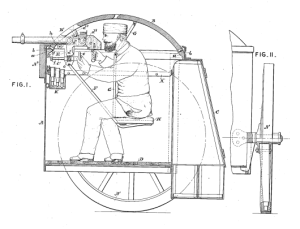
The patent for the Fahrbare Panzerlafette für leichte Geschütze (in English: movable armor carriage for light guns) was originally filed in Germany in 1880, although the patent would be approved until 1885 (1887 in the United States), by inventor Hermann Gruson. The Fahrpanzer (which is what it was quickly abbreviated to) was essentially a light artillery gun carriage. Gruson created a kind of “semi-mobile” (to use modern terminology) pillbox that could be quickly transported around the battlefield by a team of horses (like the other varieties of field artillery of the time), to strengthen local defenses.
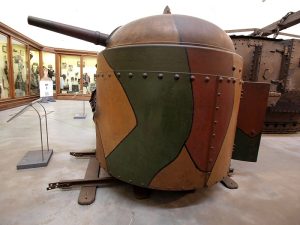
Fahrpanzer at the Royal Military History Museum, Brussels, Belgium, 2010. Public Domain.
Gruson’s design was essentially an armored pillbox, with a rotating turret, accessed by a tiny armored “closet”-like box to the rear. The turret could mount either a Maxin-type machinegun, or a very lightweight 53- or 57mm cannon, also designed by Gruson, the Cannone da 57/25 Gruson.
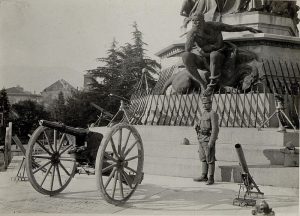
An Italian Cannone da 57/25 Gruson captured by Austrian forces. May, 1916. Public Domain.
Gruson’s turret design was unique, in that rather than relying on a central column to support the weight of the turret, the Fahrpanzer’s turret rested on the upper portion of the inside of the turret, transferring its weight to the upper portion of the cylindrical casing via a set of roller bearings, which was rotated through a full 360° using a hand-crank wheel at the gunner’s station creating, in effect, a modern turret. This had the side effect of freeing up space on the floor of the fighting compartment to fix a rubber roller (made specifically of “Indian Rubber”, according to Gruson’s recommendation) in place to stabilize and cushion the 53- or 57mm gun’s mount, whose trunnions were placed behind the center of gravity of the mount. The gun, as well as the turret, could be adjusted internally by a hand-crank, but could also be elevated similarly, allowing for limited elevation of about –5° to +10°.
If the turret had any defect, it was that the turret was made of cast iron. The resulting brittle nature of the metal left the Fahrpanzer with acceptable protection against rifle fire, but a hit from any kind of artillery would rip through the turret like paper. However, on the plus side, the system’s design offered only a very small opening for the cannon and its sight, significantly reducing the danger of infantry fire to the crew.
The gun itself, while an admitted lightweight, was no slouch: with a maximum range of c.5,500 meters it could drop a shell loaded with over 600 grams of black powder; that is not a charge a person would want to be next to. The gun was fast, quick and simple to move around the battlefield, and did very good work on its own, mostly throughout Europe and Russia, but also managing to find a home in the Chilean Navy.
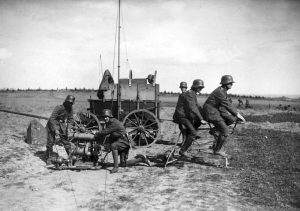
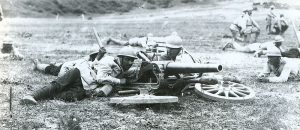
Gruson 53 mm gun installed on a Romanian-built gun carriage, being prepared to fire by a Romanian army team at Lunca Dochiei in June, 1917. Public Domain.
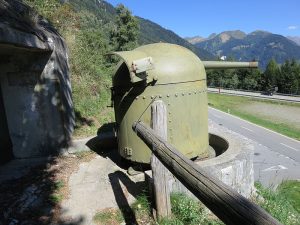
With about two thousand units ultimately being produced, Gruson’s mobile turret lasted in military service throughout the world, from the 1890’s to well after World War 1, finding use on early armored cars, as well as being fitted into permanent positions guarding critical points. Those turrets were hidden in small caves dug into mountainsides, in positions that offered a clear field of fire when the pint-sized turrets were run out for action, in a manner not dissimilar to the cannons of a warship of the Age of Sail.
Fahrpanzer in a mountain revetment, overlooking a highway, Forte Airolo, Airolo TI, Switzerland. Photo credit: Paebi. CCA/3.0
Ultimately, technological evolution passed the Fahrpanzer by. Later self-propelled vehicles would effectively duplicate the turret, to make the first real tanks; more effective models supplanted its gun; and finally, its armor – while cheap and effective for the 1880’s and 1890’s – was virtually worthless by 1914. While a few units survive in places, mostly in Greece and Bulgaria, most have long ago been either destroyed, sold for scrap, or rotted away on forgotten battlefields…
…But – you never know: someone might just decide to build a modernized version, because it’s not as hard a thing to do as one might suspect.
The Freedomist — Keeping Watch, So You Don’t Have To
“…While economics is a gun, politics is knowing when to pull the trigger…” – Caspian Report
In April of 2022, Imran Khan – the highly popular, 70-year old former international cricket player who had risen to the leadership of Pakistan, a state with one of the largest Muslim populations in the world, on a broadly “Populist” style platform – was removed from office as Prime Minister by a no-confidence vote, the first time such an action had happened in Pakistan’s history.
The no-confidence vote that led to Khan’s removal, on its own, had shady origins, and potential foreign interference. On March 27, 2022, following the first attempt at a no-confidence vote in Parliament had been dismissed, Khan pointedly accused the Biden Administration of interference in Pakistan’s internal affairs, in an affair now known as “Lettergate”, in which Khan stated publicly that he had received a letter via a diplomatic cable from Pakistan’s embassy in the United States, that he claimed threatened “horrific consequences” for Pakistan, if Khan was not removed as Prime Minister; Khan’s government reacted to the cable with a strongly-worded demarche. Khan was blocked from releasing the actual details of the cable in question by Pakistan’s Official Secrets Act of 1923, but stated that he was prepared to show the diplomatic cable to the Chief Justice of Pakistan.
For its part, the Biden Administration – reeling from the disastrous withdrawal from Afghanistan in August of 2021 – was clearly smarting from its demonstrated weaknesses at all levels of governance, and needed to do something to reinvigorate its failing image. Much like the so-called “Maidan Revolution” of 2014, the removal of Khan from power immediately began to decouple Pakistan from the PRC’s orbit, and threatens the Communist nation’s “Belt & Road Initiative”.
Major General Chris Donahue, commander of the U.S. Army 82nd Airborne Division, XVIII Airborne Corps, boards a C-17 cargo plane at the Hamid Karzai International Airport in Kabul, Afghanistan, 29 August 2021, becoming the last US soldier to leave Afghanistan. Photo by Jack Holt, US Central Command. Public Domain.
But – for the average American…so what? Why should American’s care about all of this maneuvering in a foreign country many American’s know or care very much about?
The reason the average American needs to pay attention is that the political crisis sparked in Pakistan by Khan’s removal has erupted again, with disastrous results.
Khan – who refused to go away quietly, leading protests in an attempt to hold a special election that would likely return him to power if it were held – appeared at the Islamabad High Court on 9 May 2023 to address corruption charges. After voluntarily appearing at the court, and while being processed, the courthouse was stormed by a unit of the Pakistan Rangers, a Federal paramilitary police force operating under orders from the National Accountability Bureau, who bizarrely arrested Khan, dragging him out of the courthouse, to an undisclosed location.
In the aftermath of this, large and violent protests and rioting erupted across the nation, with angry mobs attempting to storm both regional military headquarters, as well as the local headquarters of the ISI, the Pakistani version of the CIA. Despite calls for direct military force to be used to suppress the rioting, a wide array of military commanders in the nation refused, point-blank, to apply such force. This has led to an alarmingly confusing situation, including the removal of some military commanders.
This has raised alarming concerns as to who is actually in charge of Pakistan’s armed forces, as the raid to arrest Khan seems to have come at the orders of the Chief of Army Staff, General Asim Munir, with the support of Prime Minister Sharif. (The position of “Chief of Army Staff” is the Pakistani equivalent to the US Army’s “Chief of Staff” position.)
…But, again – why should this matter to Americans?
Simple: Pakistan is not Iraq; nor is it Sudan, Bolivia or Myanmar. Pakistan is different, because Pakistan is a nuclear-armed nation…a nation that shares a land border with another nuclear-armed state, with whom it has already fought several wars. And, although relations had begun to improve while Khan was in office, those have noticeably cooled since his replacement.
Pakistan has had a shaky internal situation for decades, and beginning in 2004, the internal situation deteriorated into an actual insurgency by multiple groups, some focused on religion, like the “Pakistani Taliban”, al-Qaeda and ISIL, but also inflaming and rejuvenating supporters of an independent Balochistan.
With the sudden deterioration of the situation in a nation of nearly 248 million people, some 96.5% of whom are Muslim, the world is now facing the distinct possibility of a multi-sided civil war in a nuclear-armed state, that could lead to the reality of nuclear terrorism, potentially including actual nuclear war, something long believed to have been buried, as many of the factions now swirling in Pakistan would have no issue with loosing nuclear fire onto India, if they were to secure nuclear weapons, which would naturally provoke an immediate response.
While no “smoking gun” evidence has been released that shows conclusive interference by the Biden Administration in Pakistan’s internal affairs, the possibility cannot be dismissed. The Biden Administration has demonstrated absolutely irrational and even self-destructive behavior since assuming power in the United States…and the results of those irrational and self-destructive behaviors are now coming home to roost.
If you’re not worried – you need to catch up.
The Freedomist — Keeping Watch, So You Don’t Have To
For over 75 years, the United States has been at war. American cities have been destroyed, entire states overrun, American citizens forced to live under the heel of a foreign occupier, U.S. brigades and divisions destroyed wholesale by an implacable enemy. It would not be until the mid-1980’s that the tide began to turn against the foe…the dreaded Circle Trigon State.
The preceding is real. It happened, and continues to happen – and you, the Reader, likely never knew anything about it…Because, while it was real, it was only “sort of” real.
In 1946, in the aftermath of World War Two, a board of general officers – those who had commanded forces of all types, in all theaters around the globe, during the largest war in recorded history – was “convened” (although, in reality, most of the generals were surveyed by mail), and asked what they thought had been done right, and what had been done poorly, prior to the war…Resoundingly, on the “bad” side, the generals called for more realistic training.
Prior to the war (c.1940-1941), “training” – especially for the infantry – had consisted of lining troops up on opposite sides, handing one side blue armbands and the other red armbands, and having the units go at each other in a glorified game of “capture the flag,” as adjudicated by umpires who wandered the training ranges, making largely arbitrary calls on who had been “killed” or “wounded”, and which side had “won.” Both sides used doctrines and tactics straight out of the same training manuals of the service – mostly based on First World War tactics – with only a sprinkling of speculation about how things like tanks would be used on the battlefield. Little thought was put in on how potential opponents fought, nor what attitudes, tactics and doctrines they might have used, despite detailed battlefield reports from military observers working out of U.S. embassies around the world.
As a result, US forces – and their commanders – generally performed terribly in the opening stages of the war. In fact, it would not be a stretch to suggest that U.S. forces would have been better off without the extensive – and expensive – field training, beyond the most basic of “entry-level” tactical training.
One of the most important measures adopted to correct this abysmal training gap, at least by the US Army at first, was a breathtakingly radical idea, and idea that has metamorphosed and grown into a detailed regimen that now extends well beyond the military sphere:
This was not like the thinly veiled names for potentially hostile nations that had been used for the famous color-coded war plans for the thirty-odd years preceding WW2. This was wholly different: the U.S. Army applied the same principles used by writers of popular fiction, to write what was essentially an “alternate history” of Europe at the end of WW2, a Europe that was partially reunited by a fictional Fascist political group. The scenario drew inspiration from the example of post-World War One Germany and the bodies of wandering troops known as the Freikorps, which had battled Communists across Germany in the chaotic aftermath of that war.
Freikorps in Berlin around 1919. Major a. D. F. W. Deiß. Public Domain.
In this scenario, the United States, Great Britain and the Soviet Union failed to establish positive control over the battered remnants of Europe and abandoned most of their heavy weapons and equipment on the continent in a rush to repatriate their troops home, to get them back into civilian industries. (The details of why this happened were not explored; it was simply assumed, in order to create the setting.)
Into this tumultuous morass, surviving Fascist leaders in various countries reunited in Franco’s Spain, and created a multinational movement, called the “Circle Trigon Party” (PDF link) – modeled on the lines of various fascist parties from the 1930’s and 40’s – that quickly incorporated the bulk of the wandering and leaderless troops in this alternate Western European setting, and welded them into a new force. These forces promptly seized the heavy equipment and weapons left behind by the withdrawing Allies and began planning a preemptive assault on the United States, as the new state’s leaders saw the U.S. as was the most dangerous enemy they would face in the short term.
This scenario – never thought of before, on anything like this scale – was implemented by designating certain special training units to various Army posts around the country and using surplus equipment and uniforms, dyed black, to form units of the “Aggressor Army” to train units locally, on-base. The uniforms themselves, while distinctly different from U.S. uniforms, also included a slate of awards and decorations, while the rank insignias were entirely American in origin, but were either turned upside down, or pinned on in non-U.S. arrangements.
Aggressor Force officers in the field. Yakima, WA, 1963. US Army photo.
But neither were these units organized along regular U.S. Army lines. Instead, an “Aggressor Army Command” (YouTube link) was created in a building at Fort Riley, Kansas, that developed tactics and doctrines unique to this mythical force…tactics and doctrines that were not shared with the actual U.S. Army units who would face this curious opponent. The units were issued a variety of training tools, including inflatable tanks, trucks and artillery pieces; similar tools were used in Europe during the preparations for the D-Day invasion of Normandy. Additionally, standard psychological warfare techniques were used against U.S. troops by the Aggressor forces – leaflet drops by aircraft, Jeeps with loudspeakers to broadcast propaganda, and even radio broadcasts.
But it didn’t stop there.
At this “Aggressor Army” headquarters at Fort Riley, KS, extensive records were maintained of thousands of wholly fictional officers and troops, in a format similar to U.S. personnel summary cards. These personas were “assigned” to various training units, and troops were issued identification cards in these names and ranks; if “captured” during an exercise, these were the ID’s the “enemy” forces would hand over.
Even more remarkably, the Aggressor state, according to its back-story, had adopted the “constructed language” of Esperanto – and the troops were at least partly trained in its use. The reason for this was two-fold: captured troops would do their best to only answer questions in Esperanto, forcing intelligence units to attempt various forms of interpreting, and that all radio transmissions between Aggressor units were in Esperanto, forcing radio interception teams to also attempt to interpret the signals.
As the various exercises at posts were carried out during the late 1940’s and into the 1950’s, the Aggressor Headquarters in Fort Riley kept a careful score of when operations happened where and when, and what the outcome was…And, while U.S. forces didn’t always lose, they lost enough times, that the nation could frequently be presented as being in dire peril. One stark example demonstrated for American citizens was 1952’s Operation Longhorn (YouTube link), in which the town of Lampasas, TX and its civilian population were “captured” by Aggressor forces, and the citizens were given a very mild demonstration of what European civilians had faced under Nazi occupation ten years before.
The aim of the Aggressor force and the Circle Trigons was to train U.S. forces for large-scale combat against a foe who used very different tactics, and who saw the battlefield in a completely different light than U.S. commanders. Little thought was placed into “guerrilla warfare,” which has never really been given a stable place within the training cycles of United States troops. Oddities such as the “Pentomic Army” aside, the Aggressor Nation concept performed remarkably well…
But, the concept is not gone, by any means.
During the post-WW2 period, a polite fiction was maintained, in that the Circle Trigons were constructed as a Fascist, Nazi, German-like group…but everyone involved knew that they were actually training to fight the Soviet Union and its allies, exactly as anyone who knew of the color-coded war plans knew that “War Plan Red” (YouTube link) was code for war with England, or that “War Plan Orange” was about war with Imperial Japan.
Beginning in 1979, with the opening of the National Training Center (NTC) in the California desert, the U.S. military revamped its concept of the “aggressor” training tool, renaming it “OPFOR” (“OPposing FORce”), and creating multiple nations – versus a single state – with not simply a Soviet influence, but with Western and Third World influences as well.
OPFOR Shirt and Shoulder Boards used to add realism during exercises, 2010. US Army photo.
The U.S. Army reactivated the 6th Battalion, 31st Infantry (“The Polar Bears“) from the 7th Infantry Division based at Fort Ord, California, and the 1st Battalion, 73rd Armor, redesignating the two units as the 177th Armored Brigade (Separate), to form the Center’s primary training unit. While maintaining their regular U.S. Army organization and training standards at one level, the 177th also “fought visiting” Army units by organizing and training itself to model a standard Soviet Motorized Rifle regiment (the fictional 32nd Guards Motorized Rifle Regiment, known jokingly as “the best armored regiment in the Soviet Army”). After the 9/11 Attacks, the brigade transitioned to training for counterinsurgency warfare training (along with a similar unit at Fort Polk, Louisiana) for units headed to Iraq and Afghanistan…And now, following Vladimir Putin’s Russia reminding the world that large-scale warfare is not, in fact, a thing of the past, the Center has switched back to training for major-scale warfare against a “near-peer” opponent.
An Operation-force Surrogate Vehicle (OSV) Representing a Soviet BMP at Fort Irwin, California (National Training Center), 2012. Photo credit: Mrkoww CCA/3.0
This model has worked so well as a training tool, both the U.S. Marine Corps (PDF link) and U.S. Air Force created similar training units of their own. So far, the U.S. Navy seems to be the only holdout.
U.S. Soldiers of the 1st Bn, 4th Infantry Regiment dressed in OPFOR uniforms, Hohenfels, Germany, July 2, 2013. US Army photo (SGT Caleb Barrieau).
For the casual reader, much of the background information and training materials are available online for free, courtesy of the U.S. Army, via its ODIN website, part of the Training & Doctrine Command (TRADOC), where you can explore the challenges of fictional nations like Atropia, or Olvana. (For an alternate wargame setting, based in a fictional Latin American country – once used by Great Britain as a wargame exercise – see the MapSymbs website.)
While notionally interesting, the foregoing history of recent developments in military training is something that people need to know. The gaming environment is not all about cartoon ‘first-person shooters’, played by bored kids in their parents’ basements. Wargaming simulations have been, and continue to be, one of the most valuable pieces in the training toolbox.
And this Marine doffs his cover to the Army, for getting that right.
The Freedomist — Keeping Watch, So You Don’t Have To
Back FREEDOM for only $4.95/month and help the Freedomist to fight the ongoing war on liberty and defeat the establishment's SHILL press!!
Are you enjoying our content? Help support our mission to reach every American with a message of freedom through virtue, liberty, and independence! Support our team of dedicated freedom builders for as little as $4.95/month! Back the Freedomist now! Click here