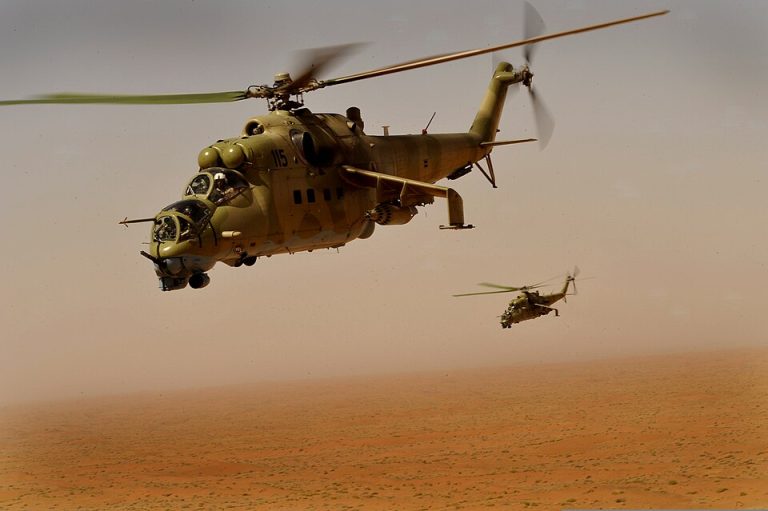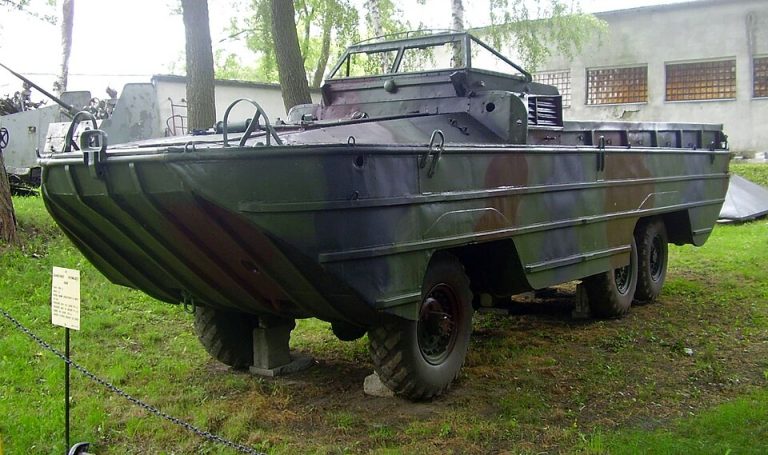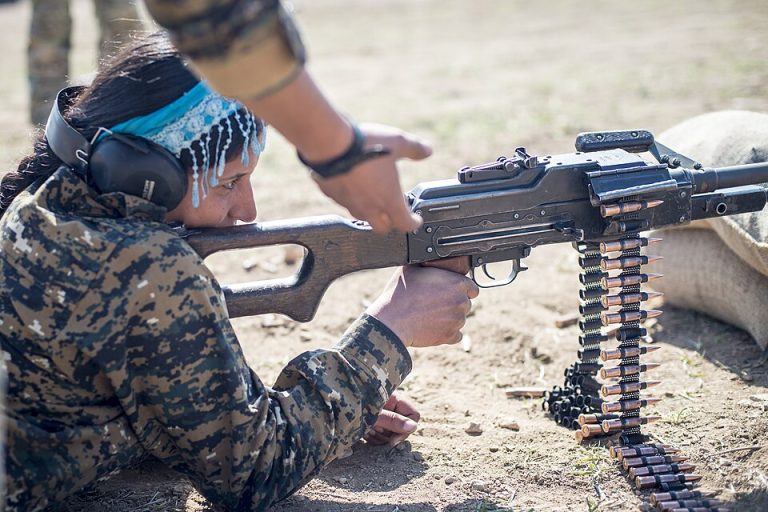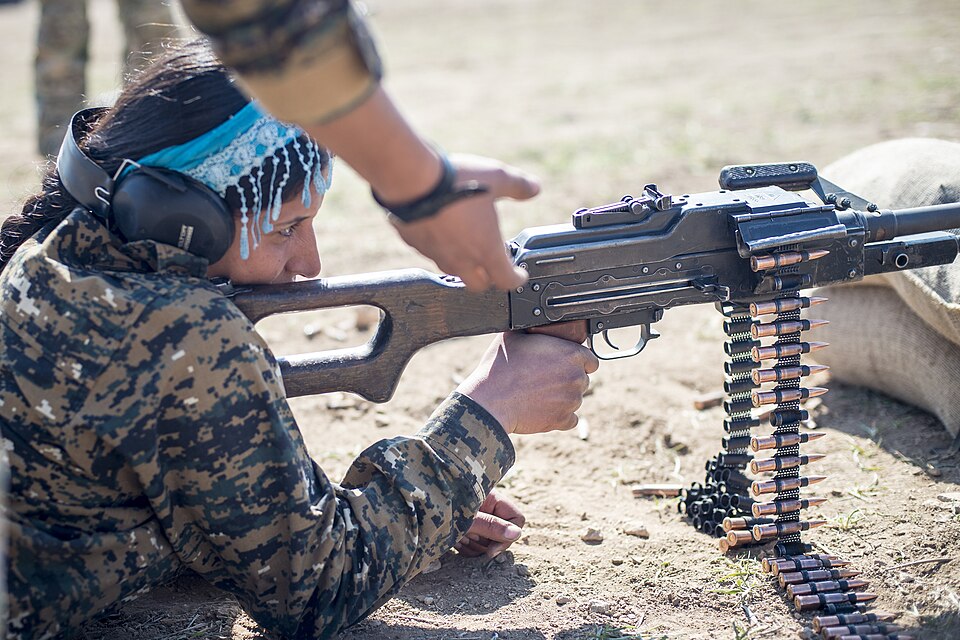

In any photograph of a militia checkpoint, a jihadist position, Russian or Ukrainian units, or a poorly equipped army’s infantry line anywhere between West Africa and Central Asia, two weapons appear with the kind of regularity that intelligence analysts use to draw supply-chain conclusions: an AK-pattern assault rifle and a PKM general-purpose machine gun. While the AK-type weapons get all the cultural attention, the PKM is the more operationally significant data point — because a force carrying PKMs has sustained automatic fire to 800 meters, which the AK cannot provide, and the combination tells an analyst specific things about who built the unit and where their training came from. With more than a million produced since 1961, the PKM has become so thoroughly embedded in the world’s conflict zone inventories that its presence is less a supply-chain indicator than a baseline assumption. The question on any battlefield where it appears is no longer how it got there. The question is what variant you are looking at and what it is mounted on.
The Second Kalashnikov
The PK — Pulemyot Kalashnikova, or, “Kalashnikov’s Machine Gun” — was not a natural follow-on to the AK-47. It was a separate design competition, run in the 1950’s, for a general-purpose machine gun (or “GPMG”, for short) to replace several aging Soviet weapons with a single family. The Soviet Main Artillery Directorate (or “GRAU”) issued the requirement in 1955: a belt-fed weapon chambered for the standard Russian rifle cartridge of the time, capable of functioning as a bipod-mounted squad automatic weapon, a tripod-mounted company machine gun, and a vehicle coaxial gun — all from the same basic action, with maximum parts commonality. The challenge was to design a weapon reliable enough and simple enough to cover all three roles in combat conditions ranging from Arctic cold to desert sand to tropical humidity.
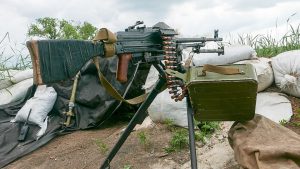
Kalashnikov won the competition in 1961 over a design by Grigory Nikitin and Yuri Sokolov, partly on reliability grounds and partly on the strength of a design approach that used proven elements from multiple sources. The bolt carrier and rotating bolt came from the Kalashnikov rifle action — well-tested, tolerant of fouling, straightforward to maintain. The feed mechanism was adapted from the Goryunov SG-43 medium machine gun, a mid-World War 2 wartime design that Kalashnikov had spent time analyzing. The operating mechanism was, in the characteristic Kalashnikov manner, derived from those elements and then simplified: the AK action was effectively inverted to allow belt feed from the top of the receiver rather than magazine insertion from the bottom.
The original PK was lightened and refined into the PKM (Pulemyot Kalashnikova Modernizirovannyi) in 1969. The modernization reduced weight through stamped rather than milled components and improved ergonomics. The PKM, at approximately 7.5 kilograms unloaded, became the standard. It is this version — or a licensed copy of it — that appears in virtually every Soviet-influenced military inventory on earth.
The Cartridge and its Feeding
The PKM’s caliber is the first data point any analyst notes: 7.62×54mmR], the rimmed rifle cartridge introduced with the Mosin-Nagant in 1891. At the time the PK was designed, this cartridge was already seventy years old. The Soviets chose it anyway, because the choice was not about the cartridge’s age — it was about what the cartridge was already in. The 7.62×54mmR was the standard round for the Dragunov SVD sniper rifle, for aircraft machine guns, and for the older SG-43 the PK was replacing. One cartridge across the squad, the sniper position, the vehicle coaxial mount, and the aircraft door gun is a logistics argument that overrides almost any ballistic preference.
The rimmed case created a design problem. A rimmed cartridge — one where the cartridge head is wider than the case body — cannot be pushed directly forward from a belt into the chamber the way a semi-rimless NATO round can. The PKM uses a two-stage feed mechanism, adapted from the Goryunov’s design, that first pulls the round backward out of the belt link and drops it into the feed way, before the bolt strips it forward into the chamber. This means the weapon must be cocked after the belt is placed on the feed tray — an extra step required because the first round is not yet in the feed way until the charging handle moves the mechanism.
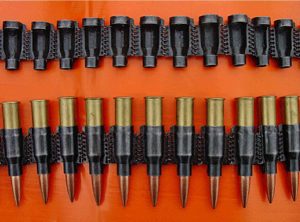
The belt itself is non-disintegrating: each link is a closed metal loop that retains the round, and the belt is recovered intact after firing. Western general-purpose machine guns — the American M-60, its replacement the M-240, and the Belgian FN MAG from which the M-240 derives — all use disintegrating M13 links that separate from the round as it feeds and are most often discarded with each shot. The distinction is more than mechanical. Disintegrating links are simpler to manage during firing but are one-use: each ammunition resupply requires new links loaded with new rounds. Non-disintegrating links must be managed during firing — the expended belt exits the weapon and must be managed — but they are reusable, reducing the sustained-operation logistics requirement for a force that cannot rely on regular resupply. In the kind of conflict where PKM’s appear most often, that tradeoff heavily favors the PKM.
The M-240 outweighs the PKM by approximately five kilograms/eleven pounds, fires the NATO 7.62×51mm semi-rimless cartridge through a direct feed mechanism derived from an inverted Browning Automatic Rifle action, and is the better fire-support weapon in a fully resourced Western infantry battalion. In an under-resourced force fighting a sustained irregular campaign a thousand kilometers from its nearest supply depot, the PKM’s lighter weight, simpler logistics, and reusable belt are the more relevant specifications.
One Family, Every Role
What distinguishes the PK series from most machine gun designs is the breadth of its role coverage from a single basic action. The PKS and PKMS are the same PKM weapon mounted on a tripod, providing a medium machine gun capability. The PKT is a modified PK with a longer, heavier barrel, a solenoid electric trigger, and no stock — designed for coaxial installation in armored vehicles, where it replaced the SGMT Goryunov as the standard tank and IFV secondary armament. The PKT became the coaxial gun in the T-54/T-55, T-62, T-64, T-72, T-80, T-90, BMP-1, BMP-2, and wheeled BTR armored vehicles — which is to say, in virtually the entire armored vehicle inventory of the Soviet Union and Warsaw Pact. Every country that received Soviet armor received, in the same shipment, the PKT as the vehicle’s secondary (or primary) weapon. There is no separate procurement decision, no separate training pipeline:
The PKT comes with the vehicle.
This is the mechanism of the PKM’s global proliferation that goes unmentioned in most discussions of the weapon. AK rifles spread through direct military aid, arms sales, and licensed manufacture. PKT’s spread through the armor itself — attached, permanently, to every T-55 sold to Egypt, every BMP-1 supplied to Syria, every BTR-60 that went to any Soviet client army from the 1960’s onward. The foot-infantry PKM follows the armor. By the time a Soviet-equipped army has equipped its infantry, its vehicle crews, and its tripod-mounted support positions, the 7.62×54mmR cartridge and the PK family’s operating system are woven through every level of the force structure.

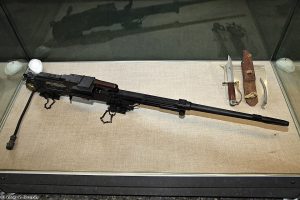
Licensed production extended the reach further. Yugoslavia produced the Zastava M-84 and M-86 (the M-84’s coaxial version); Serbian weapons derived from that production line have since shown up in Sahel jihadist inventory, primarily acquired through looting defeated government forces. China produced the Type 80 and Type 86. Bulgaria, Romania, and Poland all manufactured variants. Post-Cold War dispersal did the rest: dissolved armies, coup-stripped armories, and battlefield capture moved the weapons from state inventories into non-state hands in volumes that no export control framework was designed to address.
What This Tells You
Conflict Armament Research documented in 2025 that at least twenty percent of the weapons held by Salafi jihadist groups in Mali, Niger, and Burkina Faso had been seized directly from the regular armies of eight North and West African countries. The AK variants are the most numerous – the PKM’s are the most tactically consequential, because they provide the sustained suppressive fire that turns a checkpoint or an ambush position into something that an enemy has to plan around rather than simply push through.
The PKM’s presence on a Sahel battlefield in 2025 traces a line through at least three to five previous owners: a Soviet export batch, a government military armory, a combat loss, the black market, and/or a jihadist weapons dump. What it does not represent, in most cases, is a fresh arms pipeline from Moscow or anywhere else. Conflict Armament Research found no evidence of systematic, long-range supply chains to Sahel jihadist groups. The weapons are already there because they have always been there — because when the Soviet Union armed the armies of the developing world between 1960 and 1991, it armed them comprehensively, with a weapon family designed from the start to cover every role from the infantryman’s bipod to the tank commander’s coaxial mount.
Mikhail Kalashnikov designed the PKM to be universal. He succeeded beyond any reasonable projection. The weapon that the Soviet Army adopted to simplify its own logistics has, sixty-five years later, simplified the logistics of every irregular force on earth that inherited a Soviet-pattern inventory — which is most of them.
The PK-series is the world’s most common general-purpose machine gun — not because it is the best, but because it is everywhere, and because being everywhere is a different kind of best.