In 1968, the Soviet defense ministry signed a directive no Western air force had been willing to issue: build a battlefield helicopter that could suppress a landing zone with rockets and cannon and then deliver the assault troops it had been carrying throughout. The Americans, whose combat helicopter experience in Vietnam was producing the two-airframe model — the AH-1 Cobra providing fire support while the UH-1 Huey delivered infantry — had concluded that the two roles required two aircraft.
The Soviets concluded that two aircraft meant two maintenance chains, two logistics trains, and one irreducible vulnerability: the moment when the gunship and the transport arrive over the same landing zone at different times. Mil designer Mikhail Mil had proposed the concept years earlier and spent years winning over a skeptical ministry. His answer — designated V-24 during development, accepted into Soviet service in 1972 as the Mil Mi-24, and given the NATO reporting name “Hind” — has been in continuous combat somewhere on earth ever since. More than fifty nations have operated it. No Western air force ever built anything like it.
The Mi-24’s coexistence alongside the Mi-8 and Mi-17 transport fleet is not a contradiction of its design philosophy — it is a confirmation of it. The Soviet model was never “one airframe does everything alone.” It was “one airframe that can do both when the situation demands it, without waiting for the second aircraft to arrive.” In practice, Mi-24s escorted Mi-8s on assault missions; the difference from the Western model is that the Hind could reverse that relationship instantly — suppressing and then delivering — when the tactical situation required it and no transport was available.
The Hind
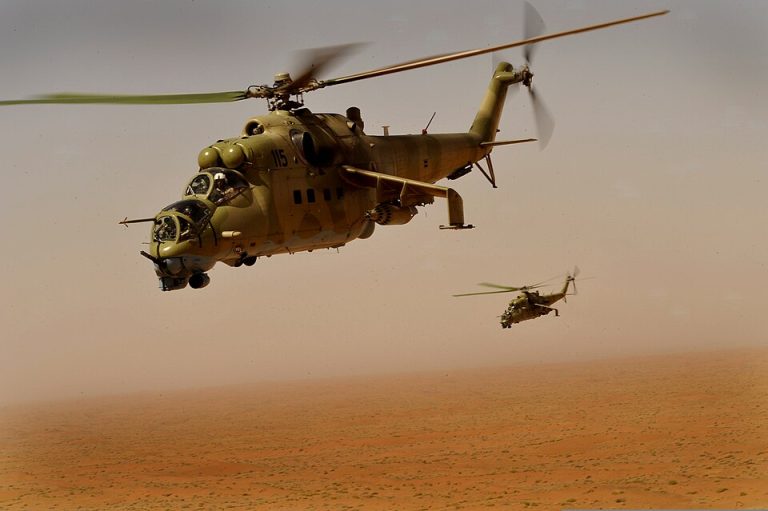
The only helicopter ever built to suppress a landing zone and carry the assault troops into it in the same airframe, the Mi-24’s prototype first flew on September 19, 1969, and from the first, the design reflected its dual mission. Behind the crew cockpit sits a fully enclosed cabin capable of carrying eight combat-equipped soldiers — so a single aircraft can suppress a landing zone with rockets and cannon and then land and deliver the infantry to the same patch of ground the fire just cleared. Its stubby wings carry anti-tank guided missiles, rocket pods, bombs and/or gun pods on six hardpoints.
The definitive version, the Mi-24D (Hind-D), introduced the tandem double-bubble cockpit that became the type’s visual signature: weapons operator in the lower forward bubble, pilot raised behind, both wrapped in armored glass, sitting inside cockpit bulkheads made of titanium armor (in contrast, the AH-64 Apache only uses Kevlar for armor). A four-barrel 12.7mm Gatling gun occupies the nose turret on the D; the Mi-24P (Hind-F) replaced the turret with a fixed, twin-barrel 30mm cannon. The entire fuselage is armored to resist 12.7mm rounds from all angles, and the titanium rotor blades were designed to take a direct hit from the same caliber without failing. Soviet crews called it the ‘Krokodil‘ — the Crocodile — partly for the reptilian camouflage of early variants and partly for the long armored snout of the tandem-cockpit nose.

The combination came at a cost. The Mi-24 is heavier and less maneuverable than a dedicated attack helicopter; the troop cabin adds weight and bulk whether or not it is occupied. Mil accepted these tradeoffs. His assessment was that an army fighting across a continent cut by rivers, forests, and defended ridge-lines needed an airframe that could deliver fire and infantry to the same point without requiring a second aircraft to be coordinated, fueled, and timed. The West has never accepted that tradeoff. The AH-64 Apache carries no troops. The UH-60 Black Hawk carries troops but no meaningful offensive armament – and if it fitted with real weapons, it, too, carries few/no troops. The Mi-24 carries both simultaneously (although the troop capacity turned out to be more useful for special operations units than actual air assault), and has for more than half a century.

Mujaheddin Teaching Points
The Mi-24’s first combat use came in 1977, when Ethiopian forces — with Soviet pilots flying the aircraft under Ethiopian markings — used it in the combined-arms counteroffensive that expelled Somali forces from the Ogaden by early 1978. The helicopter proved decisive in that fight. Two years later, the Soviet invasion of Afghanistan put more than a thousand Mi-24s into the world’s most demanding rotary combat environment, and the lessons have shaped every subsequent conversation about the type.
Early in the Afghan war, the Hind was nearly invulnerable to available Mujaheddin weapons. Its armor absorbed small-arms fire; RPG hits that would have destroyed lighter aircraft often failed to bring down the Hind. Soviet pilots ran roadrunner missions escorting convoys through the mountain passes, and hunter-killer sweeps in pairs across the valleys, attacking at speed and breaking away in tight turns. The Mujaheddin called the Mi-24 “Shaitan-Arba” — “Satan’s Chariot” — and learned to scatter the instant Soviet target-designation flares appeared overhead.

Afghanistan also revealed the tension written into the design from the start. Combat experience quickly demonstrated the practical difficulties of using a maneuvering gunship as a simultaneous troop carrier. Soviet doctrine migrated toward using Mi-24’s as dedicated gunships, with Mi-8 and Mi-17 transports carrying assault elements under Hind escort — the very two-aircraft model Mil’s design had been built to replace. In practice, the assault helicopter had become a gunship with a passenger cabin only used by tiny special forces teams.
That migration proved situational. In 1985, the CIA introduced the FIM-92 Stinger into the Mujaheddin supply chain through Pakistan, and the calculus shifted again. The Stinger’s range forced Soviet helicopter crews to fly higher and slower, where conventional ground fire could reach them. Soviet engineers added flare dispensers in 1987, but the lesson was already written: the Mi-24 was effectively immune to everything the Mujaheddin had until the United States specifically armed them to kill it.

The Flying Tank Goes to the Sahel
The Mi-24 has taken part in more than thirty conflicts since the Ogaden, exported as the Mi-25 and Mi-35 to Soviet client states and, after 1991, to any government with the currency to buy surplus stock. The current production variant — the Mi-35M, with fixed undercarriage, shortened stub wings, and updated night-attack sensors — represents Russia’s continued investment in the family and its continued relevance to the export market that matters most to Moscow right now: the Sahel.

Beginning in 2021, Russia delivered Mi-35Ms to Mali, eventually equipping the Malian Air Force with eleven aircraft. Russian African Corps personnel — the reconstituted successor organization to Wagner PMC — have operated them alongside Malian crews. In July 2024, Tuareg rebels at Tinzawaten shot down a Malian Mi-24 and an Mi-8, with a Russian crew aboard the downed Hind. The loss reportedly reduced Mali’s functional attack helicopter fleet to ten airframes; a subsequent rebel seizure of an abandoned Mi-24P brought the operational count lower still. The aircraft that Mikhail Mil designed in 1968 to escort Soviet assault forces across a European river was meeting the same end it had in the Hindu Kush: engaged from the ground by a lightly armed irregular force that had, or would acquire, the means to make it pay for flying low.
The Question Still Open
The Western doctrinal answer to the helicopter combat problem has been consistent for sixty years: separate the roles. A dedicated attack platform for fire support; a separate transport for troops. It is a correct answer to the resources available to a force that can afford two fleets.
The Mi-24 was built for forces that could not. In the Sahel, where eleven Mi-35Ms represent the entirety of a country’s attack aviation and there is no second fleet of transports waiting to fill the gap, Mikhail Mil’s tradeoff still makes operational sense. The troop cabin may spend a conflict empty, occupied only when the arithmetic of available aircraft makes it necessary. But the aircraft that can do both is worth more to that force than the aircraft that can do only one — and the flying tank, fifty-five years after its first flight, is still the flying tank.
Mikhail Mil asked the question in 1968. The Mujaheddin answered it in 1985. The Malian Air Force is still living with it now, and the answer is still flying.