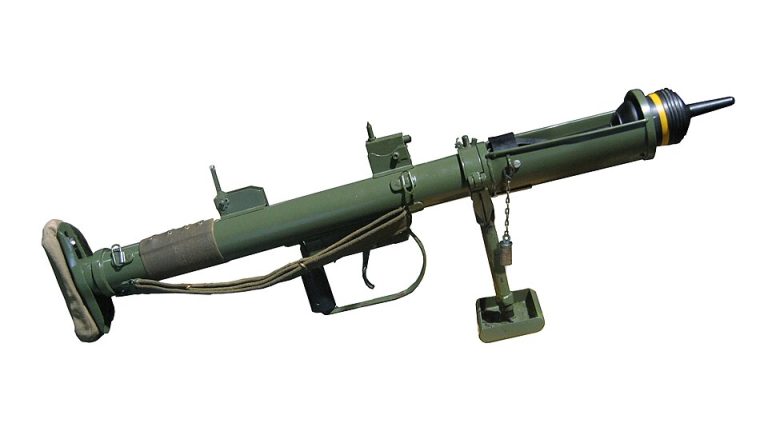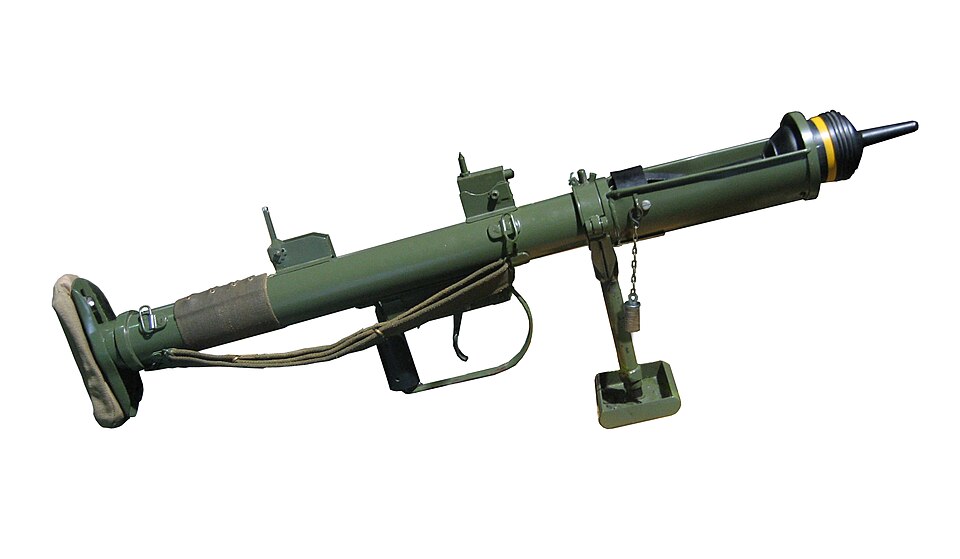

On the night of 21 October 1944, Private Ernest “Smokey” Smith of the Seaforth Highlanders of Canada crouched in a ditch on the bank of the Savio River in northern Italy, nine metres from a German Panther tank. He raised a PIAT — a weapon that weighed 32 pounds, fired a shaped charge bomb using an enormous internal spring, and had no propellant backblast to betray his position — and destroyed the tank with a single shot. When a second tank arrived to eliminate him, he damaged it with another round. Smith survived. He received the Victoria Cross. The PIAT, which entered service in 1943 and was replaced by the bazooka family of rocket launchers by the early 1950s, earned six Victoria Crosses in total during the Second World War — more than any other individual infantry weapon of the conflict. It was, by any reasonable measure, a successful weapon. It was also a very unusual one, built on a mechanical principle that conventional firearms engineers find counter-intuitive, and whose core advantages were never fully exploited before the weapon was retired. Those advantages are worth a second look.
The Toyshop Weapon
The PIAT — or, Projector, Infantry, Anti Tank — was conceived in the top-secret British weapons development organization – informally known as “Churchill’s Toyshop” – alongside other improvised innovations including the sticky bomb, the limpet mine, and the time-pencil fuse. Its lineage traces to the Blacker Bombard, a spigot mortar devised by Lieutenant Colonel Stewart Blacker for the Home Guard, which was refined by Major Millis Jefferis into a shoulder-fired infantry weapon. The result was unusual enough that its operating principle is still commonly misunderstood.
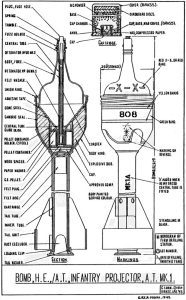
The PIAT was not a rocket launcher, and not a conventional gun. It was a spigot mortar — a weapon in which the effective “barrel” is formed by the hollow tail of the projectile itself rather than a fixed tube. When the soldier pulled the trigger, a heavy spring drove a metal rod — the spigot — into the bomb’s hollow tail resting in the weapon’s cradle. The spigot’s firing pin struck a propellant cartridge in the bomb’s tail, which launched the bomb forward while simultaneously driving the spigot rearward, compressing the spring and recocking the weapon for the next shot. The spring’s primary job was not to launch the bomb but to absorb and manage the recoil of the propellant firing — a distinction that matters for understanding both the weapon’s advantages and its limitations.
As produced, the PIAT weighed 32 pounds, was 39 inches long, and fired a 2.5-pound shaped charge bomb capable of penetrating armor up to 100mm thick — enough to defeat any German tank of the mid-war period from the sides or rear. Its effective anti-tank range was approximately 100 yards in direct fire. It could also be used as an indirect mortar, with a range out to approximately 350 yards, by bracing the stock against the ground — a secondary application that Commonwealth troops in Italy employed regularly, though never as an officially sanctioned role.
What It Did
The PIAT’s combat debut came with Canadian troops during the Allied invasion of Sicily in July 1943, and it subsequently appeared in every theater where Commonwealth forces fought — North Africa, Italy, northwest Europe, and the Far East. In Normandy in 1944, a British study found that PIAT launchers accounted for seven percent of German tanks destroyed by British forces during the campaign — one percent more than rocket-firing aircraft. Company Sergeant-Major Stanley Hollis used a PIAT on D-Day itself to destroy German pillboxes and a field gun, earning the only Victoria Cross awarded for actions on June 6, 1944. At Arnhem, Major Robert Henry Cain — also awarded the Victoria Cross — used a PIAT to drive off German armor on multiple occasions over six days, at one point turning back three tanks on consecutive days when ammunition was nearly exhausted.
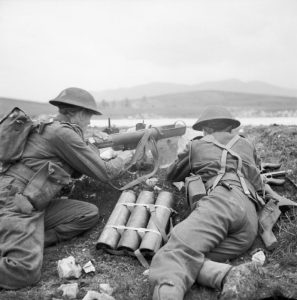
The weapon’s key tactical advantage across all of these actions was the same characteristic that made it unusual as a design: it produced no backblast and no muzzle flash. A bazooka or a Panzerfaust vents propellant gases rearward at firing, generating a visible flash and a pressure wave that prevents use from enclosed spaces and announces the firer’s position as clearly as a signal flare. The PIAT, firing by spring-driven spigot with the propellant charge contained entirely within the bomb’s tail, produced neither. It could be fired from inside a building, from a foxhole, or from against a wall without the backblast signature that made rocket launchers a liability in close terrain. The PIAT remained in service through the Korean War before being supplanted by the recoilless rifle and rocket launcher families that dominated postwar infantry anti-armor thinking.
The Operating Principle Revisited
The PIAT was retired mainly because its range was inadequate for evolving postwar armor, its cocking mechanism was notoriously difficult to use under combat stress, and its bomb was too small for the frontal armor of tank generations that followed World War 2. These are real limitations…but none of them are inherent to the spigot mortar principle itself — they are limitations of the 1942 engineering that created it, with the minimum-quality materials and manufacturing tolerances available to wartime Britain. The question worth asking in 2026 is what the same operating principle looks like when rebuilt with eight decades of advances in materials science, propellant chemistry, and projectile design.
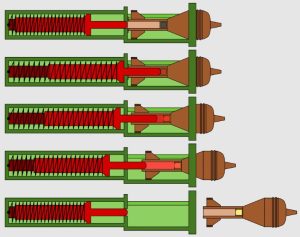
The core advantages of the spigot system remain exactly what they were in 1944: no backblast, no muzzle flash, and dramatically reduced recoil compared to a conventional propellant-fired weapon of equivalent caliber. A conventional 60mm mortar — the lightest standard indirect fire weapon in most infantry inventories — weighs between 6.8 and 15.8 kilograms depending on configuration and requires a base plate to absorb the firing impulse ramming the bottom of the tube into the ground. An 81mm mortar system runs to approximately 35-40 kilograms including tube, bipod, and base plate — equipment that requires multiple soldiers to carry, a prepared firing position to set up before firing, and generates a firing signature audible and visible at significant distances. The PIAT’s spring-managed recoil system, if scaled and modernized, sidesteps the base plate requirement entirely: the spring absorbs the impulse within the weapon itself, transmitting minimal force to the mounting — whether that mounting is a soldier’s shoulder, a vehicle bed, or a simple tripod.
The Range Problem And Its Solution
The PIAT’s 100-yard direct-fire ceiling was what really ended its service life. Modern engineering offers a clear path past it: rocket-assisted projectiles, in which the round ignites a sustainer motor after leaving the weapon, extending range by maintaining velocity through a ballistic arc that gravity would otherwise cut short. The principle is already proven in conventional artillery — the U.S. Army’s XM1113 rocket-assisted 155mm projectile extends engagement range from roughly 24 kilometers to beyond 40 kilometers in a standard weapon system, and rocket-assisted rounds are a standard ammunition category for 120mm mortar systems. Applying the same principle to a modernized spigot-launched projectile is not a speculative leap. It is an established technology applied to an unusual, but proven, launch platform.

The combined effect of the spigot launch system and a rocket-assisted projectile addresses every tactical limitation the original PIAT carried into service. Range extends from the original 100-yard ceiling to potentially several kilometers depending on the sustainer motor specification and projectile weight. Patent-documented lightweight rocket-boosted launcher concepts have demonstrated that a 25-pound, man-portable system can achieve the same range effectiveness as a 115-pound 81mm mortar system, with round weights approximately half those of equivalent mortar ammunition. The firing signature advantages — no muzzle flash, no backblast, and a substantially reduced sound report compared to a conventional propellant charge venting to atmosphere — are preserved throughout, because the launch impulse is managed by the spring mechanism rather than an open propellant charge.
Why This Matters Now
The tactical environment that makes these characteristics valuable is not hypothetical. Ukraine’s war has demonstrated repeatedly that mortar crews operating conventional 60mm and 82mm systems are located and targeted within minutes of their first firing — the muzzle blast and sound signature are sufficient for drone-assisted counter-battery to fix the position and respond. The same dynamic applies to vehicle-mounted weapons in the irregular warfare contexts that have defined conflict from Mali to Myanmar: a firing signature that announces its position is a liability that light vehicles cannot survive long enough to overcome.
A modernized spigot mortar — far lighter than a conventional mortar of equivalent caliber, mountable without a base plate, firing rocket-assisted rounds to ranges that make it relevant at company and platoon level, and doing all of it without the backblast or muzzle flash that locate conventional weapons — addresses a genuine gap in the current indirect fire menu. The PIAT’s designers in 1942 were solving a specific problem: getting a shaped charge close enough to a Panther to defeat it, without the backblast signature that would have killed the soldier using it. The tactical problems of 2026 are different in their details. The operating principle that solved the 1942 version has not changed.
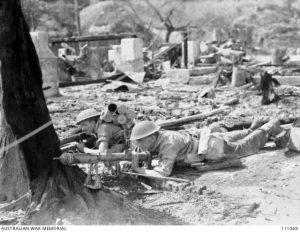
Whether any current defense manufacturer is pursuing development along these lines is not a matter of public record. What the PIAT’s combat record demonstrates is that the spigot principle is not an experimental curiosity — it is a proven approach to delivering explosive projectiles without conventional firing signatures, validated in six Victoria Cross actions across three years of the most demanding infantry combat in history. The engineering to update it exists. The tactical requirement for it is present and growing. The gap between those two facts is the only thing standing between a forgotten 1943 weapon and a relevant 2026 one.