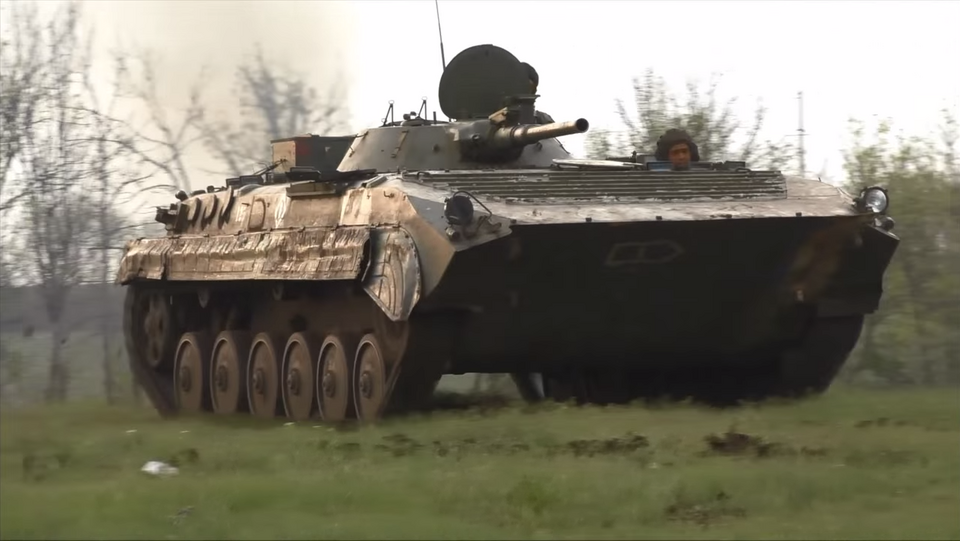

On the morning of November 7, 1967, Western military attachés watching the annual Revolution Day parade roll across Red Square got their first look at something that had no equivalent in any NATO inventory. It was low, fast, amphibious, and bristling with weapons that no armored personnel carrier had any business carrying — a 73mm main gun and a rail-mounted anti-tank guided missile capable of killing a main battle tank at 3,000 meters. NATO scrambled to assign it a reporting name, settling on M-1967, because no one yet knew what the Soviets called it. What they called it was the BMP-1 — Boyevaya Mashina Pekhoty, or “fighting vehicle of the infantry”, in English — and its appearance in that parade triggered a reappraisal of mechanized warfare doctrine across the entire Western alliance that is still unfolding today.
A New Category Of Weapon
To understand why the BMP-1 caused the reaction it did, it is necessary to understand what came before it. The armored personnel carrier of the mid-1960s — the American M113, the Soviet BTR-60, and the British FV432 — was essentially a “battlefield taxi”. Its job was to move infantry to the edge of a fight, at which point the soldiers dismounted and the vehicle pulled back. The APC carried a machine gun for self-defense. It was armored against small arms and shell fragments. It was not expected to fight alongside tanks; it was expected to survive long enough to deliver its cargo and withdraw.
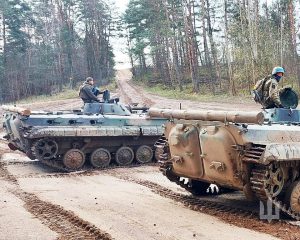
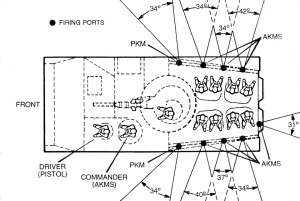
The BMP-1 discarded that entire concept. It was designed from the outset as a fighting vehicle in its own right — a platform from which infantry could engage the enemy without dismounting, and which could itself engage tanks, bunkers, aircraft, and infantry through its own organic weapons. Every infantryman in the troop compartment had a firing port and a vision block. The vehicle carried an NBC over-pressure system allowing it to operate in a contaminated environment — a direct product of Soviet doctrine that treated tactical nuclear weapons as a normal feature of any future European war. The BMP-1 was not designed for the wars the West had been fighting. It was designed for the war Soviet planners expected to fight: a high-speed armored offensive across a nuclear-contaminated Central Europe, with infantry and tanks advancing together under the same protective shell.
In theory.
When Western analysts instantly grasped what they were looking at, the reaction was acute. There was no NATO equivalent. Only West Germany had been moving in a remotely similar direction with early development work that would eventually become the Marder, and even that was years from fielding. The consensus in 1967 was that the Soviet Union had stolen a significant doctrinal zone, and the Western responses — the M2 Bradley, the Marder, the British Warrior — would take fifteen years to reach the field. Overnight, the BMP-1 had created an entirely new category of weapon: the Infantry Fighting Vehicle, and it had created it alone.
The Gap Between Theory And Practice
The BMP-1’s combat debut came in the 1973 Yom Kippur War, where Egyptian and Syrian forces used it against Israeli armor. The results were sobering for Soviet doctrine. The 73mm 2A28 Grom gun proved inaccurate beyond 500 meters — less than a third of its theoretical effective range. The AT-3 Sagger anti-tank missile, mounted on a launch rail above the gun, could not be effectively guided from inside the cramped turret, requiring the operator to expose himself to do so. The vehicle’s aluminum-reinforced steel armor proved vulnerable to .50 caliber machine gun fire in the sides and rear, and to 106mm recoilless rifle rounds all around. In the heat of the Sinai, crews kept roof hatches open for ventilation, exposing them to fire from elevated positions. Soviet technical teams deployed to Syria in the war’s aftermath to gather data, and what they gathered was not encouraging.
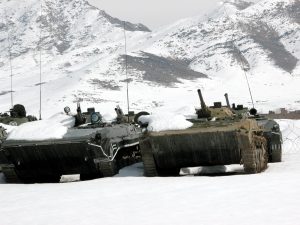
Afghanistan confirmed and extended those findings. Soviet BMP-1s operating in the mountainous terrain of the Hindu Kush encountered an enemy that understood their vulnerabilities precisely. Mujahideen fighters armed with RPG-7’s penetrated BMP-1 armor in approximately 95% of hits, frequently igniting the ammunition stored within the fighting compartment. Soviet soldiers — the people the vehicle was designed to protect — responded by riding on the outside of the hull rather than inside it, a damning commentary on the gap between the vehicle’s theoretical protection and its actual survivability. The BMP-1’s front-left seating arrangement, which placed the driver and commander in tandem alongside the engine, meant that a single mine blast or RPG hit could kill both simultaneously.
BMP-2 AND BMP-3: The Lessons Applied
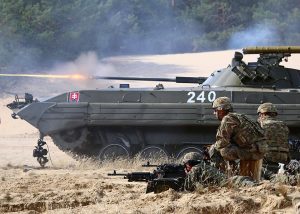
Soviet engineers had begun drawing conclusions from the Yom Kippur data before Afghanistan confirmed them. Work on a successor vehicle began in 1974, and the BMP-2 entered service in 1980, reaching Afghanistan in time to serve alongside its predecessor. The changes were pointed. The Grom’s 73mm low-pressure gun was replaced by a 30mm 2A42 autocannon capable of engaging both infantry and light armor with high accuracy at ranges the original gun could never reliably achieve. The Sagger missile was replaced by the AT-4 Spigot and later the AT-5 Spandrel, with the launcher repositioned for better usability. The turret was redesigned to improve commander visibility. The gun’s elevation arc was extended sharply upward — a direct response to Afghan mountain fighting — allowing it to engage targets on high ground that the BMP-1 could not reach. The BMP-2 became and remains the most widely produced variant of the family, the backbone of Soviet and then Russian motorized rifle formations through the Cold War’s end and beyond.

The BMP-3, which entered limited Soviet service in 1987, represented a more radical departure. Rather than the graduated improvements of the BMP-2, the BMP-3 introduced an entirely new weapon package: a 100mm 2A70 gun capable of firing both conventional ammunition and laser-guided anti-tank missiles, combined with a coaxial 30mm 2A72 autocannon and three 7.62mm machine guns. The combination made it one of the most heavily armed infantry fighting vehicles in the world by firepower, though at a cost in complexity and production expense that limited its numbers. Russia entered the 2022 invasion of Ukraine with an estimated 400 to 750 active BMP-3s — a fraction of its BMP-2 holdings — supplemented by vehicles drawn from storage.
The Ukraine Reckoning
The BMP series has paid a severe price in Ukraine. By mid-2024, open-source tracking by Oryx had documented over 500 visually confirmed BMP-3 losses alone — a figure representing the destruction or capture of potentially the entire pre-war active fleet, with losses continuing to mount through 2025. BMP-1s and BMP-2s, operated by both sides, have been destroyed in numbers too large to track precisely. The vulnerability pattern is familiar: thin side and roof armor, ammunition in the fighting compartment, and no meaningful protection against the FPV drones that have become the dominant anti-vehicle weapon in the theater.
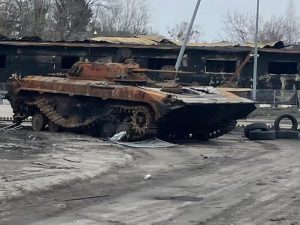
Russia’s response has been production and adaptation rather than replacement. Rostec confirmed a shipment of upgraded BMP-3s to the Russian Ministry of Defense in January 2026, claiming production running 40% above plan at 463 vehicles per year, with new builds incorporating ERA, improved belly protection against mines, electronic warfare systems, and upper-hemisphere armor responding directly to drone threats. A further development, the BMP-3M ‘Manul’, has been explicitly framed as a response to the US-supplied M2A2 Bradley and German Marder 1A3 IFVs fielded by Ukrainian forces — the same Western vehicles the BMP-1’s 1967 appearance first drove NATO to develop.
The wheel has come full circle in an ironic way. The vehicle that shocked NATO into creating the infantry fighting vehicle concept is now being redesigned to compete with the vehicles that NATO built in response to it. The BMP’s core idea — that infantry and armor should fight together rather than separately, that the carrier should itself be a weapons platform rather than a taxi — has proven more durable than any specific iteration of the vehicle embodying it. What changes with each generation is the answer to the same question the Soviet designers at the Chelyabinsk Tractor Plant were wrestling with in the early 1960s: how much protection is enough, and against what?