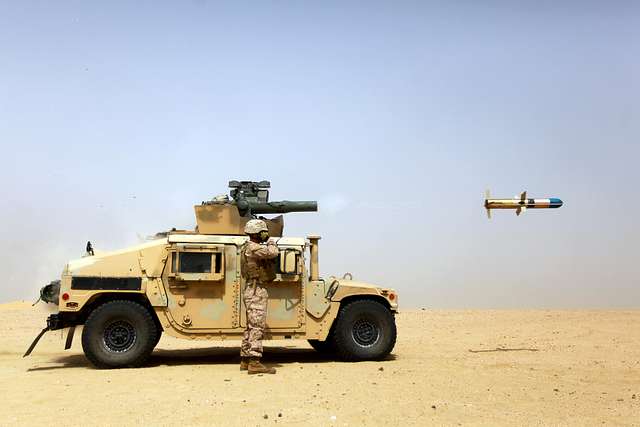

On the morning of May 2, 1972, Chief Warrant Officer Carroll Lain made history without fully realizing it. Flying a UH-1B Huey over the Central Highlands of South Vietnam, he fired an experimental anti-tank missile at a North Vietnamese tank during the Easter Offensive and hit it. The weapon was the BGM-71 TOW — Tube-launched, Optically tracked, Wire-guided — pulled from storage barely three weeks earlier and rushed to the battlefield by a three-plane airlift. That first shot destroyed a captured American-built M41 tank. By the end of the day, four tanks, a truck, and an artillery piece were wrecked. The TOW had arrived. It has not left since.
More than 700,000 BGM-71s have been produced in the fifty-five years since that morning, making it one of the most proliferated anti-tank guided missiles in history. It has been fired in anger from Vietnam to the Bekaa Valley, from the deserts of Iraq to the rubble of Syrian cities, and most recently across the steppes of Ukraine. No American anti-tank weapon has a longer unbroken combat record. That longevity is not accidental — it reflects a design architecture flexible enough to absorb five decades of warhead, guidance, and platform upgrades without requiring a fundamentally new missile — and it raises an uncomfortable question about whether a system conceived to kill Soviet armor in the Fulda Gap remains adequate for the battlefield that has emerged in the 2020s.
The Design Logic To Kill Tanks
Hughes Aircraft began development in 1963 in response to a US Army requirement for a heavy anti-tank guided weapon capable of defeating the Soviet armor then entering service. The design brief was demanding: the missile had to be effective from both ground mounts and helicopters, had to defeat contemporary Soviet tank armor at ranges out to 3,000 meters, and had to be accurate enough that a single gunner with a sight could guide it without specialized training in manual joystick control. The answer was SACLOS — semi-automatic command to line of sight — guidance. The gunner keeps the crosshairs on the target; the missile’s flight computer does the rest, reading the position of an infrared flare on the missile’s tail and transmitting corrections down the wire that spools out behind it in flight. Full-scale production began in 1968; the US Army fielded the system in 1970.
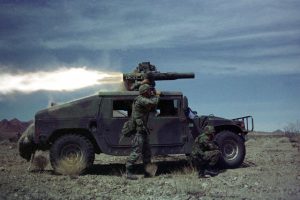
The wire itself is both the system’s defining characteristic and its principal tactical limitation. At its quoted maximum range of 3,750 meters, a TOW is in flight for roughly twelve seconds — twelve seconds during which the gunner must remain stationary, eye to sight, tracking the target while the missile guides itself toward it. In a suppressed or obscured environment, those twelve seconds are an eternity. The wire can be cut by terrain obstacles. The guidance link can be disrupted by smoke, dust, or electronic countermeasures. The launcher is a crew-served weapon weighing over 90 kilograms fully assembled, not something a single soldier moves quickly. These were known constraints from the beginning. The Army accepted them in exchange for a system that could reliably kill tanks at ranges beyond the effective reach of most direct-fire weapons available to infantry.
For the Marine Corps, the problem of the wire-guidance carries special problems. A TOW missile being fired over salt water – or even plain water – can cause a serious loss of control, potentially shorting out the guidance wires completely. Modern versions of the TOW have tried to correct this by ditching wire-guidance entirely in favor of wireless systems, but with only limited success to date.
Variants And The Arms Race With Soviet Armor
What distinguishes the TOW’s half-century run is the relentless pace at which its warhead evolved in direct response to Soviet armor improvements. The original BGM-71A delivered a simple shaped-charge warhead capable of penetrating around 430mm of rolled homogeneous armor (RHA) — sufficient for defeating the T-54 and early T-62. By 1981, the BGM-71C Improved TOW introduced a telescoping nose probe that detonated the warhead at standoff distance for optimum shaped-charge performance, pushing penetration toward 700mm of rolled homogenous armor. When the Soviet Union fielded explosive reactive armor on its tanks in the mid-1980s, the response was the BGM-71E TOW-2A in 1987, which added a small precursor charge in the nose probe to detonate the ERA block before the main warhead arrived.
The most conceptually significant variant came in 1992 with the BGM-71F TOW-2B. Rather than attacking a tank frontally — where armor is thickest — the 2B flies over the target at a preset height above the gunner’s line of sight, then fires two downward-aimed explosively formed penetrators through the thinner top armor of the turret when sensors detect the tank beneath it. The dual-mode fuze uses both a laser altimeter and a magnetic sensor to confirm the target. It is, in effect, a solution to the T-72’s carousel problem arrived at from a different angle than the Javelin‘s: instead of a steep plunging attack, the 2B attacks horizontally but shoots downward. The TOW-2B Aero extended the system’s range to 4,500 meters. A wireless radio-guided variant eliminated some of the wire constraint for platforms where wire deployment is impractical, but not in all cases.
The Modern Combat Record: From Desert Storm To Syria
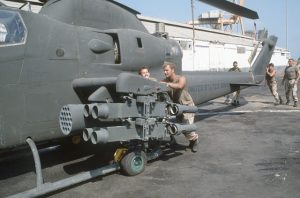
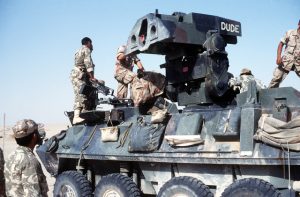
Operation Desert Storm in 1991 was the TOW’s largest conventional combat deployment. Thousands of missiles and hundreds of launchers were fielded across the 82nd Airborne, 101st Airborne, and 24th Mechanized Division, mounted on HMMWV’s, M113 APC’s, LAV-TUA (TOW Under Armor), Bradley Fighting Vehicles, and AH-1 Cobra attack helicopters. Against Iraqi armor — largely T-55s and T-72s caught in the open desert without combined-arms support — the TOW performed precisely as designed.

Syria provided a different kind of test. Beginning around 2013, opposition groups supplied with TOW missiles through the CIA’s Timber Sycamore program used them extensively against the Assad regime’s armor in complex urban and semi-urban terrain. The results were filmed and posted widely, providing an open-source library of TOW engagements against T-55s, T-72s, and BMP infantry fighting vehicles in conditions far more demanding than open desert. The system’s performance under those conditions — engagements through rubble, across built-up areas, in the kind of cluttered visual environment that degrades optical tracking — validated that a trained two-man crew could operate it effectively even where the geometry was unfavorable. According to analysts tracking the conflict, probable thousands of Assad’s armored vehicles and fortified positions were struck by TOW missiles over the course of the civil war.
In Ukraine, TOW missiles arrived as part of US security assistance packages in 2023 and again in December 2024, mounted primarily on Bradley IFVs already in Ukrainian service. The Bradley-TOW combination proved effective against Russian armor in the same conditions that have degraded every other armored system in the theater: FPV drone surveillance, mined terrain, and the absence of reliable air cover. The wire-guidance limitation becomes less significant when the system is vehicle-mounted with a stabilized sight and the engagement range is dictated by available cover rather than the missile’s maximum reach.
The Wire’s Limits In The Drone Age
The twelve-second exposure problem that was a known constraint in 1970 looks different in 2026. On a battlefield saturated with FPV drones capable of striking a static position within seconds of detection, a crew operating a tripod-mounted TOW launcher is vulnerable in ways that the original design brief never contemplated. The system’s requirement for the gunner to remain stationary and exposed throughout the flight time is a survival liability that vehicle mounting partially mitigates, but does not eliminate. Wire-cutting by terrain obstacles remains a failure mode, though it is manageable in trained hands.
Raytheon, which acquired Hughes in 1997 and has manufactured TOW missiles ever since, has stated its production line can produce up to 10,000 missiles annually and has active contracts with the US Army for fiscal years 2023 and 2024 valued at hundreds of millions of dollars. The US military has designated the TOW as remaining in service through at least the mid-2030s. Over 40 allied nations operate it. That institutional momentum is substantial — the logistics chain, the training base, the platform integration across dozens of vehicle types — and it represents a form of staying power that purely technical analysis tends to underweight.
The TOW is not the most capable anti-tank missile available in 2026. The Javelin’s fire-and-forget capability and top-attack profile represent a genuine generational advance, and the proliferation of loitering munitions has created new options for armor defeat that do not require a gunner to hold a sight on a target for twelve seconds. What the TOW retains is exactly what it has always offered: good range, a proven warhead capable of defeating any tank currently in service in its TOW-2B configuration, a platform-agnostic launcher compatible with vehicles and helicopters from three dozen countries, and a production base that can be scaled up. Carroll Lain’s first shot in 1972 was a proof of concept. Half a century of continuous upgrades turned that proof of concept into one of the most durable weapons systems the United States has ever fielded.