
Last week, we covered a “Might Have Been” military firearm, that was strangled in its crib as a sacrifice to the political gods. This week, we will extent that, and look briefly at some very bad decisions made by people who should have known better.
In the grim calculus of military history, few questions are more haunting than “what if they’d had just one more year?” For interwar Poland, caught between a resurgent Germany and Stalin’s brutal Soviet Union, that question carries particular weight. Between 1935 and 1939, Polish arms designers produced two weapons that demonstrated genuine innovation and quality: the wz.38M semi-automatic rifle and the Vis 35 pistol. The first never reached beyond test-model production numbers before the September 1939 invasion. The other was so well-designed that German conquerers of Poland immediately put it into mass production for their own forces’ use.
Together, these weapons tell the story of a nation racing against time — and losing.
The Maroszek Rifle: Innovation Without Enough Time
The wz.38M represents one of military history’s more frustrating might-have-been’s. Designed by Józef Maroszek — the same engineer behind Poland’s successful wz.35 anti-tank rifle — the infantry rifle emerged from Polish Army trials begun in 1934 seeking a semi-automatic replacement for the nation’s standard wz.29 Mauser bolt-action rifle. The requirements were straightforward: 600mm barrel, under 4.5 kilograms weight, 10-round magazine, chambered in standard 8x57mm Mauser ammunition, and critically — cheap and simple to produce.

Nine designs competed initially. Three advanced to further testing, with Maroszek’s early prototype placing third. But in late 1935, Maroszek proposed a radical redesign. The evaluation committee gave him six weeks to rebuild the rifle from scratch — roughly the same development timeline as the Sten gun…and Maroszek delivered.
The redesigned wz.38M was genuinely innovative. Its tilting-bolt locking system combined elements of the Czech ZB vz. 26 light machine gun with the Petter-Browning pistol‘s locking mechanism — the bolt tilted up into a recess in the receiver top rather than rotating. The gas system featured an adjustable regulator with three numbered settings, though the incremental differences were so minute they likely represented fine – tuning for specific ammunition lots rather than accommodation of different cartridge types. Most impressively, the rifle broke down into large, discrete assemblies with almost no small parts to lose — a single pin held the entire trigger group, which dropped out cleanly.
Contemporary accounts suggest the wz.38M was remarkably refined for a prototype. Field stripping was simpler, by far, than the M1 Garand; the sight system used familiar Mauser-pattern components; and it even incorporated a simple muzzle brake — very unusual for individual military rifles of the era. The magazine was fixed and not removable, fed via stripper clips like the Mauser and most other bolt-action rifles, but the rifle locked open on empty and closed when the trigger was pulled after reloading — a feature some designers considered elegant, others awkward.

By 1937, five prototypes underwent testing. In 1938, fifty-five rifles (serial numbers 1001-1055) were manufactured at the Zbrojownia 2 arsenal in Warsaw for troop trials, scheduled for delivery by January 1, 1939. They were delivered, and testing began. The paper trail ends there. Eight months later, German and Soviet forces invaded Poland, and the wz.38M’s development simply…stopped. Only five original examples are known to survive today.
The tragedy of the wx.38M is not just that Poland lost a promising rifle — it’s that the rifle demonstrated Poland possessed the industrial capacity and design expertise to field modern infantry weapons. Given another year or two for refinement and production ramp-up, Polish infantry might have entered World War II with semi-automatic rifles when most armies still carried bolt-actions.
Sadly, of course, it almost certainly would not have saved Poland, and may have actually harmed the war effort in Europe…in a manner far out of proprotion to our next bit of Polish ironmongery.
The Vis 35: The Pistol Good Enough for the Enemy
If the wz.38M represents potential strangled in its crib, the Vis 35 demonstrates what Polish weapons designers could achieve when given slightly more time.
Also known as the “Radom“, the pistol’s development began with 1927 Polish Army trials seeking a new sidearm. Initially focused on small .380 ACP pistols, the trials included submissions from FN, CZ, and others. FN brought along their then in-development Browning High Power as a demonstration piece — which didn’t meet the requirements, being too heavy — but Polish officers were impressed, nonetheless.
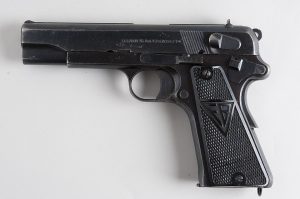
In 1929’s follow-up trials, Poland decided to adopt the High Power outright. Then the FN-manufactured wz.28 BAR contract went badly — quality issues, delivery delays, general dysfunction — souring Polish-Belgian relations and killing the High Power deal.
Poland’s solution: build it themselves.
Pistol designer Piotr Wilniewczyc filed patents in 1932 covering key features — a telescoping recoil spring guide rod, other mechanical elements — carefully sidestepping FN’s patents while legitimizing Polish domestic production of what was fundamentally a High Power derivative. The Poles don’t emphasize this lineage, but the influence is unmistakable.

The design process hit an absurd snag in 1934. The cavalry department objected to the de-cocking method: using the disassembly lever to lock the slide open, then pulling the trigger to drop the hammer safely. This was actually listed in Wilniewczyc’s patent mainly so he could charge the government more for additional patent claims, but the cavalry took it seriously and demanded a proper de-cocking lever. Under threat of derailing adoption entirely, engineers spent another year designing an elegant de-cocker that simultaneously tripped the sear *and* retracted the firing pin, preventing hammer-pin contact during the drop.
Production began in late 1936, ramping to full scale by 1939. Poland manufactured approximately 46,000 Vis 35 pistols before the invasion, beautifully finished with Polish eagles on the slides. When Germany captured the Radom factory essentially intact, they immediately recognized quality. The pistol was chambered in 9x19mm Parabellum, fit German logistics perfectly, and was arguably better-made than most German sidearms.
Germany designated it the P.35(p) — Pistole 1935, Polish origin — and produced an additional 305,000 during the occupation. By 1945, it was the third most common pistol in German service after the P08 Luger and P.38.
Polish factory workers fought back through ingenious resistance: they duplicated serial numbers, producing two pistols with identical markings daily. One passed German inspection normally; the other was smuggled to the Polish Home Army. The scheme ran until September 1942 when it was discovered. One hundred workers were arrested, fifty publicly hanged in Radom. Germany added a third, tightly-controlled Waffenamt stamp and revised procedures to prevent further theft.
The Bitter Irony
The wz.38M and Vis 35 represent opposite trajectories intersecting at the same catastrophe. The rifle demonstrated Poland’s capacity for innovation but arrived too late for meaningful production. The pistol reached full-scale manufacture but became a weapon for Poland’s conquerors. Both were casualties of timing — not technical failure, not market rejection, but simple chronology.
Had Poland been given the breathing space other nations enjoyed—even two more years — the September 1939 invasion might have faced Polish infantry equipped with semi-automatic rifles and standardized with one of the war’s finest pistols. Instead, these weapons became footnotes: the rifle that never was, and the pistol too good to abandon.
An Arsenal Squandered
The Vis 35’s postwar fate illuminates a peculiar Allied blindness, post-war. Germany, despite losing the war, understood the value of capturing and cataloging enemy weapons — the Wehrmacht’s elaborate Beutewaffe (captured weapons) designation system ensured every captured Polish, French, Soviet, and British weapon received a German nomenclature and integration into logistics chains. Captured Vis 35 pistols became P.35(p), Polish wz.29 Mausers became Gewehr 296(p), French Hotchkiss machine guns became leMG 257(f), and so on.
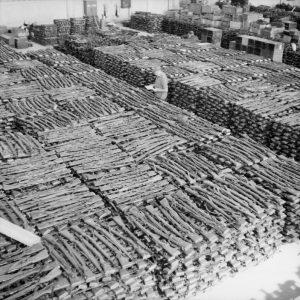
The victorious Allies, conversely, largely discarded this organizational discipline. While the USSR stockpiled captured Wehrmacht weapons systematically — MP-40s later armed Mongolia, MG-34s went to North Vietnam, 98k rifles filled Syrian arsenals into the 1960s — Western powers treated Axis equipment mostly as scrap metal. Warehouses of serviceable German weapons were crushed or dumped into the sea. Japanese Arisakas were bulldozed into Pacific landfills.
This wasn’t mere spite. It reflected industrial arrogance: why catalog enemy weapons when you could produce M1 Garands by the millions? The irony came a few years later, when Cold War allies desperately needed inexpensive small arms. Instead of issuing stockpiled Axis weapons, America sold worn-out WWII Garands to the Philippines, Guatemala, and South Korea at a loss. The Soviets, meanwhile, profited handsomely selling captured 98k’s to Egypt and Syria — weapons that cost Moscow nothing.
Very un-Capitalist behavior…Also, clearly, very short-sighted.
The failure to preserve Poland’s small WWII arsenal followed the same pattern. The fifty-five wz.38M rifles simply vanished — most likely destroyed as unidentified foreign prototypes during postwar cleanup. Had even a dozen survived in American or British repositories, the rifle’s innovative features might have influenced postwar designs. Instead, the wz.38M exists today only in fragmentary archival photographs and the fading memories of Forgotten Weapons videos.
Sometimes the cruelest questions in military history aren’t about what failed, but about what succeeded too late to matter — and what victors carelessly discarded while assuming tomorrow’s wars would never resemble yesterday’s.