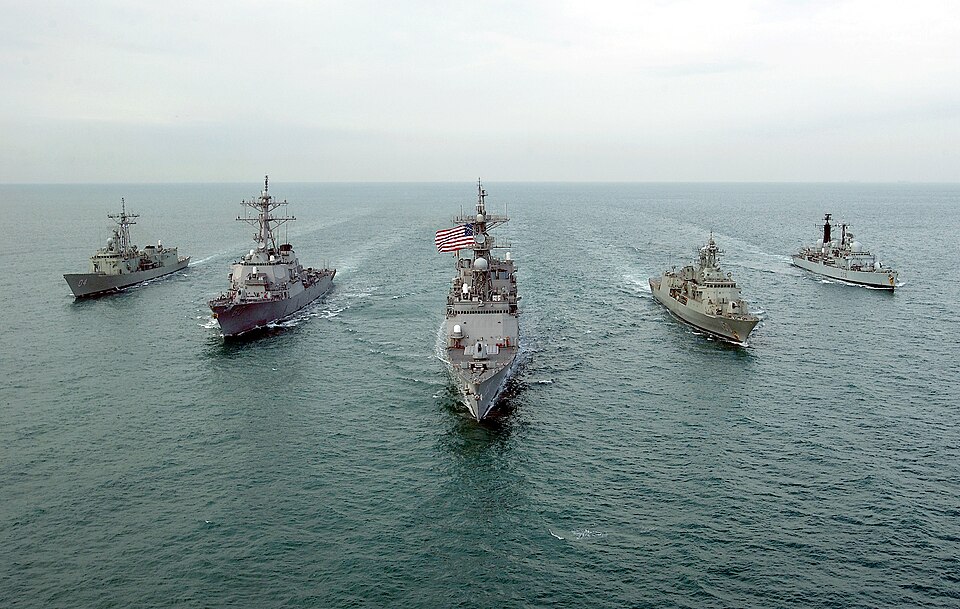

The United States relies on overseas trade. That is a fundamental underpinning of the national economy, because as wide an array of resources that North America possesses, there is not enough to satisfy our needs here. In order to ensure that type of trade, the United States has relied on a strong military naval establishment for nearly 150 years.
Navies, however, are expensive. Eye-wateringly expensive. But, spending money is better than spending lives…at least, that is the calculus of rational people, and the elected public servants in Washington, DC are rarely categorized as “rational”.
President Trump recently made headlines discussing a return to building battleships, sparking debate about naval strategy and ship types. But that conversation missed a more fundamental problem: it doesn’t matter what kinds of ships we want to build if we’ve lost the ability to build them at all. And the cold and brutal truth is that America’s shipbuilding industry — once the “arsenal of democracy“, that launched thousands of ships in World War II — has collapsed to the point where China’s shipbuilding capacity is 232 times greater than ours.
Let that sink in. Not twice as large. Not ten times. Two hundred and thirty-two times. According to leaked Office of Naval Intelligence briefing slides, Chinese shipyards have a manufacturing capacity of roughly 23.25 million tons, while U.S. shipyards manage less than 100,000 tons. One Chinese state-owned company — China State Shipbuilding Corporation — built more commercial vessels by tonnage in 2024 than the entire U.S. shipbuilding industry has produced since the end of World War II.
Josef Stalin’s supposed quip about “quantity has a quality all its own”, whether he actually said that or not, does in fact apply here.
The Numbers Don’t Lie
The Navy’s FY2025 budget tells a grim story. The fleet will shrink from 296 ships to 287 ships during the fiscal year — a net loss of nine vessels. Only six new ships will be procured while nineteen are to be retired. The fleet is projected to hit its smallest size since 1917 in 2027 at just 283 ships before beginning to grow again, and won’t exceed 300 ships until 2032 – a far cry from Ronald Reagan’s desire for a 600-ship Navy. If there is any “bright light” in this, it is that the US Army is in the same boat, figuratively speaking.
Meanwhile, Communist China’s People’s Liberation Army Navy currently operates approximately 370 warships — the largest navy in the world. The Pentagon projects China’s fleet will grow to 395 ships by 2025 and 435 ships by 2030. That’s an increase of 65 ships in just five years, while America’s fleet shrinks. (How good those Chinese ships really are, of course, is still a matter of debate.)
The Navy has a goal of reaching 381 manned ships plus 134 unmanned vessels by the early 2040s. But the Congressional Budget Office estimates achieving this will cost roughly $40 billion per year — about 46% more than historical averages, and double what Congress has actually appropriated over the past five years. The total price tag: $1 trillion. At least.
Why We Can’t Build Ships
The problem isn’t just money. America’s shipbuilding industrial base has been gutted. We currently have only four active public shipyards compared to China’s 35 major sites. The United States accounts for just 0.11% of global commercial shipbuilding. In terms of gross tonnage, China, South Korea, and Japan build over 90% of the world’s ships. America builds 0.2%.
It really does seem that there is a quiet war going on against US shipbuilding.

The Government Accountability Office recently testified that despite nearly doubling the shipbuilding budget over the past two decades, the Navy has failed to increase its fleet size as planned. Ships are consistently delivered late, over budget, and with reduced capabilities. The Navy’s new Constellation-class frigates, for example, started construction before completing ship design — violating basic shipbuilding practices — and are now expected to be at least three years late.
The Government Accountability Office (GAO) has made 90 recommendations since 2015 to improve Navy shipbuilding. The Navy has fully or partially addressed only 30. Sixty recommendations remain unaddressed.
The workforce crisis compounds the problem. Shipyards rely on decades-old physical infrastructure. Skilled workers are retiring faster than they can be replaced. Finding enough qualified workers remains the biggest barrier to expanding production, even if Congress appropriated more money tomorrow.

What This Means for War at Sea
Communist China’s shipbuilding advantage isn’t just about peacetime fleet size. In a sustained conflict—the kind of war we’d face in defending Taiwan — China could repair damaged vessels and construct replacements far faster than the United States, at least in theory. The Navy faces a significant maintenance backlog and would struggle to quickly repair battle-damaged ships, let alone build new ones.
Former Navy Secretary Carlos Del Toro told Congress in 2023 that a single Mainland Chinese shipyard had more construction capacity than the entire U.S. industry. This isn’t a matter of China having marginally better capabilities — they’ve achieved total dominance in an industry that’s fundamental to naval power.
No Quick Fixes
Trump’s “Make Shipbuilding Great Again” initiative proposes tax incentives, a Maritime Security Trust Fund, and new maritime opportunity zones. But as Senator Roger Wicker noted in a February 2025 hearing, simply pouring money into shipbuilding won’t work because the U.S. doesn’t have the industrial base to support a surge. You can’t conjure skilled welders, modern shipyards, and supply chains out of thin air.
The Navy is exploring alternatives: unmanned vessels, utilizing allied shipyards in Japan and South Korea, and smaller surface combatants. These might help, as a band-aide. But they are merely workarounds for a fundamental problem — America destroyed its shipbuilding industry through decades of deindustrialization and offshoring, and China methodically built theirs up.
So much for “guns into butter” and “plowshares into swords“.
The hard reality is that naval supremacy requires industrial capacity, and we’ve ceded that capacity to our primary strategic competitor. All the strategy papers and fleet architecture studies in the world don’t matter if we can’t actually build the ships those plans require. China understands this. We’re still figuring it out…And by the time we do, China’s 435-ship navy may already control the Western Pacific.
The one bright spot, is that Chinese ships might be the “TEMU” version of fighting ships…Hopefully.