EDITORIAL – The state of Main has passed a law that bars any state funds be used by organizations of faith to produce a service for the state, such as running a tuition program for kids of need. A Christian school had previously been given state subsidies to run a tuition program, but then was cut off from applying because they were a faith-based organization.

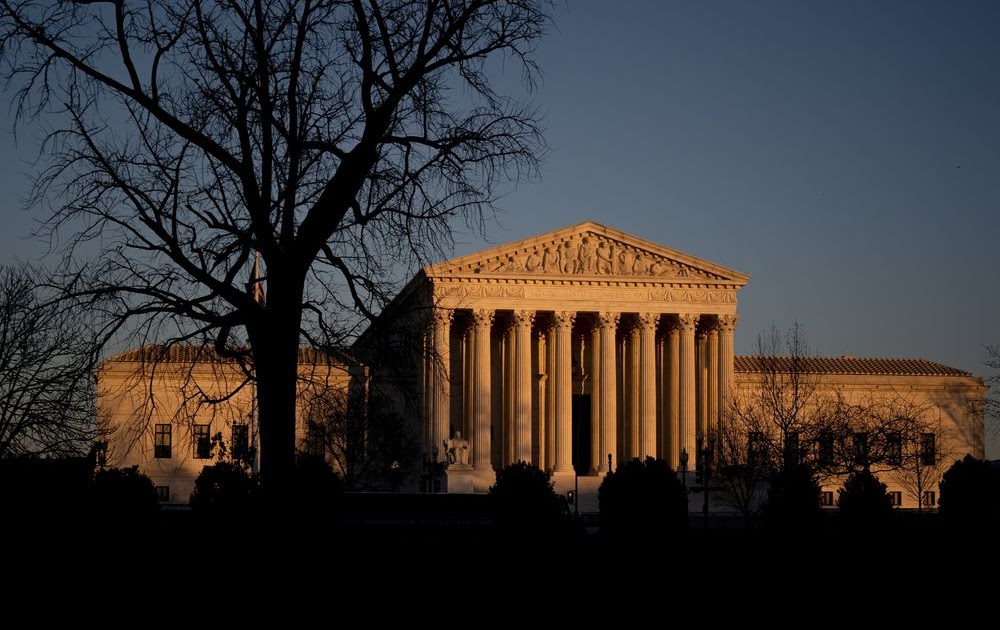
The Supreme Court will decide if the state can prevent faith groups from creating state services, which is essentially what happens when the state grants a non-government entity a grant, or a subsidy, or a no-interest loan that doesn’t have to be paid back if you meet the need the state wanted you to meet.
The question is, does the Separation of Church and State mean the state can cut off the church (any faith group, Muslim, Brahman, Zoastrian, etc) to seek state funds to provide a service to meet the needs of those who are found needing? If the answer is yes, then the separation of church and state might as well be changed to the hostility of state against the church.
As we experience the types of faiths that have no agentic presence outside of existentiality, we will come to understand (and for many, they already do understand) that ‘faith’ groups are not just about sky daddies, they’re about moral authoritrain assumptions wrapped around some narrative that makes one group the angels and the other group the demons. They’re about a lot more than that, but all ‘faith groups,’ whether they have sky daddies or not (and there is a pretty healthy mix of the two at this point), that fit into this category are the ones that are easy to produce proscription lists, lists of people who are, on a merciful day, worthy of being completely excommunicated from any way of making any type of decent living, and on a usual day, should possibly be inspired to drink a gallon of ‘kill me immediately’ poison that would kill them so bad their grand grand grand kids would also instantly die, ending their wretched heritage.
Then we might come back, if there is mercy enough to give us the grace to do so, and revisit this whole question of church and state and, perhaps, we will conclude that so long as there is a state there must be a state religion. The question is, can we build such a thing, a religion, a habit of action assumption between a people based on a narrative anyone in that group can enter into, that can reflect the diversity of the religions and non-religions that America currently represents?
I believe we can, and I believe that religion is built aroound the American narrative of an idea overcoming a human flaw, to give in to the temptation of majorityism, to use coercion to attempt to assure your conditional advantage, unearned on the main, should be protected, by any means necessary, from further competition.
We as a people, a people of the world, found ourselves by little effort on our part, the benefactors of an idea that, for a variety of practical reasons, created a significant choke on the power of the winners of the exchange of value from coalescing into ever larger spheres of influence controlled by ever smaller individials.
Our narrative recognizes the contributions of many peoples of the world with influences that range from the Koran to the Upinishads, from the Bible to the Annalects. All of the wisdom traditions of the world have found themselves in part influencing the America that we have become, and all have been given that space to cross-hybridize one another thanks to the creation of a civic space that allowed all of our fundamental differences to be non-relevent when getting down to the simple act of exchange value with one another.
Where we exchange value with one another, for whatever reason, our exchange in this space should be the same whether we are dealing with one of our own tribes or one from a tribe that our tribe detests. Whatever we feel about Dallas Cowboys fans, when they come to our stores in Philly, we serve them and treat them well.
We can exchange value even with people we hate if we honor one another’s bills of rights in all the spaces in which we exchange value with one another outside our consensually created specific fellowship associations. In other words, if we are addressing or serving the public, we are operating in civic space.
The Bill of Rights, and how they emerged, an honest look at how they emerged, not an ideal one, is a compelling story in and of itself that all of us in this nation can enter into. The way in which so many people among us were pressed by the fact that our use of slavery, our definition of human beings as being 3/5 of a person were so violently and vulgarly out of line with these bill of rights standards that, for so many others, had brought checks on state power in ways few realized at that time.
The few that understood what the Bill of Rights did to empower the weakest of us against the most majority of us, be it in numbers or resources or both, knew that so long as a land with such a power-flipping tool as the Bill of Rights continued to allow the weakest, the most vulnerable, of their land, the coerced sojourner, if you will, to be denied the Bill of Rights protections of the land, to be enslaved and defined as non-human, the power of the Bill of Rights was dying as these people died, under the same oppressive whip.
Thus America struggled to overcome its utter failure at the most crucial place in society, to assure that the weakest, the most hated, the most vilified, are afforded the same Bill of Rights protections as the most powerful, an ideal that surely is never to occur, though, if your starting point does not at least give myth to this goal, then your sense of fear of the outrage of the people you allegedly serve will be significantly reduced, and your authoritarian solutions to authoritarian problems is only sure to multiply upon itself.
It would be too much for the Supreme Court to fundamentally revisit the whole question of separation of church and state, since it is based not on the letter of the Constitution, but on the letters of Jefferson to a Church that was concerned the state would be encroaching on the church. The separation of church and state phrase itself was directed at assuaging the fears of the church that the state would impose itself on them. Jefferson was assuring them that the church was separated from such an attenpt.

Regardless, as I stated earlier, in some part, the notion that the state can exist withoout a church is simply not possible. The state must have a myth and an ethos that emerges from that myth that the vast majority of peoples it governs can enter into. The real question is not a separation of church and state, but can the state create a church without an answer to a creator or non-creator that has standards that allow humans of diverse faith and non-faith views to exchange value in open, non-coercive ways despite these fundamental differences in ‘belief’?
My assumption is you can, and the honest American story as a hard, diffuclt path, one we have yet to overcome, but are seeking to get to, building a consistent space in all our civic arrangements reflect the values expressed in our Bill of Rights, where humans are sovereigns in and of themselves insofar as they do not generally first aggress on others.
U.S. Supreme Court to hear Maine dispute over religious schools
From www.reuters.com
2021-07-02 07:00:00
Excerpt:
July 2 (Reuters) – The U.S. Supreme Court on Friday took up a challenge by two families with children attending Christian schools to a Maine tuition assistance program that bars taxpayer money from being used to pay for religious educational institutions in a case that could further narrow the separation of church and state.
The court, which has a 6-3 conservative majority, agreed to hear an appeal by the families of a lower court ruling in favor of the state that concluded that Maine’s program did not violate the U.S. Constitution’s First Amendment right to the free exercise of religion. The eventual ruling could build on other decisions by the court in recent years allowing public funds to go to religious institutions.
It was one of 10 new cases the justices added to their list of ones they will hear during the court’s next term, which starts in October. Friday’s announcement on cases was the final action in the court’s current term, which culminated in a major 6-3 ruling on ideological lines on Thursday that could make it easier for states to enact voting restrictions.