It is a general article of faith in most armed forces around the world, that the enlisted soldier – meaning, that 18 to 22 year old kid brought into the military, because war is a young person’s game – need close supervision by a college-educated officer, so that the young soldier can be kept out of trouble. But, while young adults, far from home for the first time, getting into trouble is a given despite supervision, that is not the real reason.
The real reason the establishment and their commissioned officers, is that unless the enlisted troops are closely monitored, they will invariably “go off script”. Case in point: Faustin Wirkus…
…Or, if you prefer, King Faustin II of La Gonâve, Haiti.
Born in about 1896, Faustin Wirkus was born into a Polish family in Rypin, Poland, then part of the Russian Empire. In around 1905, the family moved to the coal country in Dupont, Pennsylvania. After a few years working in the coal fields as a child, in 1915 Wirkus enlisted in the United States Marine Corps, and was soon deployed to the island of Haiti, rising to the rank of Gunnery Sergeant by 1920.
The United States had intervened in Haiti in 1915, following a wild series of uprisings that had resulted in the lynching death of the then-President Vilbrun Guillaume Sam, to – as always – “protect American interests”. The United States quickly established what amounted to a military dictatorship, administered by the US Marine Corps. Part of this administration involved recruiting a Gendarmerie that could be carefully trained as a kind of “lightweight military police”, to keep the island under control and to hunt down bandits and rebels.

Haiti, unlike today, had a very credible military reputation. After throwing off the yoke of French colonial oppression in 1804, Port-au-Prince decided to flex its muscle as the Spanish Empire began to collapse, invading and conquering the neighboring Spanish colony of Santo Domingo (the modern Dominican Republic) in 1822. Haiti’s 20-odd year rule over Santo Domingo was so brutal, that February 27 is celebrated as the day Dominicans finally overthrew Haitian rule, and gained their independence.
Following this, Haiti began its downward spiral, resulting in the collapse in 1915, that led the United States to intervene.
Following his basic training, Faustin Wikus was deployed to the island in 1915 as part of the “Advanced Base Force“, and was assigned to the “Haitian Constabulary” (the formal name for the Gendarmerie) in 1918. The Gendarmerie’s first US commander was the legendary Smedley Butler, then a Major in the Marine Corps, making it no surprise that the Gendarmerie’s all-Black Shooting Team went on to take Olympic Bronze in the Men’s Free Rifle Team event at the 1924 Paris Olympics.
Wirkus, meanwhile, apparently fell in love with Haiti, and worked hard to try and help stabilize the country. Because of how the Gendarmerie was organized, many enlisted Marines were given commissions as officers in the Constabulary, leading small units of native Gendarmes.
It was in this capacity that Wirkus eventually arrived at La Gonâve Island, in 1926. While there is some conjecture – nearly one hundred years on, hampered be scanty records – Wirkus came into contact with a woman named Ti Memenne. Recognized locally as a “tribal queen”, which was a position not recognized by the nation’s republican government, she was apparently arrested for “trivial voodoo offences“, where it seems that she came into contact with Wirkus for the first time, with him aiding in her release from custody.
When Wirkus (apparently volunteering on his own in late-June or early-July of 1926) was sent to La Gonâve to assume command of the Constabulary unit there, he had apparently made such an impression on Queen Ti Memenne, that she convined her subjects that he was the reincarnation of Faustin Soloque, the first (and last) Emperor of the Second Empire of Haiti…and then convinced them to agree that Wirkus should be crowned as King Faustin II, Co-Monarch of La Gonâve in a Voodoo ceremony.
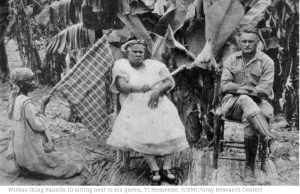
Well, then.
Wirkus went on to “rule” the island until 1929, when he was removed from the island and transffered back to the United States, proper. Apparently, Wirkus’ efficiency at ruling the island had cut too deeply into the corruption kickbacks Haitian politicians were extracting from the island. The United States government was only too happy to comply with this request, because the idea of a US enlisted man ruling as a “king” of a foreign island while still on active duty, was very unpopular…”alarming”, even.

Wirkus subsequently left the Marine Corps in 1931, and did a stint on the speaking circuit, giving talks about his time as the “White King of La Gonâve“. Then, with war looming again in 1939, Wirkus reenlisted in the Marine Corps, serving first as a recruiter, then as a gunnery instructor, eventually rising to the dual ranks of Warrant Officer [https://en.wikipedia.org/wiki/Warrant_officer] and Marine Gunner [https://en.wikipedia.org/wiki/Marine_gunner] for aviation gunnery.
Faustin Wirkus fell ill in January of 1945, and passed away on October 8th of that year. He was survived by his wife, Yula, and his son – Faustin, Jr. – who went on to serve in the Marine Corps as a helicopter pilot.
So. What does the story of Faustin Wirkus teach us?
Primarily, that enlisted troops – and especially Marines – are hyper unpredictable. Give them a clear goal, and they will do whatever is necessary to make it work.
Whatever. Is. Necessary.
And for the Establishment, that is not a good thing – after all, if some unlettered, uncouth enlisted critter can accomplish national goals with minimal supervision, why do their own high-society positions and privilege need to exist? I mean, how can their friends skim off the top of contracts, when some 25 year-old kid with a high school diploma, an attitude, a hangover and a coffee pot can do a better job, faster and more efficiently?
While the foregoing statement is rather “tongue in cheek”, it really isn’t, because it is very real – after all, how the hell can the Ivy League alumni expect to shave off hundreds of millions of dollars of money deducted from the troop’s pay to fund mess hall menus, leaving them eating lima beans and toast for “Thanksgiving Dinner”…assuming that the mess hall is even open? Because the $460 per month deducted from the troop’s pay to fund the mess halls on-post comes to $115 per week – I don’t know about you, but I can eat pretty well on $115 a week, including steak and shrimp…assuming that I can use a hot plate in the barracks – which on most bases, you can’t do.
Because you can eat at the mess hall. You know – dining on lima beans and toast.
And that’s LONG before we talk about telling troops to fix and repair their own barracks – It’s almost like there is little, if any, need for contracting with civilian companies to do anything beyond making weapons, ammunition and gear…and maybe uniforms. Maybe.

And this extends to security, because as the recent mass shooting at Fort Stewart, GA shows, troops trained to handle some of the most lethal weapons on the planet cannot be trusted to go about armed to protect themselves from either jilted lovers or, you know, terrorists.
And believe me when I say that this has been the norm on US military bases for decades.
Feel safe?