The Ugly Duckling Becomes The Swan
Previously in this series, we talked about the FN FAL and the G3 rifle families. Throughout the period from the 1960’s to the 1990’s, those two weapons systems competed on an equal footing with the AR and AK platforms. The end of the Cold War however, brought a worldwide contraction in the arms industry, as nations around the world – with no looming global war in the offing any longer, and terrorism still being viewed as a strictly local security problem – began to demobilize large sectors of their armed forces. One result of this was a desire in many nations to standardize on one weapon or another, to reduce their logistical costs even further. Ultimately, although some nations clung to legacy small arms, the rest of the world more or less standardized on either the AR-platform (the M-16 and its derivatives) or the venerable AK-platform, both of which had frequently either been given away as “gifts” or “sold” at ridiculous discounts…It’s hard to beat “free“.

One casualty of this rush to military standardization and downsizing was the G-11 rifle, from Heckler & Koch, builders of the G3. An expensive project that H&K had sunk mountains of money and talent into developing over nearly twenty years, the G-11 – a thoroughly radical design (video) – was actually adopted for service by West Germany, as a test run of the “caseless ammunition” concept that all the other NATO countries were watching closely…Then, of course, the Berlin Wall collapsed, the Germanies reunified, and the newly reunited Germany was suddenly awash in a literal mountain of Warsaw Pact-standard weaponry, as well as few realistic enemies to turn those weapons against. The G-11, which would require a completely new – and staggeringly expensive – logistical system from the ground up, in ways far exceeding anything required by more conventional small arms, was immediately cancelled as unnecessary.
Which left H&K with a serious problem.
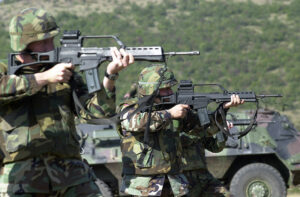
The German Government realized that it still needed a new rifle; the G3’s were getting a bit “long in the tooth,” as it were, and H&K did not want to get beaten out by another company in supplying the German military. So H&K thought fast, and scrapped its “intermediate cartridge” rifle projects and started a crash design program from scratch. That new design became the G-36, which has become so popular, it has been adopted by many national armies and police forces throughout the world…The G-36, however, has a secret hiding under its hood: H&K did not develop the G-36 from scratch — the guts of the G-36 derive directly from one of the most unsung, unloved and underrated (in its time) weapons of the post-World War 2 era:
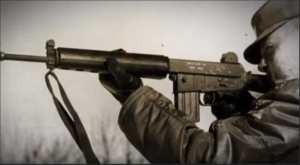

The AR-18 was developed by Eugene Stoner, the chief engineer of the AR-15/M-16 rifle series. (The “AR” in those designs, incidentally, derives from “Armalite Rifle”, not “Assault Rifle”, which was seen – somewhat ironically – as being “too German”, since the term is a direct translation from the German of “Sturmgewehr”, literally “Storm/Assault Rifle”, of Nazi “StG-44” fame.) After successfully developing several weapons for ArmaLite (then a division of Fairchild Engine & Airplane Corporation in the 1950’s) – including the AR-5 (which later became the AR-7) for the US Air Force, Stoner’s AR-15 rifle design was adopted for general general issue by the entire US military establishment. As neither ArmaLite nor Fairchild were geared to produce firearms on the industrial scale needed by the US military, a complicated series of boardroom dances resulted in Fairchild divesting itself of ArmaLite, and selling all the rights to the AR-15 to Colt Manufacturing, who would go on to reap immense profits from the design.
Eugene Stoner – who had had left ArmaLite in 1961, just before the divestiture and sale of rights – had been working on a follow-on design, which he abandoned after taking consulting jobs for Colt on the M-16, and ultimately landed at Cadillac Gage, where he would go on to design the “Stoner 62 (video) and 63“ (video). After the sale, ArmaLite’s new chief engineer, Arthur Miller, took over the remnants of Stoner’s last project, and worked those notes into a new design and concept, in an attempt to compete with Colt.

The military AR-18 (a civilian-legal version, the “AR-180”, would come later) was envisioned as an “entry-level” rifle for 3rd World nations wanting to upgrade their national arsenals and jump-starting their national industrial bases. It was designed to be easy to produce, in addition to being reliable and capable in action, and the goal was to license production and tooling to a 3rd World government in one package, while only needing to sell the country a few production weapons to get them started.

In the technical sector, ArmaLite succeeded: the AR-18 was, indeed, reliable, capable and simple to produce. Unfortunately for ArmaLite’s business strategy, not many nations of the 1960’s and 1970’s were willing to invest the money to set up an arms manufacturing system to produce only a few thousand weapons. Only four nations ever purchased large numbers for military use, and it did become famous as the signature weapon of the Provisional Irish Republican Army (IRA) in Northern Ireland. Prior to the mid-1980’s, only three licenses were let, the first to the Nederlandsche Wapen-en Munitiefabriek (NWM) division of Den Bosch of the Netherlands, although none are known to have been produced there; one to Howa Manufacturing Co. of Japan (which ended production in 1974, when new Japanese regulations closed the company’s export market); and the Sterling Armaments Company in England (which ended production in 1985). Along with ArmaLite’s own manufacturing center in Costa Mesa, California, fewer than 22,000 AR-18’s and AR-180’s were ever built. The company – which had been sold to Elisco Tool & Manufacturing of the Philippines in 1983 – would close its own doors in 1985, and Elisco itself was liquidated [https://en.wikipedia.org/wiki/Liquidation] in the late-1980’s. Although a few companies tried to revive the design over the years, the AR-18/-180 looked like it would fade into historical obscurity…
…Or not.
The core of the AR-18/-180 was its bolt carrier and gas system. The bolt itself was based on the multi-lug design of the AR-15 bolt, although the carrier was a unique design. Similarly, the gas system was a short-stroke gas piston design that had not been widely used before. The combination of those two systems, either as direct copies or as derivatives, live on in most of the major small arms systems developed since 1990, including the G36, HK416, FN F2000, FN-SCAR, Steyr AUG, CZ 805 BREN, Chinese QBZ-95, Daewoo K1, HOWA Type 89, SAR-80, T-91 and British SA80 family of weapon systems.
Without any kind of doubt, the AR-18 has had more impact on the world’s small arms design than virtually any other weapon in nearly a century, and will continue to do so, potentially outliving the rivals that killed the AR-18 in the 1980’s.

About Author

Michael Cessna
Michael Cessna is a former Active Duty United States Marine, a long-time personal protection specialist, security and defense analyst, military subjects instructor, general information researcher and amateur historian. He has been contributing security and defense writing since 2015.