
Every series has its cautionary tale. The M72 LAW refused to die because it kept solving real problems. The RPG-7 conquered the world through its sheer brutal simplicity. The Carl Gustaf earned its longevity through continuous intelligent evolution. The SMAW survived on institutional momentum and genuine urban assault utility. This week, we going to look at the weapon that rounds out this series on a different note entirely – the one that didn’t work very well, that the troops genuinely disliked, that the Army was trying to replace almost from the moment it was fielded, and that still managed to serve for 26 years before the Javelin finally put it out of its misery.
Meet the M47 Dragon.
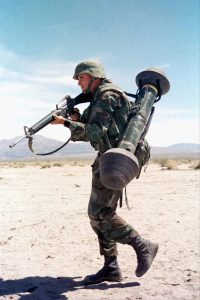
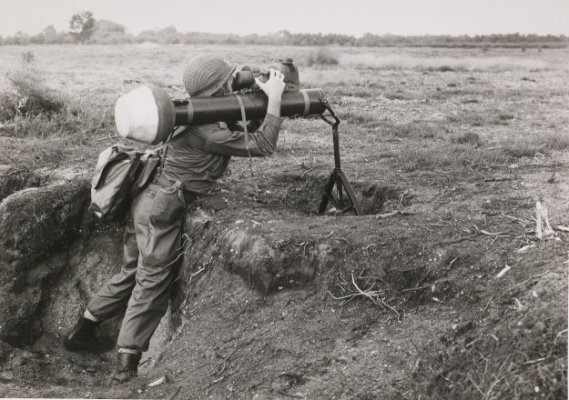
The Dragon holds a legitimate historical distinction: it was the first man-portable, shoulder-fired, wire-guided anti-tank missile to reach production. That is genuinely significant. Every weapon system we have covered in this series has been an unguided rocket or recoilless round – point it, pull the trigger, hope for the best. The Dragon was something categorically different: a wire-guided missile that the operator steered to the target using a tracker that read infrared emissions from a pyrotechnic source on the missile’s tail, automatically transmitting correction signals through a wire that unspooled behind the missile in flight. In theory, a trained operator could guide a Dragon onto a tank at 1,000 meters with precision that no unguided rocket could match. In theory.
The Pit of Origin
The Army’s requirement for what it called a Medium Antitank Weapon dated to 1959 – the same Cold War imperative that drove the entire weapons landscape we have been exploring in this series. The Soviets were fielding T-55s and T-62s in massive numbers, and NATO needed infantry-portable anti-armor capability at every level of the force structure. The heavy end was covered by the BGM-71 TOW, a crew-served wire-guided missile that remains in service today. The Dragon was supposed to cover the medium range – something one man could carry and fire, that could kill a tank at ranges beyond what any unguided rocket could reliably reach.
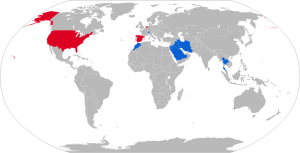
McDonnell Douglas won the development contract in 1966. The weapon was designated FGM-77, nicknamed ‘Dragon’ in 1967, and first fielded to U.S. Army units in Europe in January 1975. The Army assigned one Dragon per rifle squad, with a dedicated anti-armor specialist as the operator. Approximately 7,000 launchers and 33,000 missiles were eventually produced, with export sales to Israel, Jordan, Morocco, Saudi Arabia, Thailand, the Netherlands, Spain, Switzerland, and pre-revolutionary Iran.
On paper, the specifications were reasonable for the era: effective range of 65 to 1,000 meters, maximum range of 1,500 meters, a HEAT warhead capable of penetrating 330mm of rolled homogeneous armor on the base model. The guidance system required no assembly before firing – the operator simply removed the shock absorbers, attached the tracker unit, sat down, and fired. Lighter than most contemporary guided anti-tank systems in Western Europe, it gave American infantry a tank-killing capability at the squad level that was genuinely novel.
In practice, the Dragon was a mess.
The Problems Begin
The guidance system demanded that the operator track the target continuously from the moment of firing until impact – in the open, stationary, for up to eleven seconds on a base-model Dragon shot at maximum range. Eleven seconds is a very long time to sit still while a tank crew, now aware they are being engaged, attempts to shoot back. The Dragon’s distinctive “popping” sound as its side-mounted thruster rockets fired corrections downrange announced the shot to anyone within earshot. U.S. Army planning documents from the Cold War period acknowledged bluntly that Dragon crews were expected to take heavy casualties in any actual European land battle.
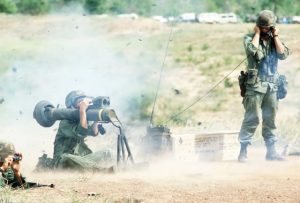
The hit probability numbers were damning. A U.S. Army study of Dragon firings under combat conditions found a hit rate of approximately 20%. For a weapon whose entire value proposition rested on guidance precision, this was a serious indictment. The causes were multiple: the sudden loss of the missile’s 30-pound weight from the shooter’s shoulder caused many operators to flinch badly enough to break target track at the moment of launch. The wire could break. Bodies of saltwater – a notable concern for a weapon issued to Marines – could interfere with the missile’s circuits. Crosswinds degraded accuracy. Over-correction by the operator caused the missile to ground itself. And the base warhead was quickly rendered inadequate by Soviet advances in explosive reactive armor.
The Marine Corps, to their credit, did not simply accept the situation. In 1986 they initiated a product improvement program that produced the Dragon II – an 85% increase in armor penetration, entering USMC service in 1988. A further upgrade, the Dragon III, added a tandem warhead precursor charge. The Army, already focused on finding a replacement, largely declined to participate in the improvement program. The two services were, characteristically, heading in different directions with the same weapon.
Combat Record and Exit
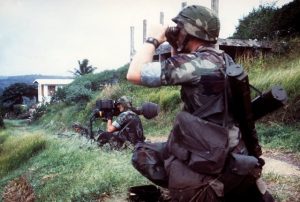
The Dragon saw combat in Grenada in 1983, and during Desert Storm in 1991, where 150 launchers and 5,000 rockets were deployed. Its performance in the Gulf War was, at best, unremarkable – the conflict’s short duration and the Iraqi Army’s swift collapse limited meaningful data collection. What the Gulf War did confirm was that the Dragon’s export customers had occasionally lost weapons to advancing Iraqi forces, making Iraq an inadvertent operator of American anti-tank technology – a recurring theme in Middle Eastern arms flows.

The weapon the Army had been waiting for arrived in the form of the FGM-148 Javelin, a fire-and-forget infrared-guided missile that allowed the operator to acquire the target, lock on, fire, and immediately take cover – no eleven-second tracking requirement, no sitting in the open while the missile flew. The Javelin entered service in 1996, and the Dragon was officially retired from U.S. service in 2001. The US Army destroyed its last remaining missile stocks at the Anniston Defense Munitions Center in Alabama on September 8, 2009. It was not a moment of particular mourning.
The Dragon’s afterlife has been appropriately ironic. Iran reverse-engineered it as the Saeghe, which has been supplied to Hezbollah and various militia forces across the Middle East. Morocco, Saudi Arabia, and Thailand continue to operate versions of the system. The weapon that American infantry quietly despised for a generation has found a second career in the hands of non-state actors and smaller militaries that cannot afford the Javelin – which, at roughly $175,000 per missile, represents a rather different procurement universe.
Conclusion
The Dragon is the necessary counterpoint to everything else in this series. The M72, the RPG-7, the Gustaf, and the SMAW all demonstrate that simple, well-matched solutions to genuine problems tend to outlast their predicted obsolescence. The Dragon demonstrates the corollary: that technological ambition without adequate attention to the human factors of combat – the flinch, the exposure time, the noise signature, the weather vulnerability – produces weapons that technically work, while practically failing the people who carry them.
The Javelin learned those lessons. The Dragon paid for the education.